Deepgram acquires Daily, the company behind Pipecat, in a deal that folds the most widely used open-source voice agent framework into a commercial voice AI stack while promising to keep the project free and vendor neutral.
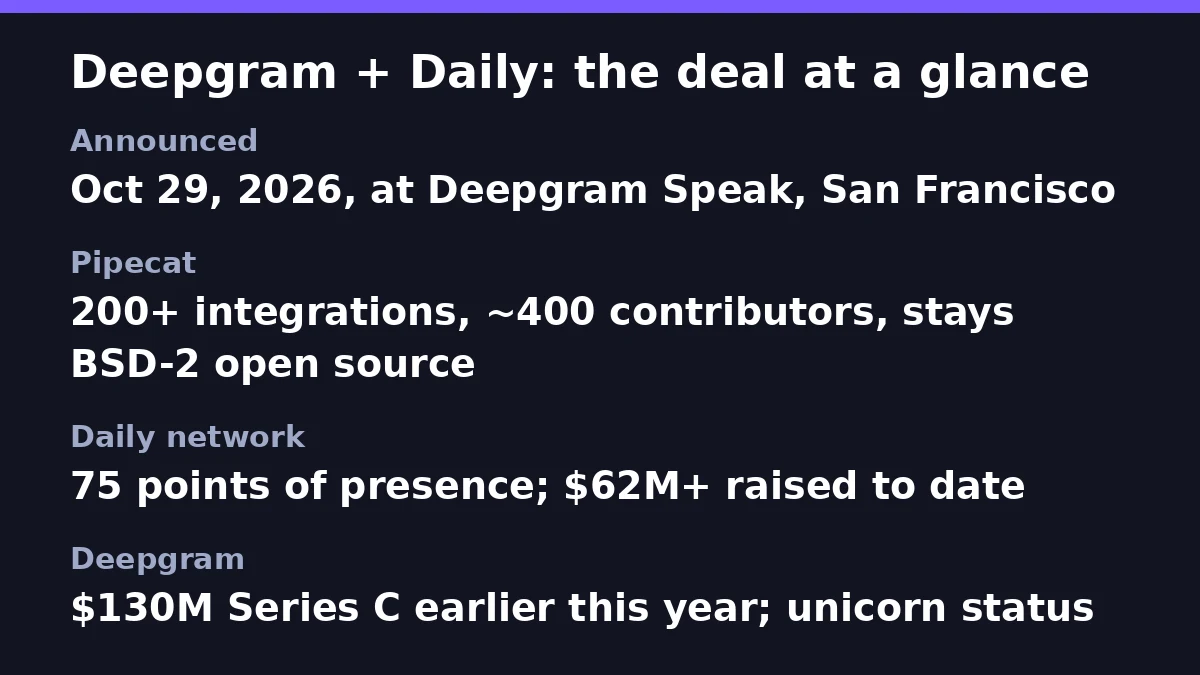
Deepgram announced the acquisition on October 29, 2026, at its inaugural Deepgram Speak event in San Francisco. The companies did not disclose the deal amount. Daily’s team will join Deepgram, with Daily co-founder Kwindla Hultman Kramer becoming the company’s new Head of Open Source.
What Deepgram gets
Pipecat is an orchestration framework that manages voice and video streams alongside the pipeline pieces of a voice agent: speech-to-text, large language models, and text-to-speech, while keeping latency low. TechCrunch reports the project has more than 200 integrations and almost 400 contributors, built by a team of 18 engineers at Daily.
Daily itself brings hosted real-time infrastructure: a global network of 75 points of presence engineered for the latency and reliability demands of live audio and video. The company has raised more than $62 million to date, per PitchBook data cited by TechCrunch, from investors including Tiger Global, Highfield Capital, Nat Friedman, Lachy Groom, and Kevin Weil. Deepgram, for its part, reached unicorn status earlier this year with a $130 million Series C round.

Open source stays open, says Deepgram
The central commitment in the announcement is that Pipecat will remain fully open source and free to all developers under its existing BSD 2-Clause license, and that Deepgram will invest in the project’s continued development while keeping it vendor neutral.
“Keeping Pipecat open was fundamental to our decision to join Deepgram,” said Kwindla Hultman Kramer, Daily’s co-founder. Deepgram CEO Scott Stephenson told TechCrunch he wants developers to use “the best models for your use case,” even when those models are not Deepgram’s.
To back the neutrality pledge, the companies are establishing an independent Pipecat Foundation together with organizations that have contributed to and use the framework. Its steering committee is expected to represent the wider real-time AI ecosystem, including companies that compete directly with Deepgram.
A new open protocol and a coming platform
Alongside the deal, Deepgram introduced the Real-Time Context Standard (RCS), an open protocol co-developed with the Pipecat team that carries context across an entire conversation, so agents preserve conversational cues between models.
Deepgram also previewed a forthcoming Voice Agent Platform that bundles its speech models with Pipecat and Daily’s network, which it describes as the first complete, open, production-grade platform for conversational voice AI. The companies say developers will keep control over model selection and system architecture.
Why it matters
The voice AI sector is consolidating fast as agents move from demos to production deployments where latency and reliability decide winners. Owning both the speech models and the open orchestration layer gives Deepgram an end-to-end story, while the independent foundation is meant to reassure a 400-contributor community that has alternatives. The two companies already have history: Deepgram has supplied transcription for Daily’s audio and video APIs since 2019.