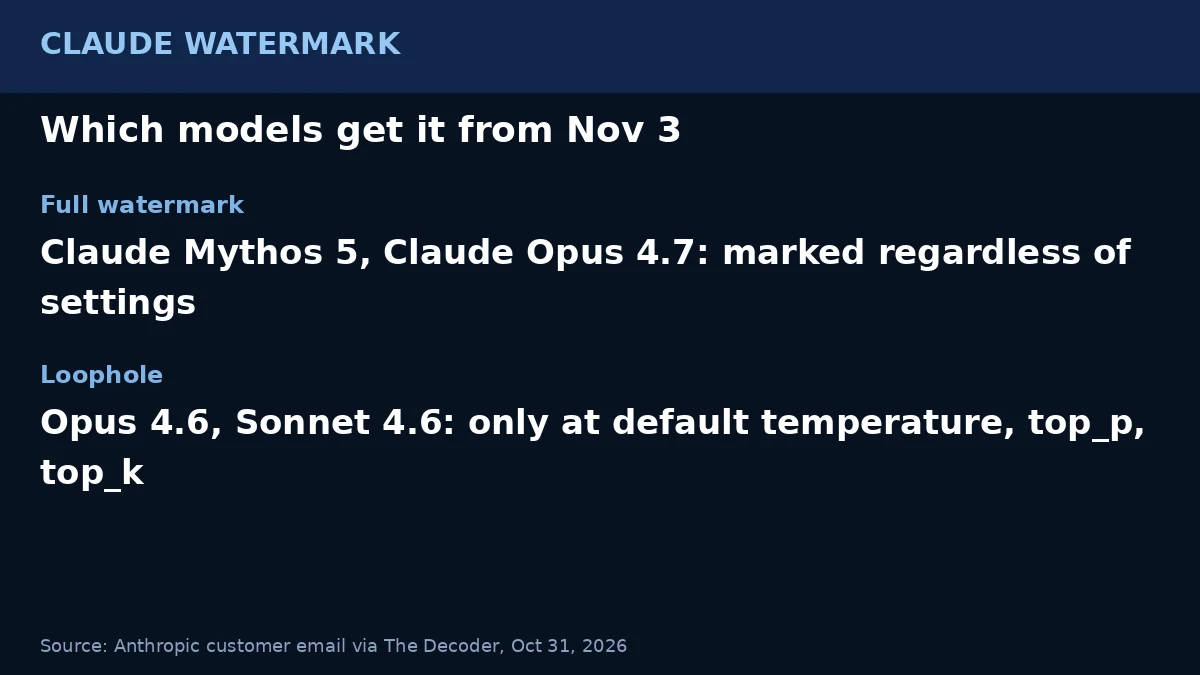
Anthropic is extending its invisible Claude watermark to four more models starting November 3, but on two of them a single settings tweak is enough to dodge the mark. In an email to API customers, reported by The Decoder on October 31, Anthropic said it will watermark Claude Mythos 5, Claude Opus 4.7, Claude Opus 4.6 and Claude Sonnet 4.6. Newer models such as Claude Opus 5.5 already carry the mark.
The loophole on two older models
On Claude Opus 4.6 and Claude Sonnet 4.6, the watermark applies only when developers leave the three sampling parameters at their default values: temperature, top_p and top_k, which control how much randomness the model uses when picking words. Change any one of them, even slightly, and the output comes back without the watermark. Anthropic is upfront about the caveat in its customer email: “If you rely on the watermark for your own compliance, keep these settings at their defaults.”
The email carries no such warning for Claude Mythos 5 or Claude Opus 4.7, which suggests those two are marked regardless of sampling settings. The loophole still matters: Opus 4.6 remains Anthropic’s best writing model, ahead of even Opus 5.5, The Decoder notes.
How the mark works
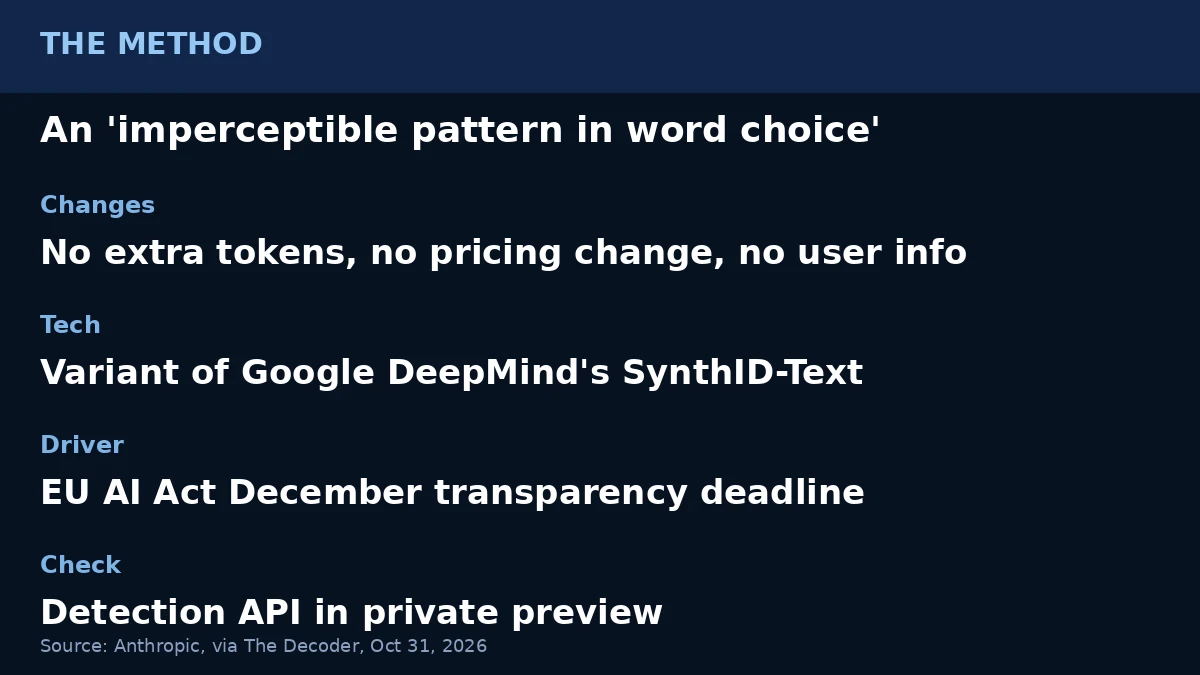
Anthropic describes the watermark as an “imperceptible pattern in word choice” that does not change meaning, quality or readability. It adds no extra characters or tokens, does not affect pricing or request formats, and barely slows output speed. The company says the watermark “contains no information about the user, their organization, or their conversations with Claude.”
The technique is a variant of Google DeepMind’s SynthID text method, which tweaks the randomness behind word selection to produce a statistically detectable pattern. Anthropic operates a watermark detection API in private preview for verifying the mark, and points customers to its content labeling information page for more detail.
Why now: the EU AI Act deadline
The retrofit is driven by transparency rules. Anthropic says it is watermarking “to comply with the EU AI Act,” whose December deadline requires that AI-generated outputs be marked in a machine-readable format. Every Claude model released after August 2, 2026 shipped with the watermark on day one; older models are being brought up in stages. Anthropic applies the watermark globally, saying it has no durable way to scope it by region, and customers cannot turn it off. The rollout on Amazon Bedrock may take a few extra days.
A broader industry move, with skeptics
Anthropic is not alone. OpenAI launched its textGrain watermarking system in October 2026, though it only activates by default for ChatGPT and Codex users in the EU; API customers worldwide can flip it on or off, and it ships disabled. Google DeepMind open-sourced SynthID for text and built it into the Gemini models, The Decoder reports.
Not everyone is convinced the marks are free. Blogger John Gruber argues that no two synonyms mean exactly the same thing, so picking words by a watermark key instead of semantic fit inevitably degrades precision, while the legal outlet Artificial Lawyer warns that layered watermarks inside one document could complicate compliance for law firms. Anthropic’s own caution is narrower: a detected mark signals that content may have been generated or processed by Claude, but it is not conclusive proof of provenance.
Sources
- Anthropic’s Watermark Rollout Leaves a Loophole on Two Older Claude Models (The Decoder, Oct 31, 2026)
- Anthropic to Watermark 4 Older Claude Models for EU AI Act (FourWeekMBA, Nov 1, 2026)
- Claude Watermarks Expand to Four More Models on November 3 (Abijita, Nov 1, 2026)
- Anthropic Extends Claude Text Watermark to 4 More Models (DEV Community, Oct 31, 2026)