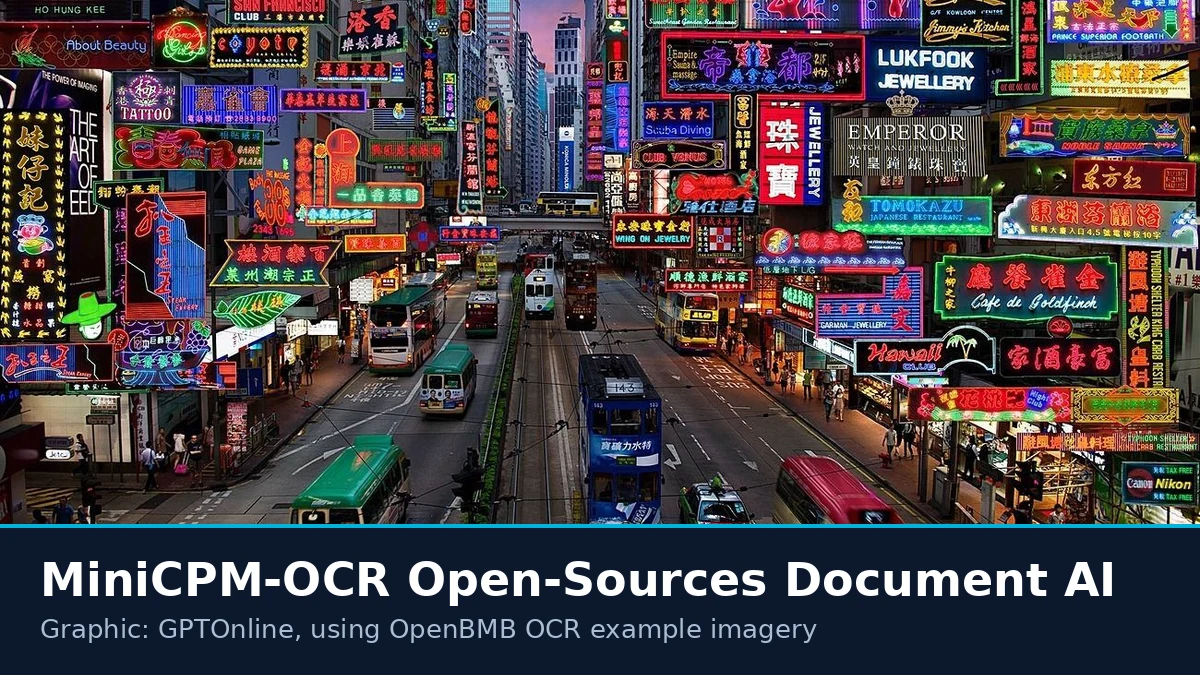
ModelBest and OpenBMB released and open-sourced the MiniCPM-OCR series on October 31, a family of document AI models that pair a compact 1.3-billion-parameter OCR model with what the companies call the first OCR result decision model, an “AI quality inspector” that scores the reliability of OCR output. Both models are available on GitHub, Hugging Face and ModelScope with open-source fine-tuning code, according to the joint announcement.
What Was Announced?
The launch includes two models: MiniCPM-OCR 1.0 (1.3B), described as the first OCR-focused model in the MiniCPM family, and MiniCPM-OCR Jev (2B), the decision model that judges OCR results rather than performing OCR itself. The release frames the pair as a complete pipeline for large-scale document digitization, from parsing pages to automated quality control.
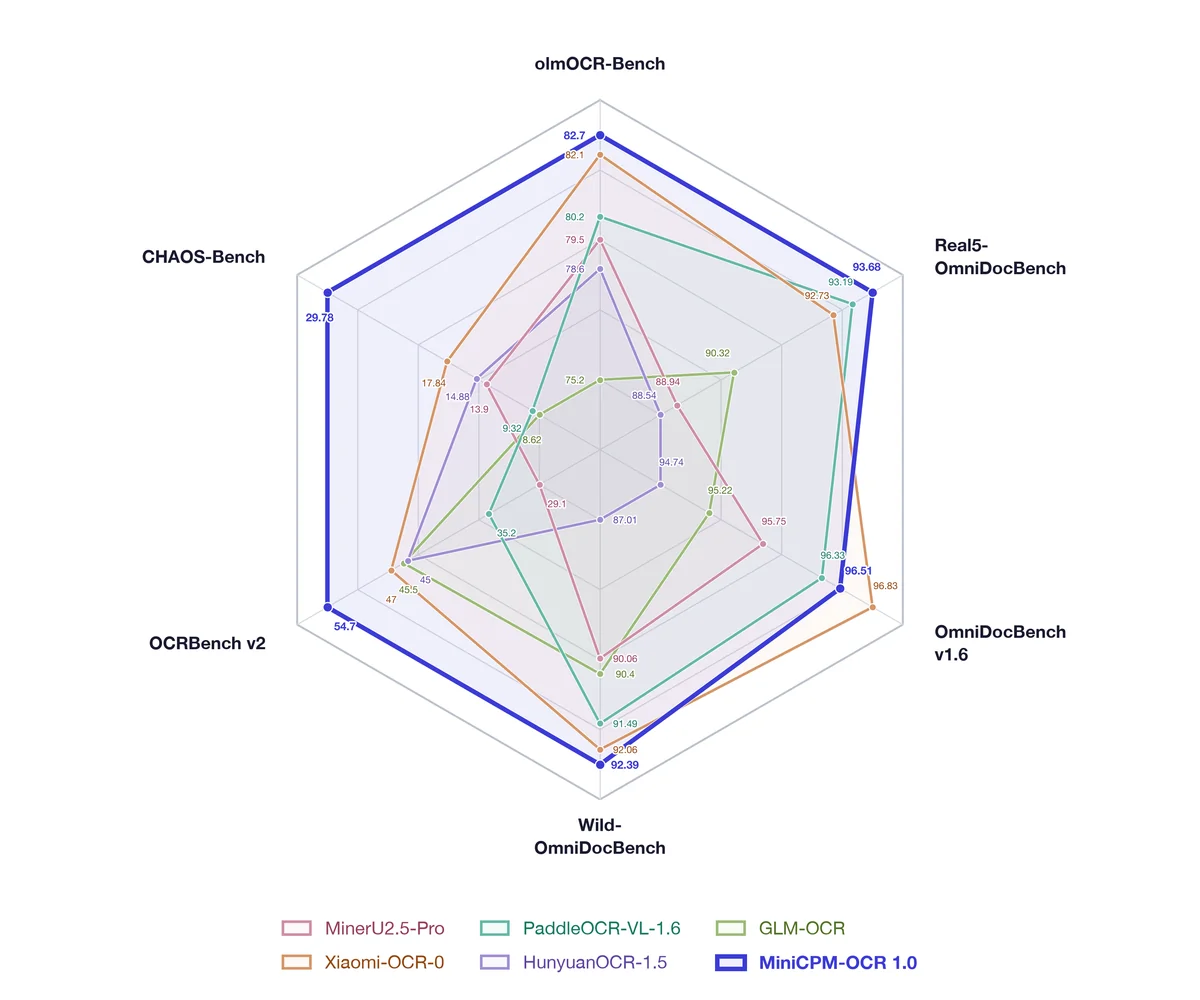
MiniCPM-OCR 1.0 targets real-world documents: it parses scanned, photographed, curved, tilted and screen-captured pages without what the announcement calls “cumbersome image pre-correction,” and it handles dense bilingual Chinese-English content, complex mathematical formulas and multi-level or borderless tables. Beyond full-page reconstruction, the model supports key information extraction, pulling specified fields from invoices, IDs and financial statements according to business instructions.
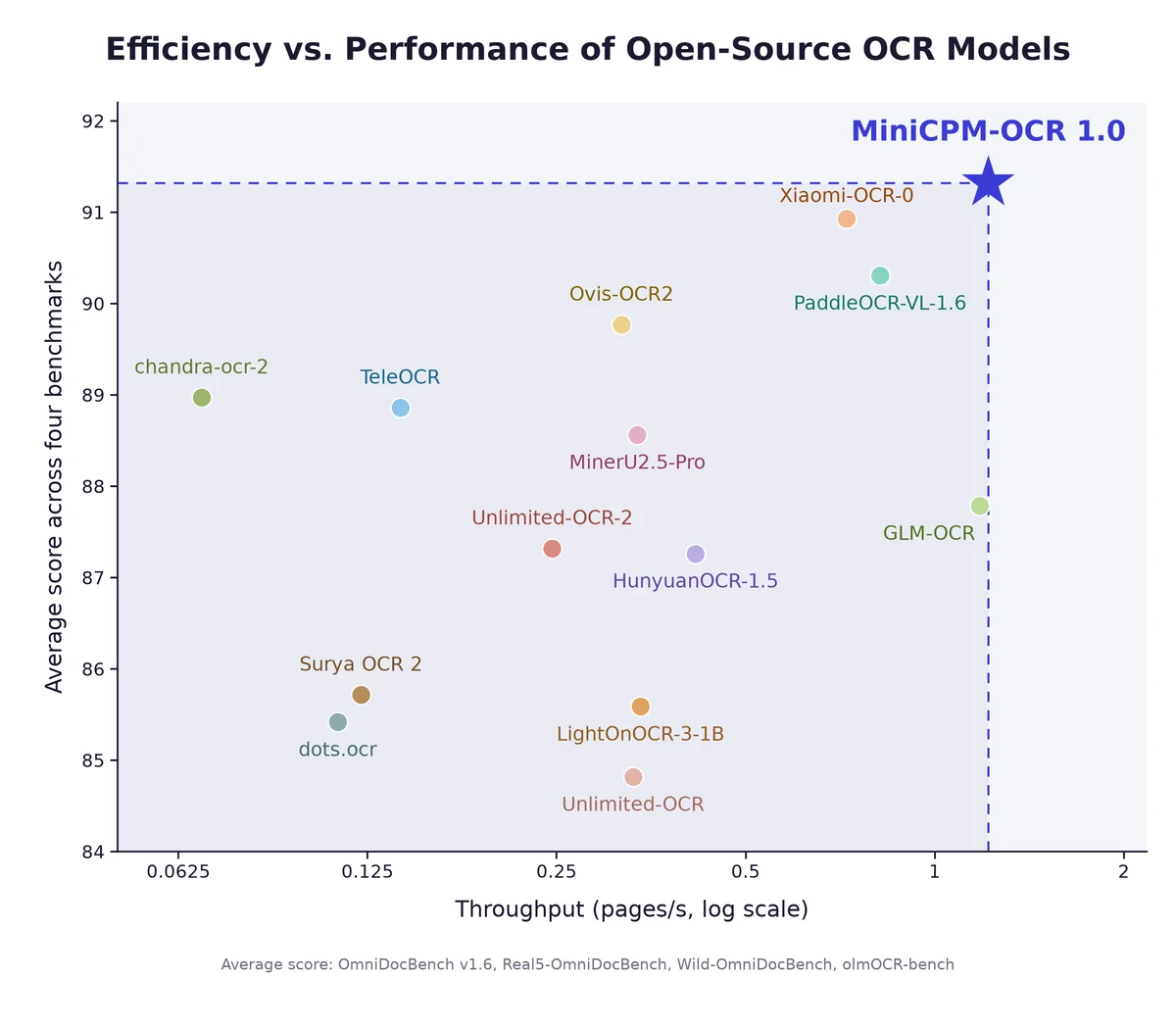
Powered by DSpark decoding acceleration, MiniCPM-OCR 1.0 is designed to raise end-to-end throughput while lowering per-page latency. For enterprises processing millions of pages, such as financial contract archives, academic libraries and government records, the companies say this means far more documents per hardware budget at a substantially lower computing cost.
The “AI Quality Inspector”
The second model addresses the long-standing need for page-by-page manual review. Rather than performing OCR itself, MiniCPM-OCR Jev compares the source image with OCR output and rapidly assigns confidence scores to text, LaTeX formulas and tables, detecting missing characters, errors and formatting misalignments.
Despite its compact 2B-parameter size, the announcement says Jev delivers judgment accuracy typically associated with far larger models. It supports cross-model deployment and integrates into existing OCR workflows without replacing the underlying OCR engine, automatically routing reliable results to direct processing, flagging potentially inaccurate outputs for human review and selecting the best result from multiple OCR systems. The pitch is a shift from full manual inspection toward risk-based, automated quality control.
The companies position Jev as a first in the category: the first OCR result decision model. As stated in the announcement, the model “acts as an AI quality inspector” over outputs from any OCR engine, not just MiniCPM-OCR 1.0.
Availability and Ecosystem
The series ships with broad tooling support: vLLM, SGLang, llama.cpp and Ollama, plus SDKs, APIs, Agent Skill plugins and open-source fine-tuning code, with the official repository hosted on GitHub.
Hardware coverage is unusually wide at launch. Day-0 adaptation covers AMD, Arm, Houmo AI, Intel and NVIDIA, and through the FlagOS software stack the models also support AI and edge chips from CIX Technology, Huawei Ascend, Hygon, Iluvatar CoreX, Kunlunxin, MetaX, Moore Threads, Sunrise, T-Head, TsingMicro, NVIDIA and Apple Mac on Arm.
Why It Matters
Open-source OCR has lagged the general model race in an important dimension: reliably digitizing messy, real-world documents at scale, and then trusting the output. Most production pipelines still bolt human review onto OCR precisely because a single misread figure in a contract or financial statement can be expensive. A small, edge-deployable parser paired with an automated quality inspector is a practical answer to both problems at once, and the open release means researchers and companies can inspect, fine-tune and extend the pipeline rather than treating OCR as a black-box API call.
The launch also continues the MiniCPM line’s emphasis on small, efficient models that punch above their weight, this time aimed squarely at the document-heavy workflows of finance, legal and government users.
Sources
- ModelBest, “ModelBest and OpenBMB Open-Source MiniCPM-OCR Series, Delivering High-Performance Document Parsing and AI-Powered Quality Control” (PR Newswire, October 31, 2026): press release
- OpenBMB, MiniCPM-OCR repository: GitHub
- TNGlobal coverage of the launch (October 31, 2026): article