Phonic has launched Phonic-1, a speech-to-speech voice AI model it says is the most advanced for agentic tasks, and announced a $27.5 million Series A led by First Round. The MIT-founded startup says Phonic-1 debuted at number one on the Artificial Analysis Speech to Speech Index, ahead of models from xAI, OpenAI and Google.
The funding round, announced on October 29, 2026, included participation from Lux Capital, Felicis, Definition and Essence VC, bringing Phonic’s total funding to $31.5 million. The company says the model is available today through its API.
What Phonic-1 Does
Phonic-1 processes speech directly, without the transcribe-then-respond cascade most voice agents use today. Its headline trick: it can call tools while the caller is still talking, so answers are ready the moment the caller stops. In a company demo, Phonic-1 fired off all five tool calls during a travel request and replied 1.1 seconds after the caller finished, versus 15.7 seconds for GPT-Live in the same test.
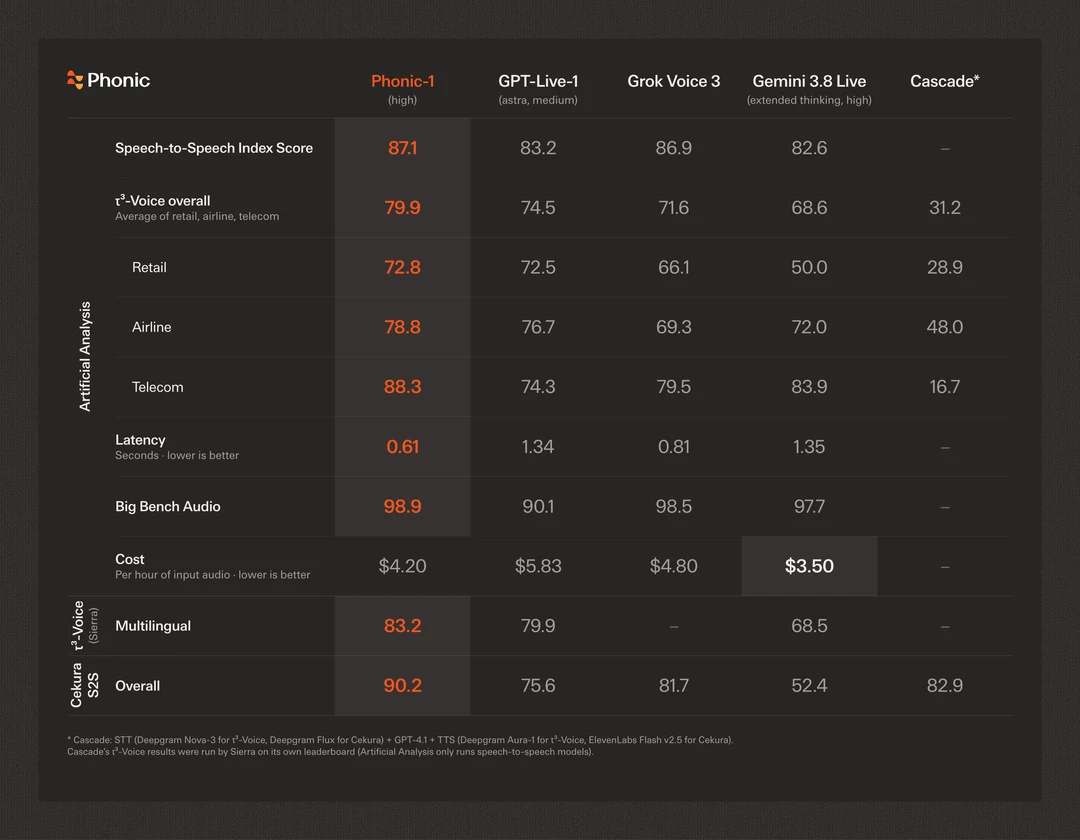
The model responds in about 600 milliseconds, hears tone and hesitation rather than words alone, and is trained on more than 50 languages, switching languages mid-conversation while keeping the same speaker identity. On Sierra’s multilingual full-duplex tau-Voice benchmark, Phonic-1 scored 83.2, ahead of GPT-Live-1 at 79.9 and Gemini 3.8 Live at 68.5.
Benchmark Results
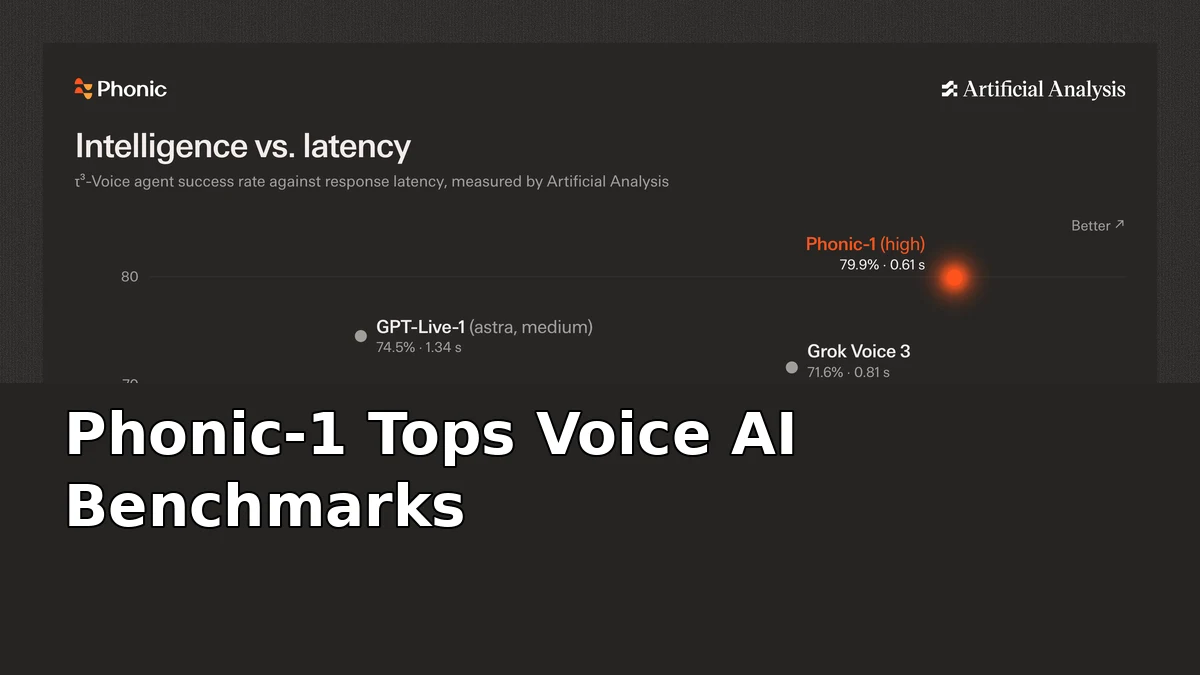
On the Artificial Analysis Speech to Speech Index, Phonic-1 (High) scored 87.1, narrowly ahead of Grok Voice 3.0 at 86.9, GPT-Live-1 at 83.2 and Gemini 3.8 Live at 82.6, according to AI Aulis. It also posted the fastest time to first audio among the index’s top five models at 0.61 seconds, and the highest agentic task success rate at 79.9%.
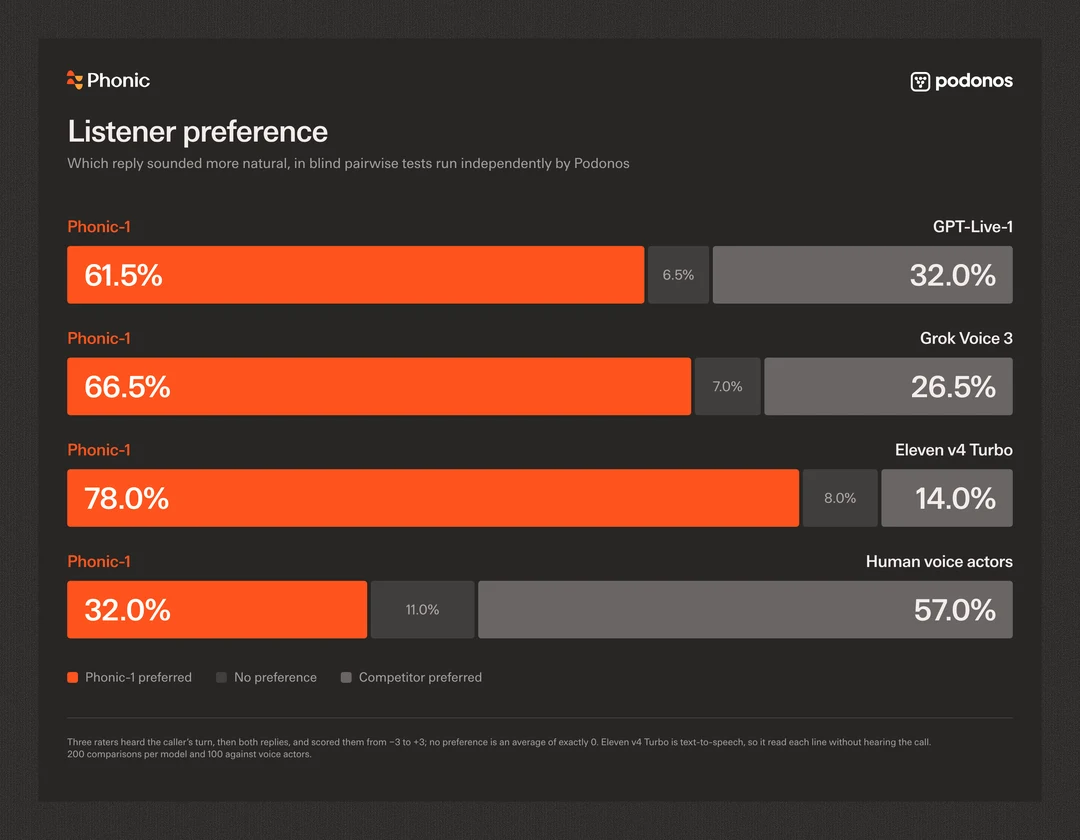
In blind listener tests run independently by Podonos, judges preferred Phonic-1 over GPT-Live-1 61.5% to 32.0%, over Grok Voice 3 66.5% to 26.5%, and over Eleven v4 Turbo 78.0% to 14.0%. Human voice actors still won, preferred over Phonic-1 57.0% to 32.0%, a gap Phonic says is a core research target.
Funding and Traction
Phonic says it has had a breakout year, powering calls across six continents for customers including Ashby, Maven AGI and Rho, plus a Fortune 50 IT infrastructure company. “We came to Phonic for the model and found a great partner. The speech-to-speech model was ready for production, and its voices are some of the most natural we’ve heard,” said Abhik Pramanik, co-founder and VP of Engineering at Ashby, which uses Phonic for AI interviews in 25 countries.
The Series A adds to a $4 million seed round previously led by Lux Capital. Angel backers include Erik Bernhardsson of Modal, Clement Delangue of Hugging Face, Arash Ferdowsi of Dropbox, Amjad Masad of Replit, Gokul Rajaram, Guillermo Rauch of Vercel, Naval Ravikant and Qasar Younis of Applied Intuition.
Pricing and Availability
Phonic-1 is available now via the Phonic API at $0.07 per minute on the Starter plan and $0.065 per minute on Pro, according to ExplainX, which verified the pricing on Phonic’s site. New signups get $250 in free credits if they register by November 30, and the company offers three free months to teams switching from cascaded stacks such as ElevenLabs or Bland.
Why It Matters
Voice AI has been stuck between two compromises: cascaded pipelines that are reliable but slow and lossy, and end-to-end models that sound natural but rarely survive production. Phonic-1’s pitch is that it breaks the tradeoff, pairing frontier-level agentic scores with sub-second latency on real customer calls. With fresh capital and an independent benchmark crown, the startup is now racing incumbents like OpenAI and xAI for the voice layer of the agent economy. One caveat worth noting: the “acts while the caller talks” claim and the 600ms figure come from Phonic’s own materials, and independent testing beyond the Artificial Analysis suite remains limited.
Sources
- Introducing Phonic-1 and our $27.5M Series A, Phonic Blog, October 29, 2026
- Phonic 1 narrowly tops Artificial Analysis’s Speech to Speech ranking, AI Aulis, October 2026
- Phonic-1 Speech-to-Speech: 87.1 Index, $0.07/min Checked, ExplainX, October 2026