The nonprofit behind Wikipedia has entered one of the most closely watched legal battles in technology. On October 30, the Wikimedia Foundation filed a friend-of-the-court brief in the consolidated copyright cases against OpenAI and Microsoft, including The New York Times’ landmark lawsuit, urging the court to draw a sharp line between training an AI model and using a chatbot to serve up someone else’s work. The filing takes no side in the fight, and instead argues both camps are pushing readings of fair use that go too far.
What was filed
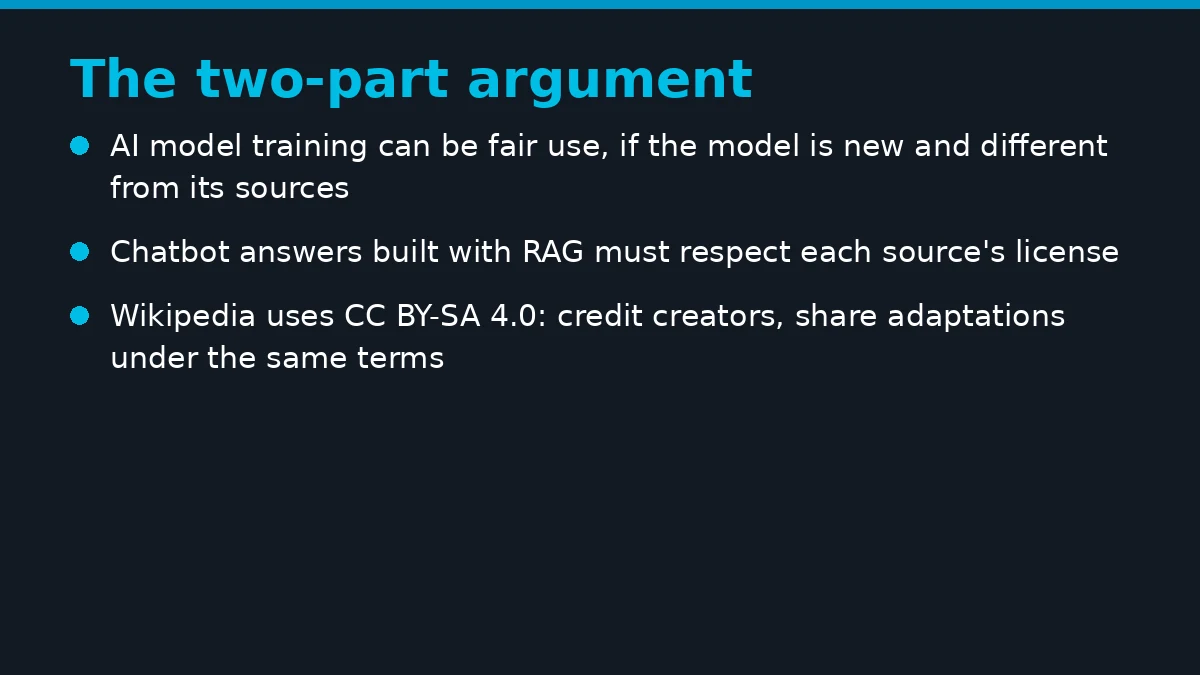
According to the Foundation’s own announcement, it filed the amicus brief in In re: OpenAI, Inc. Copyright Infringement Litigation, the proceeding in the Southern District of New York that combines 12 lawsuits against OpenAI, the best known being The New York Times Co. v. Microsoft and OpenAI, filed in 2023. The Foundation sought leave to file on October 29 and announced the filing the next day, per Pivot News, citing thenextweb.com. The court has not yet decided whether to accept the brief, and no date is confirmed for a ruling on the central fair-use question.
The two-part argument
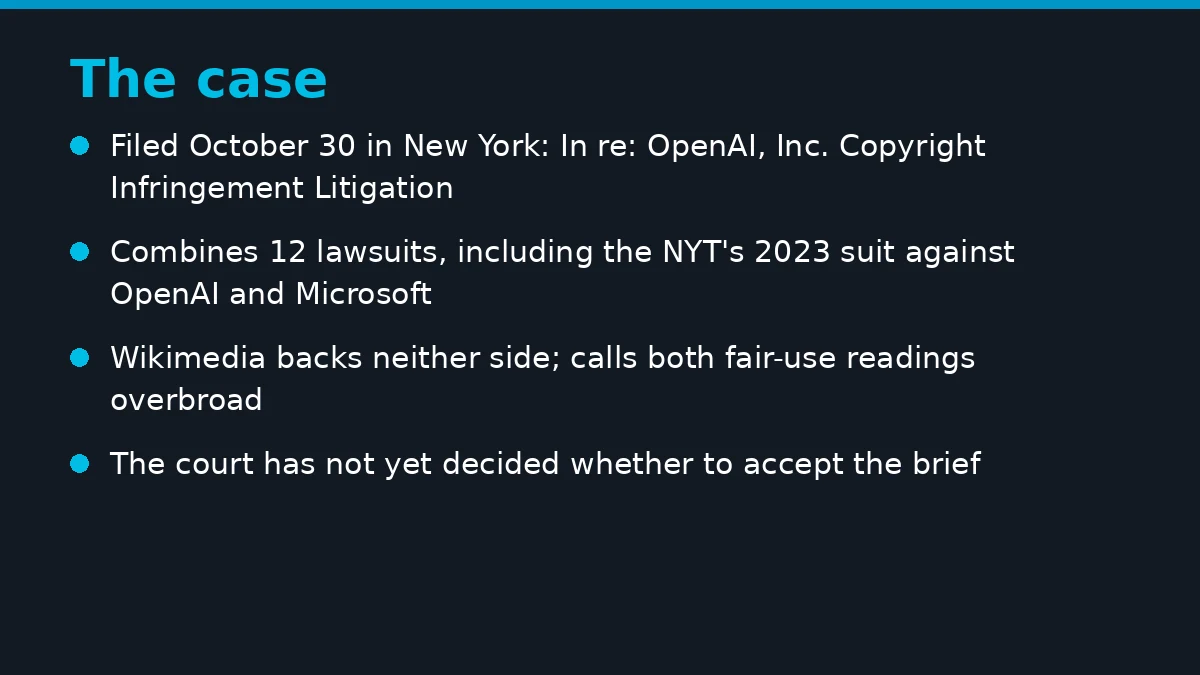
Wikimedia splits the fair-use question in two. For model training, the Foundation argues that using copyrighted works should be considered fair when it is used to train large language models that are “something new and different from the original sources,” according to its announcement. A ruling that training is not fair use, it warns, could inhibit technological innovation and limit the tools that benefit open-source projects like Wikipedia.
For retrieval-augmented generation, known as RAG, the Foundation takes the opposite view. When a chatbot retrieves material from the web and returns it in a form that can stand in for the original, that use should not count as fair use. Companies offering this feature should respect each content platform’s licensing requirements, the brief argues. In Wikipedia’s case that license is Creative Commons CC BY-SA 4.0, which requires credit to the original creators and that adaptations remain under the same license.
Why it matters
The brief puts the operator of the world’s largest open-knowledge project in the uncomfortable middle of the defining copyright fight of the AI era. Wikimedia says a blanket ruling in either direction would damage the open knowledge ecosystem: too restrictive, and AI development stalls along with the tools that help Wikipedia; too permissive, and the web closes up as publishers lock away content, weakening the secondary sources the Foundation itself depends on. As Skimwire notes, an amicus brief does not bind the court, but in a case this consequential, the judge is likely to read it.
Sources
- Wikimedia Foundation: The Wikimedia Foundation files to protect open knowledge in New York Times v OpenAI case (Oct 30, 2026)
- Skimwire: Wikimedia’s amicus brief in NYT v. OpenAI, explained (Oct 30, 2026)
- Pivot News: Wikimedia asks court to split AI training from chatbot answers (Oct 31, 2026)
- RobotPulse: Wikimedia Files AI Copyright Brief in OpenAI Lawsuit (Oct 30, 2026)