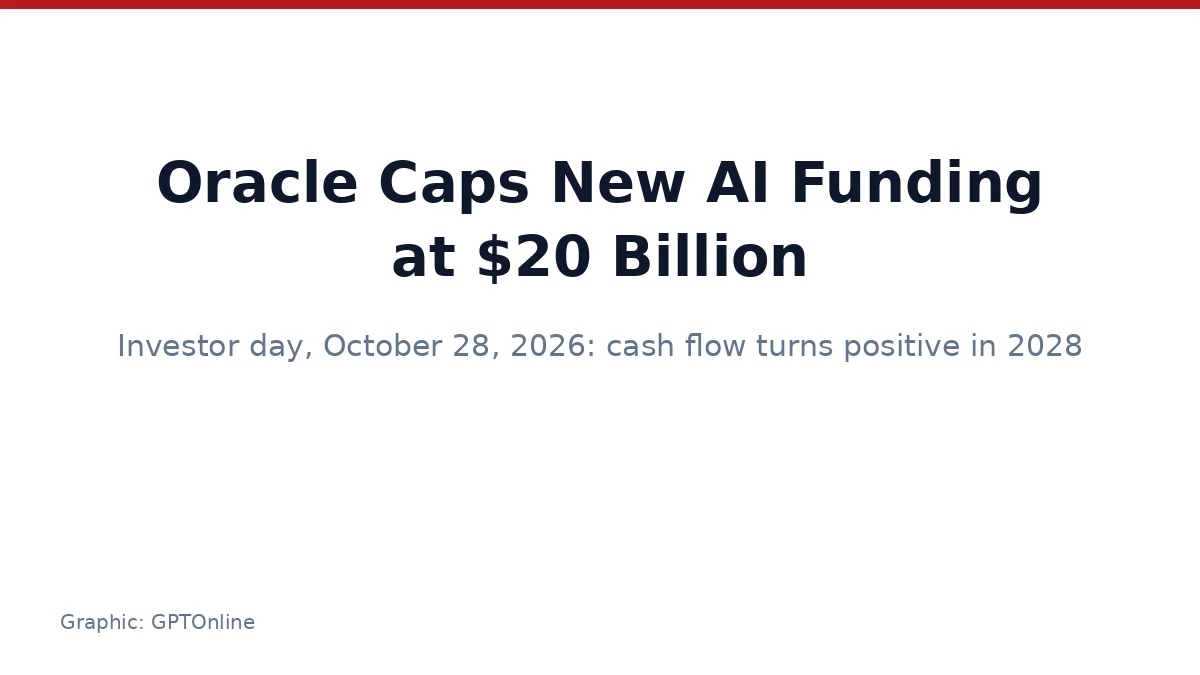
Oracle has put a number on the end of its AI spending surge. At its investor day in Las Vegas on October 28, 2026, the company said it will raise no more than $20 billion in additional capital market funding through fiscal 2030 to pay for its AI cloud buildout, and it promised investors a clear path back to positive cash flow. The Oracle AI funding cap is the centerpiece of a plan meant to answer the question hanging over the whole AI infrastructure boom: how much outside money will this take, and when does it stop?
Chief Financial Officer Hilary Maxson told investors that free cash flow will turn positive in the second half of fiscal 2028 and reach at least $30 billion in fiscal 2029, according to Reuters. Capital spending will peak in fiscal 2027 and fiscal 2028, then decline, and from fiscal 2029 the company expects its growth to be self funded. Shares jumped more than 11% on the news, a sign that investors had been waiting for exactly this kind of limit.
“We’re announcing that this $20 billion, split evenly between debt and equity, is the final amount needed to fund the remainder of this cycle,” Maxson said, as reported by CTech. The cap covers new equity and gross debt, and it excludes refinancing of existing debt. It comes on top of a $20 billion at the market equity raise Oracle completed in the first quarter of fiscal 2027. Oracle had previously said it planned to raise $40 billion through debt and equity in the current fiscal year, so the new pledge effectively closes the door on further large raises beyond the remaining $20 billion.
What Was Announced?
The investor day set out both a financing ceiling and a long term growth story. Oracle reaffirmed its fiscal 2027 guidance of at least $90 billion in revenue and $8.10 in non-GAAP earnings per share, and it set fiscal 2030 targets of at least $225 billion in revenue, a non-GAAP operating margin of at least 40%, and non-GAAP earnings per share of at least $21, according to InvestingLive. On debt, the company targets net debt below 3.5 times adjusted EBITDA in fiscal 2029.
Oracle also said vendor financing, customer provided hardware and customer prepayments will reduce its upfront cash needs until free cash flow turns positive, according to CNA. The event was not an earnings release, and no new quarterly results were reported. The share move reflected a reset in how investors view the risk around Oracle’s heavy spending on data center capacity.

Why Oracle Became the Test Case for AI Spending Worries
Oracle has become a focal point of worries about the cost of the AI infrastructure boom because it lacks the deep revenue base of cloud giants such as Microsoft and Amazon, and it relies heavily on a single customer, OpenAI, which is not yet profitable. Its partnership with OpenAI has added hundreds of billions of dollars to its cloud backlog, but building the data centers and computing infrastructure to fulfill those contracts has forced it to lean heavily on debt and stock sales.
That backdrop is why the funding cap mattered more than the growth targets. “Oracle is trying to show investors that there’s a method to the madness of its massive AI infrastructure spending,” eMarketer analyst Jacob Bourne told CNA. “Though the projections are ambitious and far from guaranteed, they demonstrate an understanding of investors’ concerns and offer an optimistic path toward addressing them.” Oracle’s free cash flow was negative $23.7 billion in the fiscal year ended May 2026, according to reports on the investor day, which is why a dated promise of positive cash flow carried so much weight.

Why It Matters
Oracle is the first major technology company whose AI buildout pushed free cash flow deeply negative, so its timeline is being read as a signal for the whole sector. If capital spending really does peak in fiscal 2027 and fiscal 2028 and cash flow really does reach $30 billion in fiscal 2029, the AI infrastructure cycle starts to look like a bridge with an end, not an open ended drain. If the targets slip, the same numbers will be quoted back at the company as evidence that the spending was never under control.
The plan also lands in the middle of a wider financing wave. Meta priced $37.5 billion in stock offerings the same week to fund its AI infrastructure, and Alphabet and Microsoft reported record AI driven cloud growth days earlier. Oracle’s answer to that environment is different in kind: not another raise, but a ceiling on raises, paired with a date when the business funds itself. Investors rewarded that framing on the day, with Oracle shares up more than 11% and other cloud stocks rising alongside. Whether the ceiling holds will be tested by the pace at which Oracle actually delivers data center capacity against its OpenAI backlog.
Sources
- Reuters: Oracle expects to turn cash flow positive in second half of fiscal 2028 (October 28, 2026)
- CNA: Oracle eases AI spending worries with plan to turn cash flow positive (October 28, 2026)
- CTech: Oracle CFO tells investors $20 billion is “the final amount” (October 28, 2026)
- InvestingLive: Oracle jumps around 11% on $225bn 2030 revenue goal and $20bn cap on new funding (October 28, 2026)