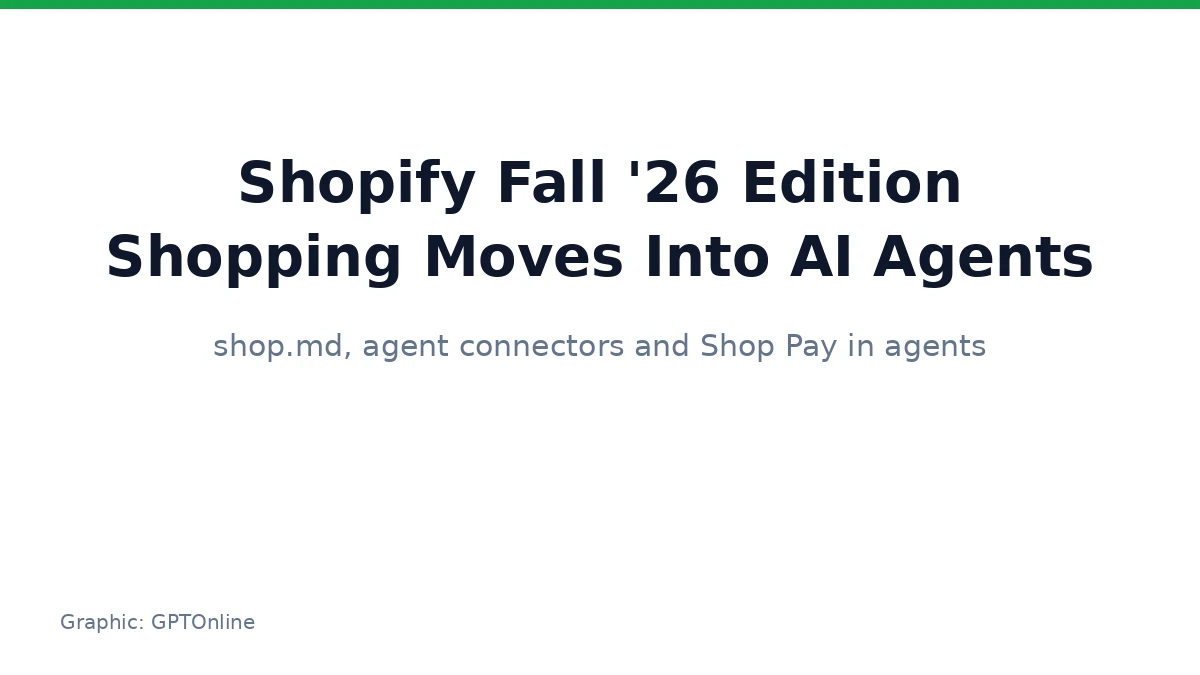
Shopify has released its Fall ’26 Edition, called Exponential, putting AI agents at the center of how shoppers discover and buy products. Announced on October 28, 2026, the edition includes a shopping skill that turns any AI agent into a personal shopper, connectors that let merchants run their stores from inside nine AI agents, and Shop Pay checkout inside personal agents, according to Shopify’s official Fall ’26 Edition announcement. The message is blunt: shopping is moving into chat, and Shopify wants its catalog, cart and checkout to be the infrastructure behind it.
The centerpiece for shoppers is shop.md. Buyers point an agent such as ChatGPT or Claude to shop.md, and the agent can search more than 1 billion products, check out with Shop Pay and track orders, Shopify said. Because the agent knows a buyer’s preferences, sizes and order history from Shop, it can find products from Shopify merchants without the shopper re-entering that information. Anyone can customize the skill to fit their style, according to Shopify.
What Was Announced
Shop Pay is also moving inside personal AI agents, starting with Muse from Meta, Claude Duet and Instinct. Claude Duet, Grok Bot and Instinct also offer Shop Pay for brands not on Shopify. More than 400 million people already trust Shop Pay, Shopify said, and its security model carries over: the buyer remains in control of purchases, and their card is never shared with the agent. Shop Pay uses tokens from Mastercard, Visa and Discover for agent purchases from merchants off Shopify, with American Express coming soon.
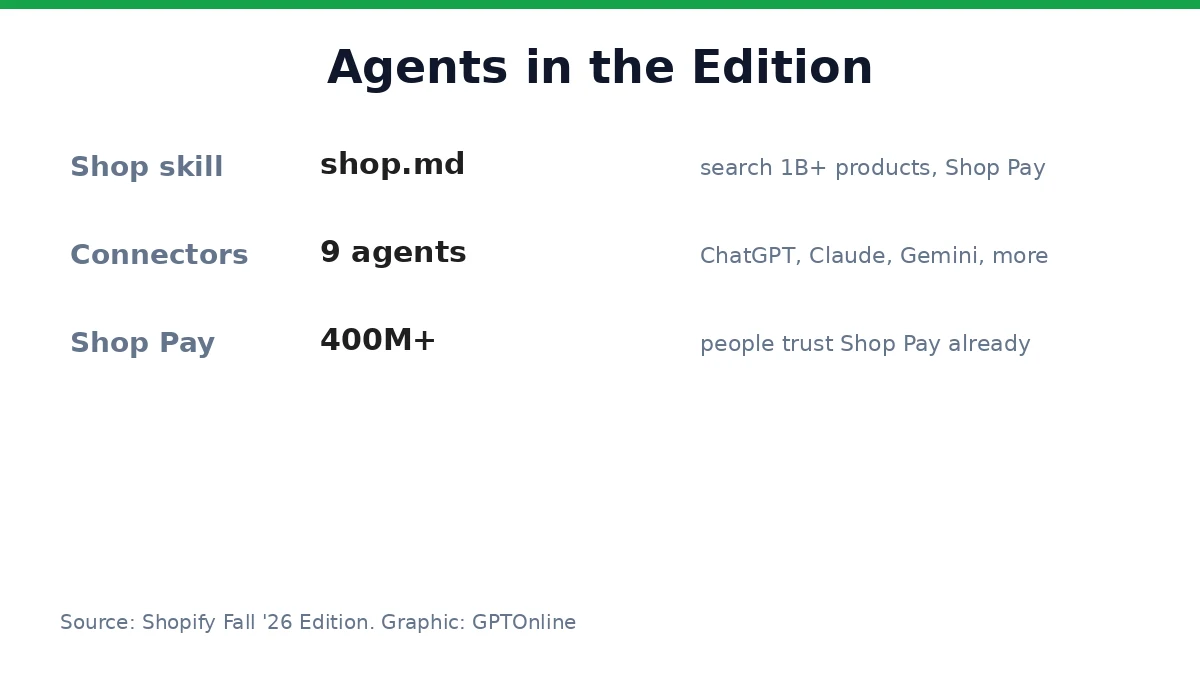
For merchants, Shopify connectors now work with nine agents: ChatGPT, Claude, Claude Duet, Microsoft Copilot, Google Gemini, Grok, Grok Bot, Muse and Perplexity. Merchants can connect Shopify to the agents they already use to manage products, inventory, orders and performance without leaving the conversation, Shopify said. Aspiring entrepreneurs can also start in the same chat, turning an idea into a storefront preview.
Shopify’s own AI assistant, Sidekick, has been rebuilt in the edition. It can now run calculations, write code, search the internet and remember what a merchant teaches it, while still requiring merchant approval for changes. A new Canvas view, now in early access, lets merchants see their entire store on one surface and edit it with Sidekick, from small tweaks to full redesigns.
Why It Matters for Merchants
The edition also addresses a problem agentic commerce creates: agents can only sell what they can understand. A new catalog eligibility view in the Shopify admin shows whether a store qualifies for Shopify Catalog and links to fixes for anything in the way. A new knowledge base page, at Sales channels then Agentic, lets merchants review and publish the facts agents get about their store, such as return windows, shipping destinations and gift services. Shopify drafts the facts from the storefront and suggests updates, but agents only receive facts the merchant has published.
“Every merchant that joins Shopify benefits from every other merchant that has ever been on Shopify,” said Vanessa Lee, Shopify’s VP of Product. “And they make it better for whoever comes next. Shopify’s Fall ’26 Edition shows how that network effect makes every business on Shopify exponentially more capable.”
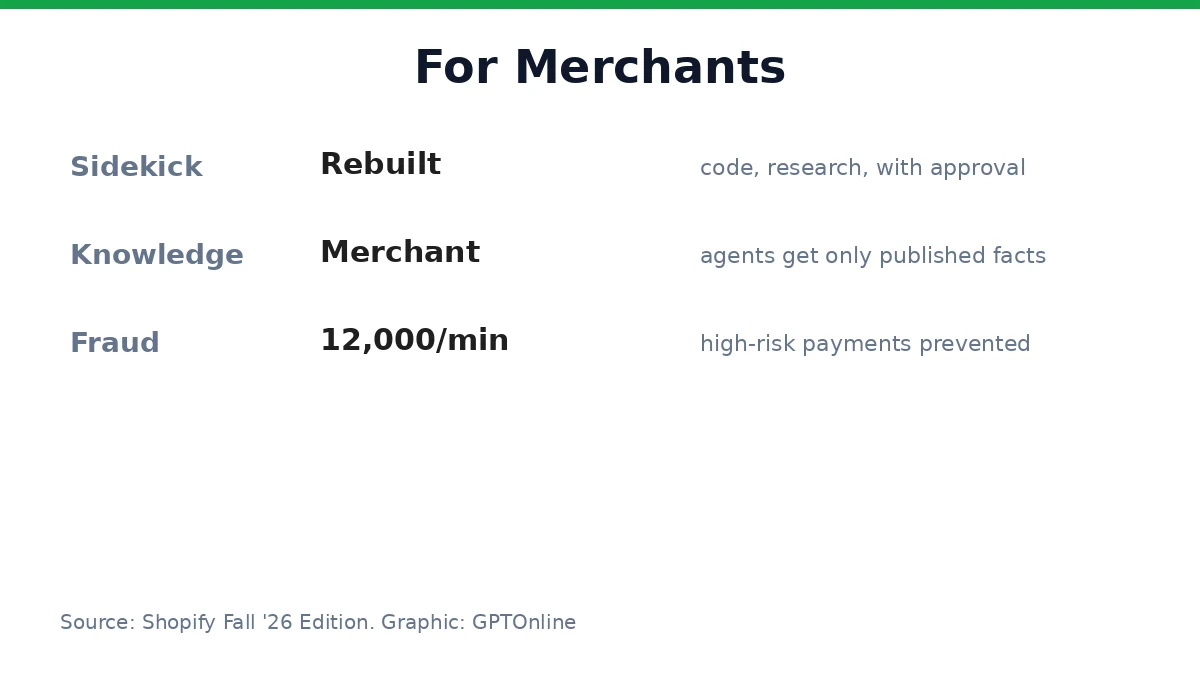
Other parts of the edition are less about agents and more about trust at checkout. Shopify Protect, a collection of risk and disputes tools in the admin, lets merchants write and test their own fraud rules, and Shopify said Shopify Payments prevents more than 12,000 high-risk payments every minute. Seven new local payment methods join Shopify Payments: Alipay, WeChat Pay, MB WAY, OXXO, Satispay, Scalapay and GrabPay. Universal Checkout on Shop gives shoppers one checkout for carts built from multiple merchants, and Shop.com becomes Shop’s new home on the web, with shoppable posts, editorial curations and package tracking.
The Bigger Shift
The Fall ’26 Edition matters because it treats AI agents as a sales channel, not a novelty. If shoppers increasingly start product discovery by asking an agent, then the product data, store facts and checkout flow a merchant exposes to agents become part of the storefront, even when the buyer never visits the store’s website. Shopify’s answer is to make that exposure merchant controlled: agents see only published facts, buyers approve purchases, and cards stay tokenized rather than shared with the agent.
There are limits to watch. Shopify describes Canvas as early access, and the edition’s agent features depend on merchants keeping catalog data and store facts accurate. An agent that reads a wrong return policy will give a wrong answer, no matter how polished the checkout is. Still, with connectors to nine agents, Shop Pay inside personal agents and a catalog of more than a billion products behind shop.md, Shopify has made its clearest move yet to own the transaction layer of agentic shopping, rather than just the storefront where it used to happen.