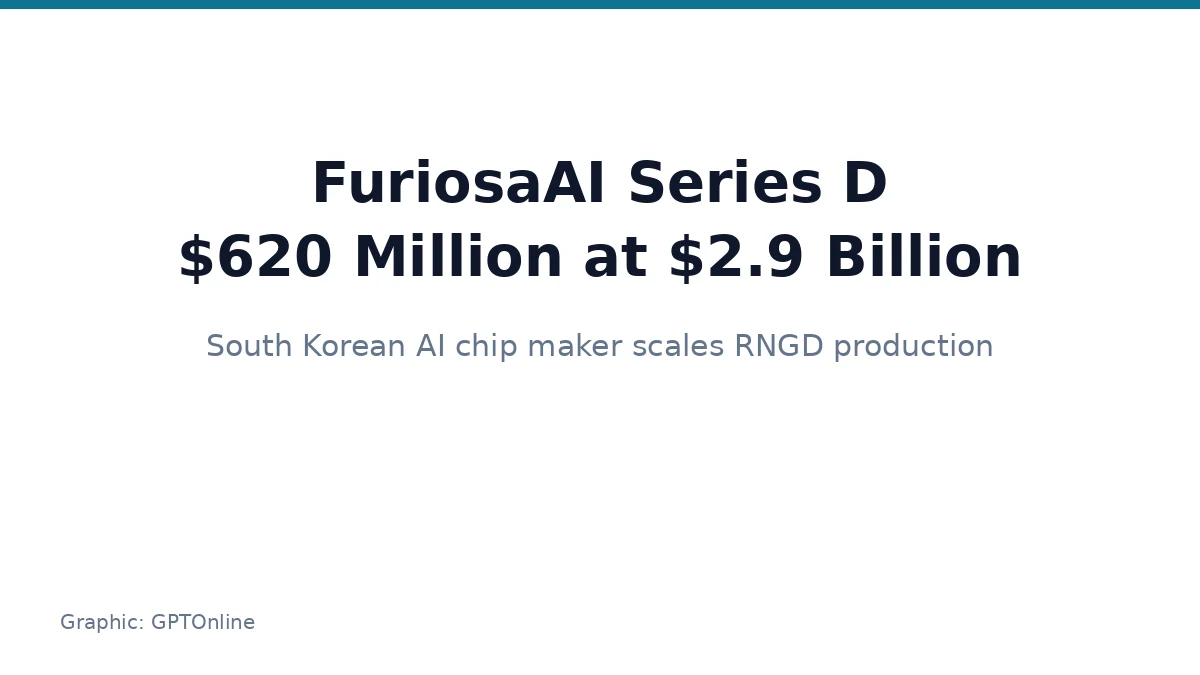
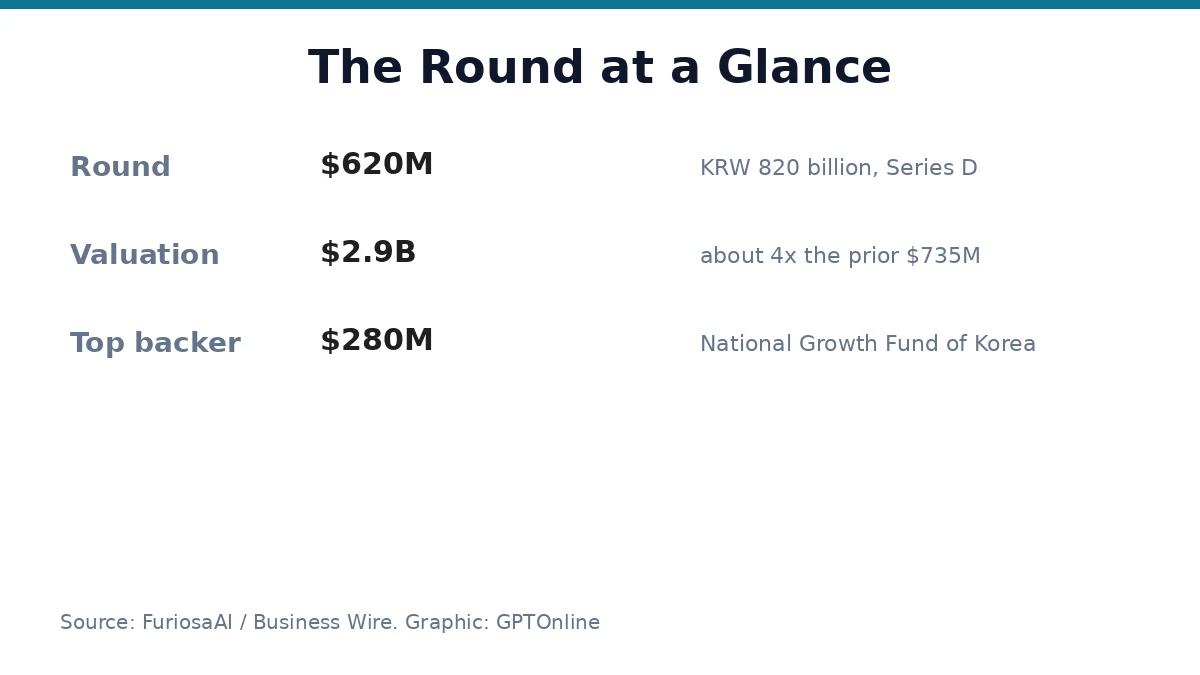
South Korean AI chip startup FuriosaAI has completed a $620 million Series D funding round, lifting its post-money valuation to approximately $2.9 billion, the company announced on October 28, 2026. The round, disclosed in a FuriosaAI press release carried by Business Wire, is one of the largest AI semiconductor financings outside the United States this year, and it positions FuriosaAI as one of the most serious challengers yet to NVIDIA in the market for AI inference chips.
The valuation is roughly four times FuriosaAI’s previous valuation of $735 million, according to Bloomberg’s reporting on the round. That jump reflects a shift investors are betting on: as AI moves from training giant models to running them for millions of users, the chips that serve those models efficiently, known as inference chips, are becoming a market of their own. FuriosaAI builds chips designed only for inference, and it says its second generation accelerator, RNGD, is already in volume production and in deployment with enterprise customers.
Who Funded the Round
South Korea’s National Growth Fund was the largest investor, contributing $280 million, according to the company. International investors contributed $110 million in total, led by US based Infinitum, with Singapore based QUDA Capital Partners, Cisco Investments, Abu Dhabi based NeoFort Holding, Jericho Capital and Worldline Capital also joining. Existing shareholders added $125 million in follow-on investments, including an additional $22 million from the Korea Development Bank.
The round also attracted new Korean institutional investors. The Export-Import Bank of Korea selected FuriosaAI for its first direct investment in a startup, and Korea’s United Asset Management Company committed $30 million, the largest new domestic commitment after the National Growth Fund. All three of FuriosaAI’s original seed investors, NAVER, DSC Investment and KDB Capital, participated, with DSC Investment, which first backed the company in 2017, taking part in every round since the seed stage.
“This Series D financing marks an important milestone for FuriosaAI and reflects the confidence of investors around the world in our technology and ability to execute,” said June Paik, Co-Founder and CEO of FuriosaAI. “We are entering a new phase of bringing our technology to the global AI infrastructure market at scale,” Paik added. “By accelerating the commercialization of RNGD and advancing the development of Gen 3, we aim to help shape the next generation of AI infrastructure.”
What the Money Will Do
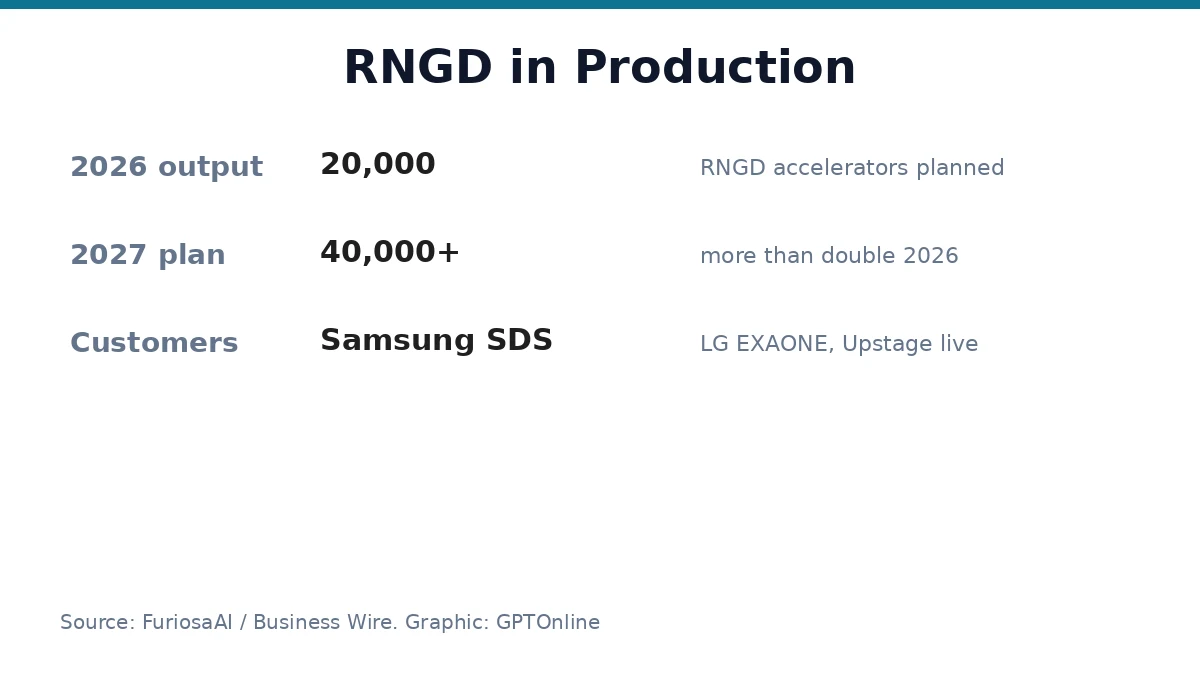
FuriosaAI said it will use the new capital to expand RNGD production, strengthen its software ecosystem and accelerate development of its third generation AI accelerator, which it is building in collaboration with Broadcom for hyperscale infrastructure. The company expects to produce 20,000 RNGD accelerators in 2026, with plans to more than double production to over 40,000 units in 2027.
The production claim is backed by named deployments. LG Group is running its EXAONE deployments on RNGD, Upstage now uses RNGD to serve live search summarization for millions of users, and Samsung SDS launched its commercial NPU-as-a-service on RNGD in July, according to the company. RNGD entered mass production in January 2026, FuriosaAI said.
FuriosaAI’s pitch rests on efficiency. Its proprietary Tensor Contraction Processor architecture treats tensor contraction, rather than fixed-size matrix multiplication, as the basic unit of work, and the company says its 180-watt, air-cooled RNGD card delivers throughput comparable to a GPU drawing twice as much power or more. That claim matters because inference at scale is constrained as much by power and cooling in existing data centers as by raw speed, and a chip that delivers more tokens from a fixed power budget can slot into facilities that cannot be rebuilt for hotter hardware.
Why It Matters
Investors are hunting for energy efficient alternatives to NVIDIA chips, which dominate AI data centers, Bloomberg noted in its coverage of the round. FuriosaAI is not the only startup in that race, but few have reached volume production, named enterprise deployments and a third generation chip in development with Broadcom. “We look for the moment a technology company moves from proving its technology to proving its business,” said Yong Jung Park, General Partner of NAVER Ventures. “FuriosaAI is at that point now, with its chip in volume production and in deployment with customers.”
John Yetimoglu, Chief Investment Officer with Infinitum, made a similar point. “Taking an advanced AI chip from design to volume production is an exceptionally difficult undertaking, and few companies have demonstrated the ability to do so successfully,” Yetimoglu said. “FuriosaAI has gone further, securing production deployments with leading enterprises such as Samsung SDS and LG Group.”
Founded in 2017 and headquartered in Seoul, with offices in the United States, Portugal and Singapore, FuriosaAI is now valued at a level that invites direct comparison with the established chip industry rather than with early stage startups. Whether RNGD can scale from tens of thousands of units to the volumes hyperscalers buy will be the test of this round. For now, the financing gives FuriosaAI the capital to try, with a state backed fund as its largest investor and a production ramp already under way.