Liquid AI LFM3 is here, and it is built to run where the user is. Liquid AI announced the new family of open-weight models on October 27, 2026, covering text, vision, audio, omni and decision tasks in six models of about 2 billion parameters. All six branch from one shared backbone, LFM3-1.7B-Base, and are designed to be fine-tuned on a single GPU and run on phones, laptops and edge hardware rather than in a distant data center. The weights are available now on Hugging Face, through the Liquid AI Playground and API.
What Was Announced?
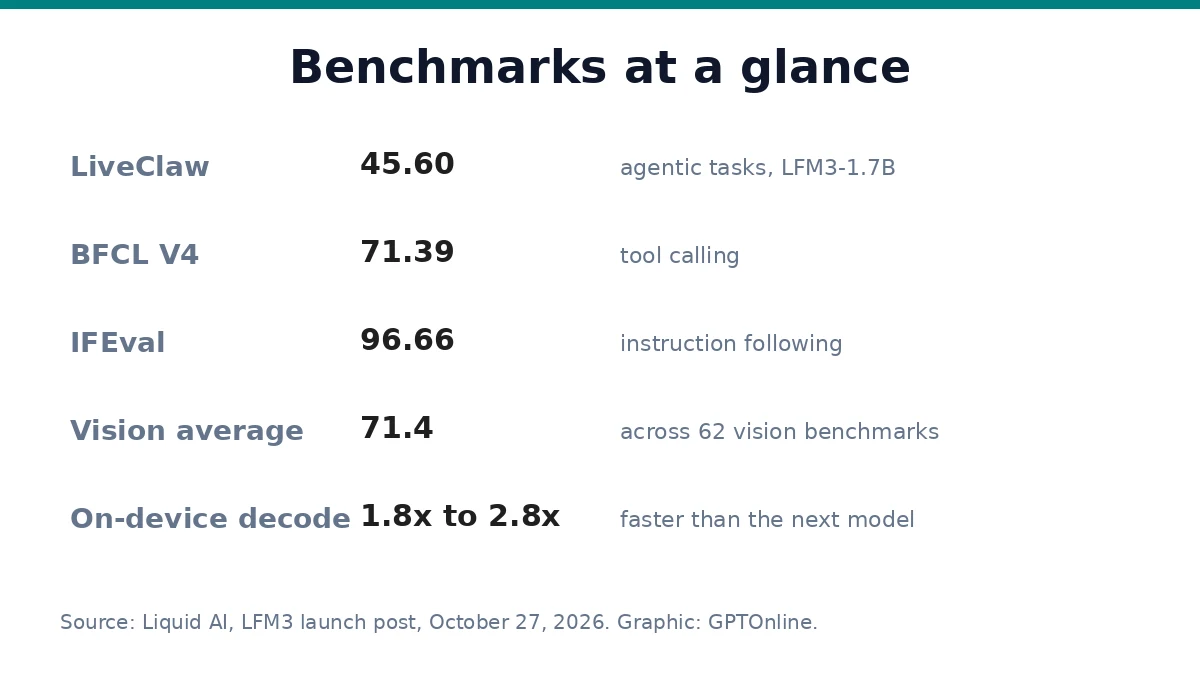
The first LFM3 release includes six models, all branched from the same LFM3-1.7B-Base backbone and all around 2 billion parameters. Four cover different modalities: LFM3-1.7B for text, LFM3-VL-2B for vision, LFM3-Audio-2B for audio and LFM3-Omni-2B, the company’s first omni model, handling vision, audio and language together. The last two are decision models, d1-2B and d1-Omni-2B, specialized from the vision and omni models.
The base model was pre-trained on 22 trillion tokens, and the text model carries a 256,000-token context window. At 4-bit precision it fits in roughly 1 GB of memory, small enough for a phone or a laptop without a dedicated GPU. Under the hood, LFM3 uses a tri-hybrid architecture: 13 gated short-convolution layers, 5 sliding-window attention layers with a 256-token window and 6 global attention layers across 24 layers, with a kernel size of 7 and a 128,000-token vocabulary. Liquid AI says the architecture was tuned against 14 device and backend combinations, from a Samsung Galaxy S26 Ultra and a Raspberry Pi 5 to Apple M4 Max laptops and the Qualcomm Hexagon NPU.
AMD, a launch partner, said the family “combines strong multimodal capabilities with a compact footprint that is well suited for on-device AI experiences.”
Benchmarks: Small Models, Big Claims
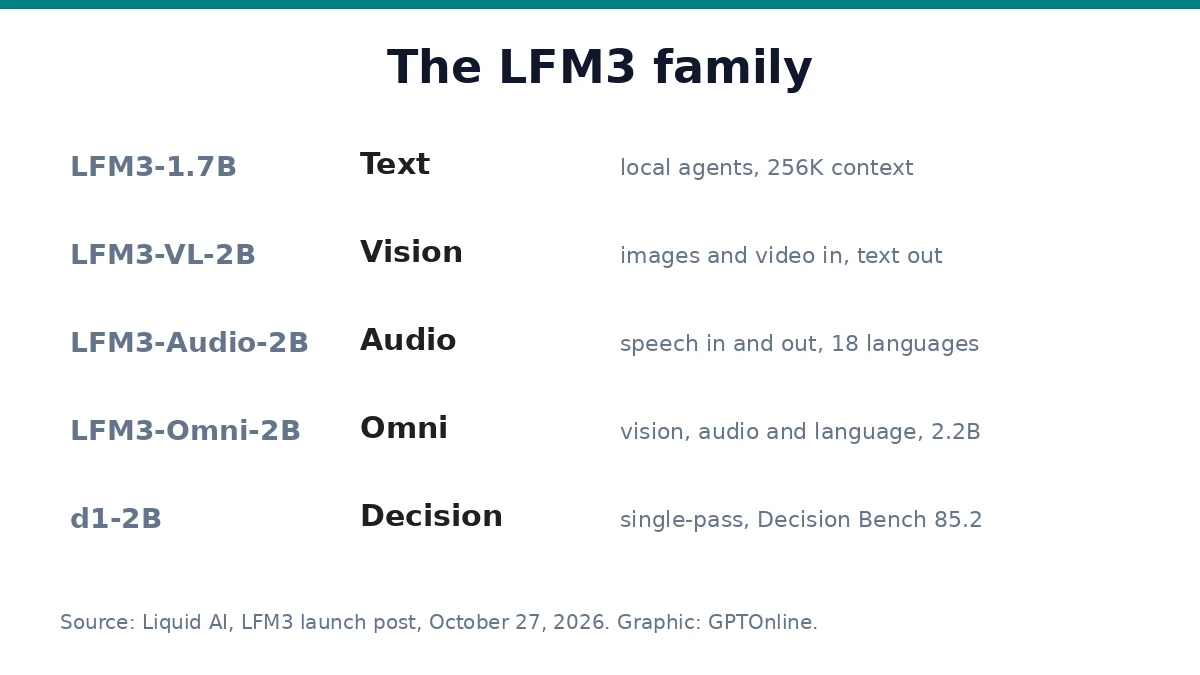
On agentic tasks, the text model punches above its size in Liquid AI’s own evaluations. LFM3-1.7B scored 45.60 on LiveClaw, 71.39 on BFCL V4, 96.66 on IFEval and 80.36 on ToolSandbox, averaging 49.37 across 29 benchmarks, ahead of Qwen3.5-9B at 47.24. Larger models still win on knowledge-heavy tests and agentic coding, Liquid AI acknowledged. The vision model averaged 71.4 across 62 vision benchmarks, matching Gemma 4 12B, more than six times larger, and landing within 2 points of GPT-5.6 Luna. It is also the first LFM vision model to accept video as input.
On-device, LFM3-1.7B decodes 1.8 to 2.8 times faster than the next model on the three devices Liquid AI tested. On a single NVIDIA B300, it can produce 3.6 billion tokens per day at 1,024 concurrent requests, according to the company. In a real-world test by MacPaw on 65 everyday agent tasks in macOS, the model reached 64 percent task success against 48 percent for Qwen3.5-2B, using 58 percent fewer tokens and getting stuck in under 1 percent of attempts against 15 percent. “Small models are ready for real agent work on the Mac, and LFM3 is the proof,” said Ivan Petrukha, staff AI engineer and LLM efficiency lead at MacPaw. These are vendor-reported results, and independent verification will matter.
Audio, Omni and Decision Models
LFM3-Audio-2B takes text or audio as input and responds with text, speech or both, across 18 languages. It scored 73.1 on VoiceBench and supports voice chat, audio understanding and tool calling, with a time to first token as low as 50 milliseconds for live microphone input.
LFM3-Omni-2B, at 2.2 billion parameters, brings vision, audio and language together in one model. It handles spoken visual question answering, video with synchronized audio, and multimodal tool calling, from a tutor reading handwritten math to in-car assistants combining camera and voice input.
The two decision models take a different approach. Instead of writing an answer, d1-2B and d1-Omni-2B decide in milliseconds, answering many questions in a single forward pass, each with a calibrated probability. They can point to objects, read text and dates from documents, estimate a number with its likely range, or pick every option that applies. The smaller d1-2B replaces the earlier d1-3B with a third fewer parameters and still scores 85.2 on Decision Bench, against 83.6 for its predecessor.
Availability and Licensing
Liquid AI LFM3 models are open-weight and available today on Hugging Face, the Liquid AI Playground and the Liquid AI API, with checkpoints for llama.cpp, MLX, vLLM and SGLang. They ship under the LFM Open License v1.0, which allows free commercial use for companies with under $10 million in annual revenue, according to coverage of the release. The company did not detail hosted API pricing; the free path is the download itself, fine-tuned on a developer’s own hardware.
Day-one launch partners include Ambarella, AMD, Arm, Intel, NVIDIA, OpenRouter, Qualcomm and Vercel, with Mercedes-Benz and Shopify joining pre-release testing. “Our ambition is to make the interaction between driver and vehicle as natural and intuitive as possible,” said Jörg Burzer, member of the board of management of Mercedes-Benz Group AG.
Why It Matters
Liquid AI LFM3 lands in a week when small, specialized models are getting serious attention. Google DeepMind’s Genie 4 world model arrived the same week, and the industry is splitting between giant cloud systems and compact models that run locally, privately and cheaply. Liquid AI’s bet is that specialization beats scale for most real deployments: a model fine-tuned for one narrow job can beat a frontier system at a fraction of the cost.
A short fine-tune of LFM3-VL-2B on about 3,000 public photos of wind turbine blades, trained for a few hours on one A100 GPU, lifted defect classification accuracy to 67 percent, from under 10 percent out of the box. A robotics extension turned the same vision model into a vision-language-action model with 96.2 percent average success across the four LIBERO manipulation suites. If those results hold up outside Liquid AI’s own labs, the most useful model for a job may soon be the small one a team trains itself, not the biggest one it can rent.
Sources
- Liquid AI: Introducing LFM3, Every Modality for Specialized Intelligence (October 27, 2026)
- MarkTechPost: Liquid AI Releases LFM3, 6 Open-Weight 2B-Class Multimodal Models (October 27, 2026)
- Unite.AI: Liquid AI Launches LFM3 Family of Six Open-Weight 2B-Class Models (October 27, 2026)
- TokenPost: Liquid AI Debuts Six Open-Weight Models for Local AI Workloads (October 28, 2026)
- GPTOnline: Google DeepMind Unveils Genie 4, a World Model With Native Audio and Talking Characters (October 28, 2026)