NVIDIA and Oracle will expand Oracle Cloud Infrastructure (OCI) Superclusters with NVIDIA Vera Rubin NVL72 systems to multi-gigawatt scale, the companies announced at Oracle AI World in Las Vegas on October 27, 2026. The expansion pairs with the general availability of Vera Rubin NVL72 systems and NVIDIA Vera CPUs on OCI, putting the newest NVIDIA hardware in customers’ hands for training frontier models, running inference and powering AI agents. NVIDIA and Oracle said the added capacity supports “growing customer demand for AI training, inference and agentic applications.”
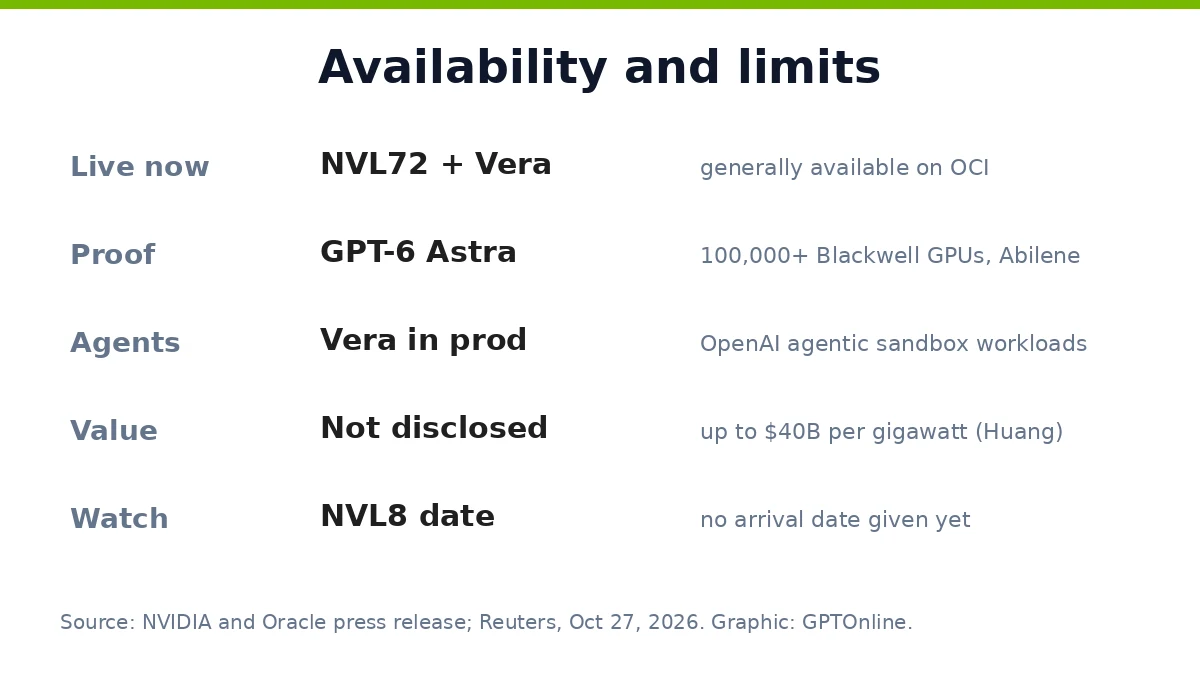
The announcement is the hardware half of Oracle’s AI World. At the same event, Oracle and OpenAI unveiled a separate software partnership that brings ChatGPT into Oracle applications, a story GPTOnline covered separately. Together, the two announcements show Oracle trying to be the neutral ground where every major AI model and chip can run. Neither company disclosed the value of the Vera Rubin expansion, though Reuters reported that NVIDIA chief executive Jensen Huang has previously said Vera Rubin systems can generate up to $40 billion in revenue per gigawatt for the chipmaker.
What Was Announced?
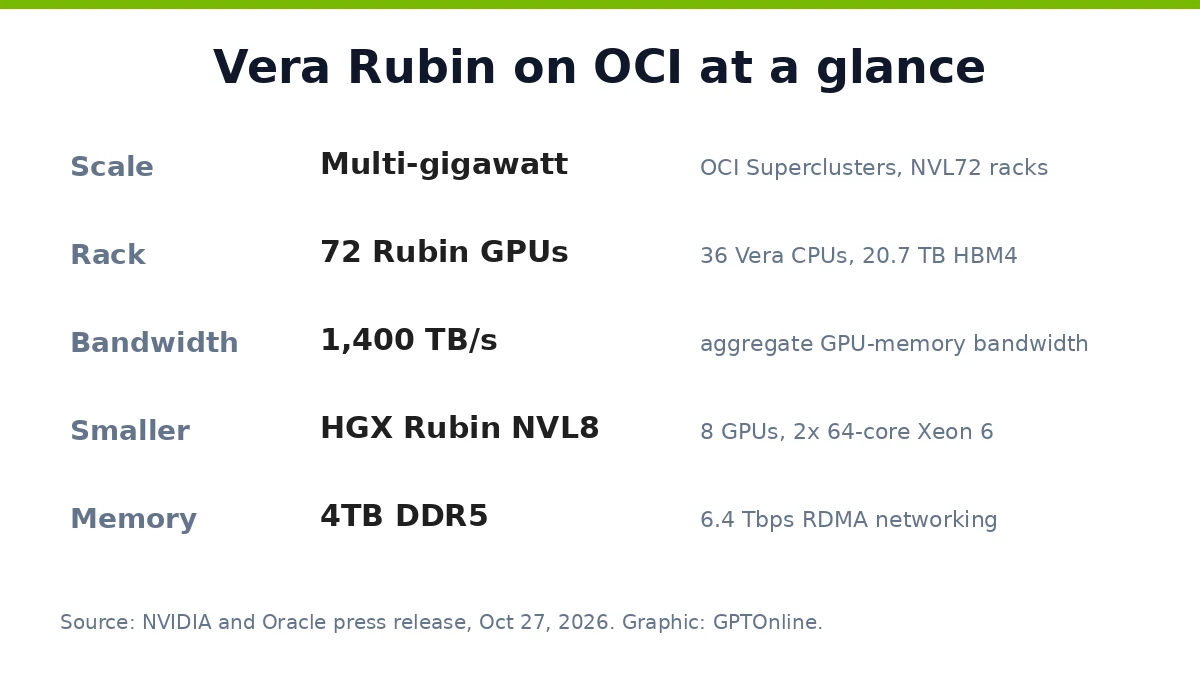
OCI Superclusters combine NVIDIA NVL72 rack-scale systems with Oracle Acceleron networking, NVIDIA Spectrum-X Ethernet featuring Spectrum-6 switches, NVIDIA BlueField-4 data processing units, and gigawatt-class power and cooling. Each rack connects 72 GPUs through NVIDIA NVLink scale-up networking, while OCI’s network scales across hundreds of thousands of GPUs. The planned expansion builds on OCI’s existing NVIDIA-powered infrastructure, including GB200 and GB300 NVL72 systems, and on NVIDIA’s common CUDA software foundation, which the companies say helps customers support new models across hardware generations.
Each Vera Rubin NVL72 rack pairs 72 Rubin GPUs with 36 Vera CPUs, with 20.7 TB of aggregate HBM4 memory and 1,400 TB/s of aggregate GPU-memory bandwidth, according to NVIDIA’s specifications. OCI also plans to introduce a smaller option, NVIDIA HGX Rubin NVL8, with eight Rubin GPUs connected through NVLink in an x86-based server. That configuration pairs the eight GPUs with two 64-core Intel Xeon 6 CPUs, 4TB of DDR5 memory and 6.4 Tbps of RDMA networking, aimed at customers who want Rubin GPU technology for training, fine-tuning and inference without committing to a full rack.
Vera CPUs for the Work Behind AI Agents
The announcement gives Vera CPUs a starring role, because AI agents do more than generate responses. They call tools, execute code and retrieve information between model calls, and slow execution of those CPU-intensive operations can leave expensive GPUs waiting. OCI Compute with NVIDIA Vera CPUs combines high single-thread performance with memory bandwidth to help agents complete those tasks faster, and OCI Kubernetes Engine lets customers scale CPU and GPU resources independently. Oracle Acceleron adds hardware-based isolation for workloads running untrusted, AI-generated code.
OpenAI is the reference customer. The company has trained and served GPT-6 Astra on an OCI Supercluster with more than 100,000 NVIDIA Blackwell GPUs in Abilene, and it is now bringing Vera CPUs into production for its agent workloads. “NVIDIA Vera CPUs on OCI deliver the world-class loaded performance needed to execute code and run tools across our rapidly growing agentic sandbox workloads,” said Uday Ruddarraju, chief technology officer of compute at OpenAI. “We are bringing Vera into production on OCI to support these workloads at scale.”
Sreekanth Pothanis, engineering leader for compute infrastructure at OpenAI, added: “As our frontier models advance, we need infrastructure that can keep pace. NVIDIA Vera Rubin on OCI gives us the computing performance and scale to accelerate model training and serve increasingly demanding AI workloads.”
Why It Matters
For NVIDIA, the deal locks its newest platform into one of the fastest-growing clouds for frontier AI training, with OpenAI’s production use as proof. For Oracle, Vera Rubin is the flagship of a broader chip-diversification play announced at the same event: Google TPUs are coming to OCI starting in 2027, and Cerebras and SambaNova Systems will join as inference providers. Oracle is even swapping some NVIDIA networking chips for its own in-house Acceleron chips in certain systems, a sign it wants leverage over every supplier, including its biggest one.
Mahesh Thiagarajan, president of Oracle Cloud Infrastructure, framed the deal around keeping GPUs busy: “Our collaboration with NVIDIA extends those capabilities across training, inference and agentic AI. By combining NVIDIA Vera Rubin GPUs and Vera CPUs with Oracle Acceleron networking and AI-optimized data centers, we’re helping customers keep GPUs productive, secure and scale efficiently as their needs grow.”
Ian Buck, vice president of hyperscale and high-performance computing at NVIDIA, added: “AI factories must be productive, durable and fungible, delivering efficient computing, remaining useful through continued software advances and serving different models and workloads as demand changes. With Oracle, we’re bringing Vera Rubin and Vera CPUs to OCI to help customers put more of their infrastructure to work today and sustain its value as AI evolves.”
Some caution is warranted. The multi-gigawatt figure is a plan, not built capacity: the release gives no price, no regions and no count of racks in service, and no arrival date for the HGX Rubin NVL8 option. Oracle’s release also carries its standard future-product disclaimer, which says development, release timing and pricing may change. The firm data point is the general availability of Vera Rubin NVL72 and Vera CPUs on OCI today, with OpenAI already running production agent workloads on them.