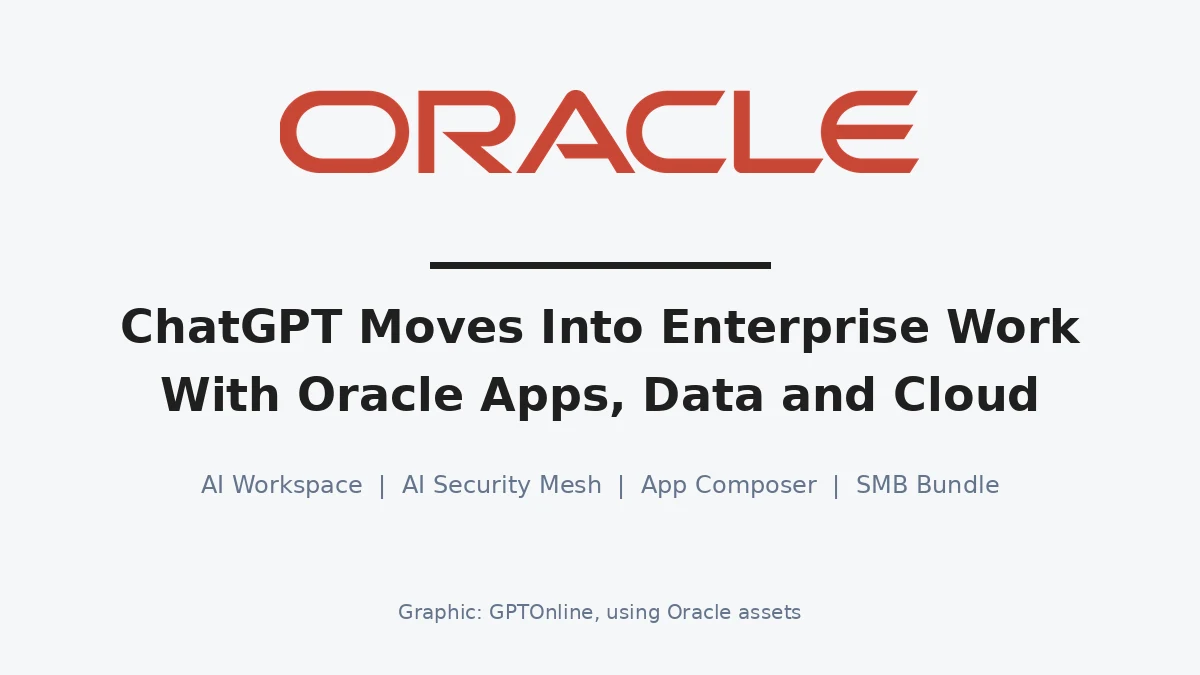
Oracle and OpenAI have expanded their partnership to bring ChatGPT and OpenAI’s frontier models directly into the software businesses use every day. Announced at Oracle AI World in Las Vegas on October 27, 2026, the Oracle OpenAI partnership adds four new offerings that connect OpenAI models, ChatGPT and Codex with Oracle applications, enterprise data and Oracle Cloud Infrastructure (OCI). Oracle says the two companies want to put AI “directly to work across the systems and operations used by customers that power the world’s economy.”
The move is less about a new chatbot than about where work already happens: instead of leaving their business systems to use AI, employees describe a task in ChatGPT and get an answer drawn from Oracle’s own applications and data, with the company’s permissions and approvals still in place. It builds on an existing commercial relationship across the OpenAI API, ChatGPT Work and Codex, and Oracle says it already counts 130,000 active ChatGPT users and more than 95,000 active Codex users inside its own operations.
What Was Announced?
The expansion centers on Oracle AI Workspace, a single experience that brings OpenAI frontier models together with Oracle applications, enterprise data and cloud services. Through plugins in ChatGPT, employees can access information, complete approved business workflows and take action alongside Oracle systems, including Oracle Fusion Applications, NetSuite, Oracle AI Database and OCI. OpenAI describes the goal as letting people “describe what they need to accomplish, find the right information, and complete approved business workflows in one place.”
OpenAI gave a concrete example: “For example, a new finance team member could use ChatGPT to investigate costs, understand purchasing decisions and identify what remains before month-end close. The intended experience would bring information from finance, procurement and planning applications together, helping more employees use Oracle software within their organization’s permissions and approvals.”
The Four Offerings
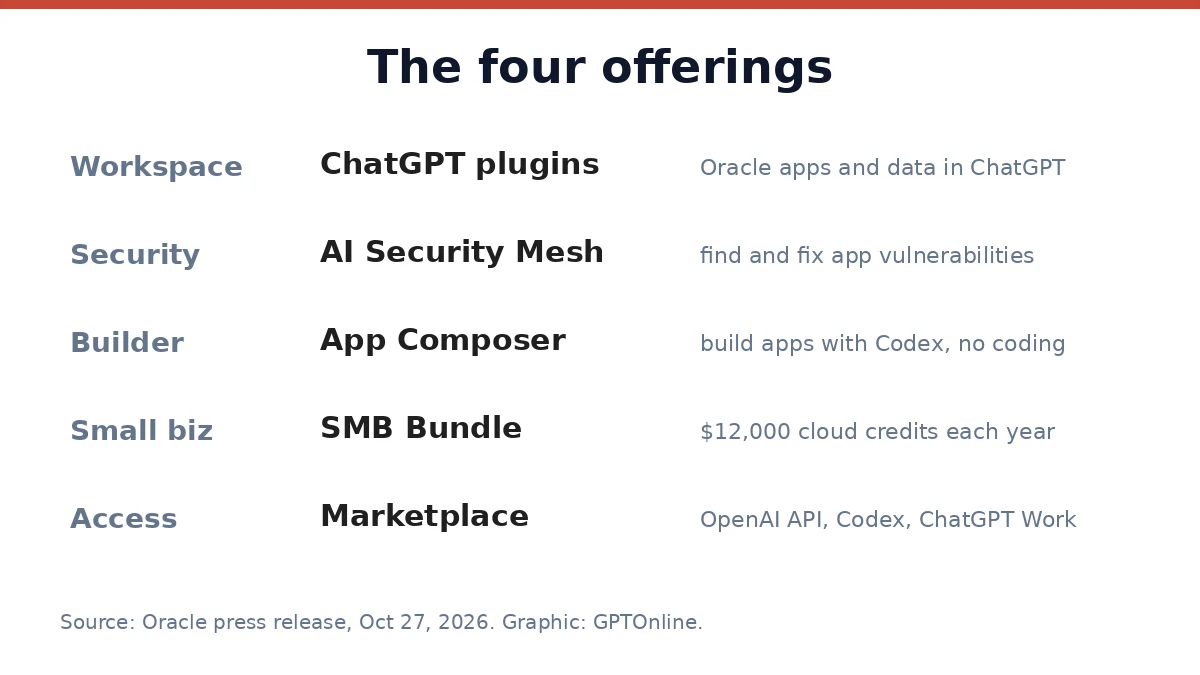
Oracle AI Workspace is the front door: ChatGPT plugins that make Oracle’s business capabilities agent-ready, so an employee can ask about a customer order, a supplier delay or a month-end close and get an answer drawn from the systems that hold the data. Oracle stresses that the experience keeps enterprise governance, approvals and controls in place.
Oracle AI Security Mesh is a managed service that uses OpenAI cyber models to help customers find and fix vulnerabilities in their applications and infrastructure across OCI, other clouds and on-premises environments. Oracle manages the testing infrastructure and safeguards, while customers define where testing is authorized and control its scope.
Oracle App Composer lets employees turn ideas into enterprise applications without coding expertise, building with Codex while Oracle manages deployment and operations on OCI. The apps connect to approved Oracle data and workflows and inherit enterprise identity, permissions, networking and audit controls. It also supports APEXlang, a new Oracle technology meant to keep AI-generated application code fast to build and easy to maintain.
Oracle AI SMB Bundle is a free-to-start package for small businesses that includes $12,000 in Oracle cloud credits each year, plus ChatGPT Business, Oracle AI Workspace, Codex, Oracle App Composer, OCI and NetSuite QuickStart for managing invoicing and cash flow. Terms, conditions and restrictions apply.
Availability and Access
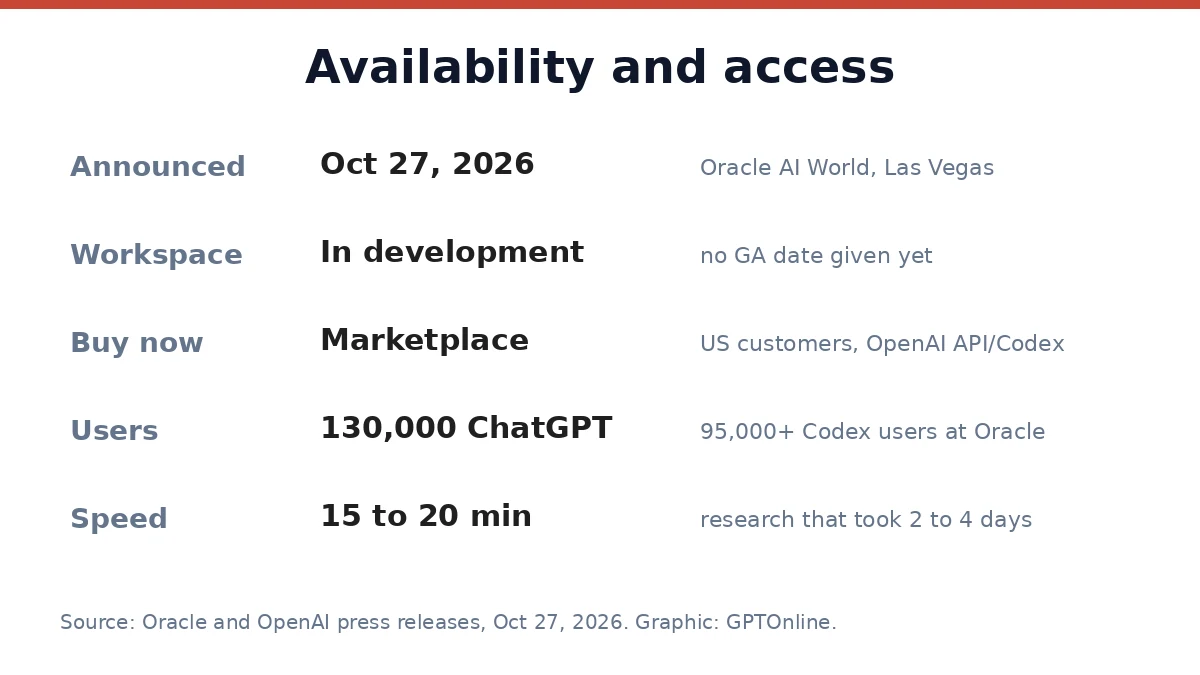
Oracle is still developing AI Workspace, and the announcement gives no general-availability dates for all four offerings. Oracle’s release carries its standard future-product disclaimer, which says development, release timing and pricing may change.
One part is available now. Oracle customers in the United States can purchase access to the OpenAI API, Codex and ChatGPT Work through Oracle Marketplace, using existing procurement processes and eligible Oracle Universal Credits. Oracle also points to early internal results: its recruiting team uses ChatGPT Work for market research that once took two to four days to compile, with preparation now taking 15 to 20 minutes.
Why It Matters
The partnership is the software half of a bigger Oracle AI World. At the same event, Oracle also announced Google TPUs coming to OCI in 2027, NVIDIA Vera Rubin systems expanding OCI superclusters to multi-gigawatt scale, and Cerebras and SambaNova chips joining the lineup. The message is that Oracle wants to be the neutral ground where every major AI model and chip can run, and the OpenAI deal gives that infrastructure a front door employees already know: ChatGPT.
For OpenAI, the deal pushes its models deeper into enterprise workflows it cannot reach alone: ChatGPT becomes the interface for Oracle’s installed base of finance, HR and supply-chain software, while Codex builds the custom apps on top. Neither company disclosed financial terms.
Oracle chief executive Clay Magouyrk framed the deal as a change in how enterprise software works: “OpenAI is transforming how enterprises solve business problems, from chat, to coding, to analytics, to autonomous agents. With this new product suite, we are uniting their transformative AI capabilities with Oracle applications, data, and cloud infrastructure, technology that businesses around the world rely on to run their most critical operations.”
OpenAI president and co-founder Greg Brockman added: “More businesses are choosing OpenAI as we make it easier to put AI to work through the tools and systems they already use. Our expanded partnership with Oracle helps bring that opportunity to more companies, putting frontier AI into everyday operations so teams can build software faster, strengthen security and take on more complex knowledge work.”
Sources
- Oracle: Oracle Reinvents Enterprise Computing for the AI Era with OpenAI (October 27, 2026)
- OpenAI: OpenAI expands partnership with Oracle to bring its apps to ChatGPT (October 27, 2026)
- PYMNTS: Oracle Integrates Enterprise Data and Applications With OpenAI Frontier AI (October 27, 2026)