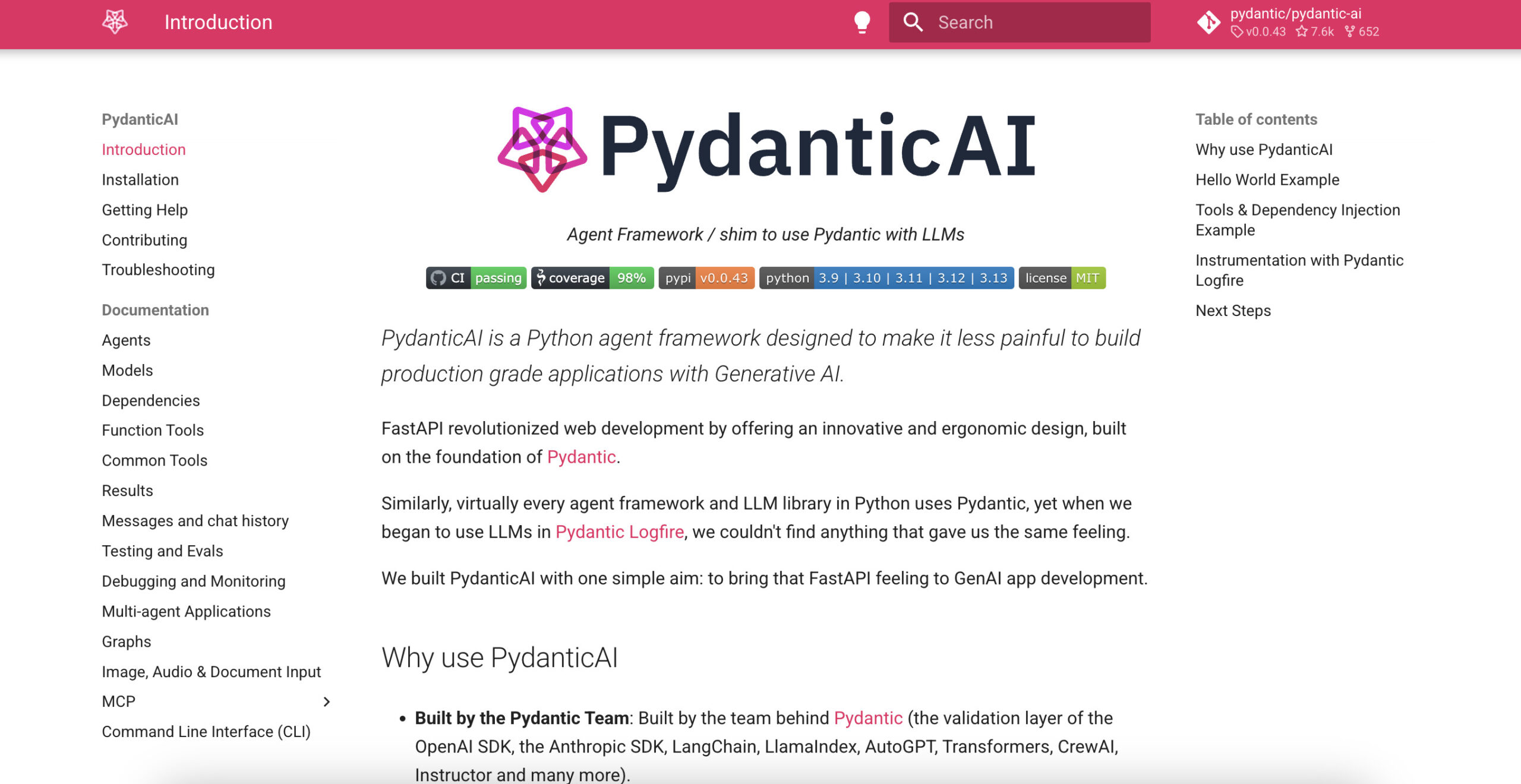
Existing image: an earlier Pydantic AI documentation page showing version 0.0.43. Its capture date is unrecorded; the screenshot is not evidence of the current release, and its MIT badge does not certify an application’s output quality.
| Field | Description |
|---|---|
| Name | Pydantic AI |
| Overview | Pydantic AI is an open-source framework developed by the creators of Pydantic, designed to help Python developers build AI-powered applications with type-safe, production-ready agents. It brings FastAPI-like ergonomics to the world of Generative AI, offering support for multiple LLMs (like OpenAI, Anthropic, Google Gemini, Mistral, and more) and integration with Pydantic Logfire for debugging and insights. Built with a strong emphasis on developer experience, Pydantic AI provides structured outputs, dependency injection, and graph-based workflows to manage complex agent interactions. |
| Key features & benefits |
|
| Use cases and applications |
|
| Who uses? |
|
| Pricing | Free and open source under the MIT license. Model-provider usage and your hosting can incur separate costs. Optional hosted services such as Pydantic Logfire and Pydantic AI Gateway have their own free allowances, plans or usage charges; they are not required licence fees for the framework. |
| Tags | #Python #AIFramework #OpenSource #LLM #Pydantic #DevTools #AgentFramework #StructuredAI #LangchainAlternative |
| App available? | Available as a Python package via pip install pydantic-ai. The documentation also provides CLI and web-UI integrations; this is a developer framework, not a claim of a consumer mobile app. |
Before production use, test representative failures, handle retry exhaustion and verify important outputs against trusted data. Sources: output validation, retry limits, MIT licence and optional hosted-service pricing.