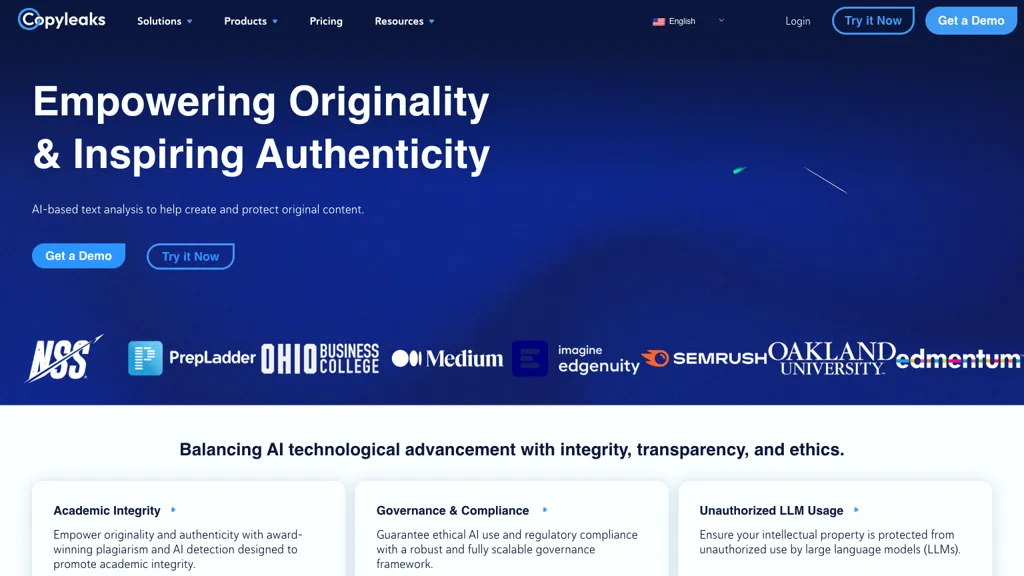
Historical Copyleaks homepage image retained from the original December 2024 listing. Its interface, product cards, and promotional claims may differ from the current service. It is not evidence of a GPTOnline product test.
Updated October 15, 2026. This guide reviews public Copyleaks documentation. We did not upload documents, run detection tests, access a paid account, or test an integration.
Copyleaks provides tools for examining possible AI-generated text and similarities to existing sources. It can help an editor identify passages that need a closer look, or help an organization add content checks to an established review process. A detector result cannot establish who wrote a document, and a similarity report still needs interpretation.
What Copyleaks checks
- AI-writing signals: The AI text detector analyzes writing patterns and supports more than 30 languages. Its AI Logic features provide explanations for flagged material. Those explanations support investigation; they do not verify authorship.
- Source overlap: The plagiarism checker identifies potential matches, including similar or paraphrased text, and supplies source links in its reports. Read the matched source to distinguish a properly attributed quotation, common wording, and copying that needs correction. An unmatched passage is not a guarantee of originality.
- Related services: The API suite also lists grammar checking and text moderation. Copyleaks markets image-analysis products separately; confirm the required scan type rather than assuming text checks establish an image’s origin or reuse rights.
The useful question is what a report helps you check next. It does not fact-check every claim, establish copyright permission, or replace an editor’s source review.
How to interpret an AI detection result
Copyleaks’ Terms of Use, revised August 24, 2026, acknowledge false positives and false negatives. They describe the AI features as assessment tools, require meaningful human oversight, and prohibit relying on their results alone for decisions affecting individuals. Do not treat a score as proof of misconduct or definitive authorship.
For performance claims, check the model and test conditions. The published V11 methodology reports testing on September 10, 2026, with publication on September 28. The described evaluations were performed by Copyleaks’ own data science and QA teams. This is useful vendor documentation, not a GPTOnline accuracy test or a guarantee for your documents.
Official pages also differ: the text detector page advertises a 0.03% false-positive rate, while the extension page still cites 0.2% and an English-dataset testing note. We do not combine those figures into a universal reliability rating. Preserve drafts and source notes, review the actual passages, and give the writer a chance to explain their process.
Access and integrations
Copyleaks offers a web service, a Google Docs add-on, browser extensions, and organizational integrations. Its extension page links Chrome and Edge; the current pricing page also lists Firefox. Check the provider’s installation route for the browser you use.
The LMS page lists Canvas, D2L Brightspace, Google Classroom, Moodle, Blackboard, Schoology, Sakai, and Edsby. Institutional configuration still matters: confirm access, reporting, permissions, and the applicable review policy before rollout. Availability on an LMS does not mean a consumer subscription includes the institution’s integration.
For custom systems, the API offering includes hosted or embeddable interfaces and developer integrations. A ready-made interface can reduce implementation work, but custom authentication, scan handling, and report workflows require planning. Check implementation requirements for your setup before relying on a no-code promise.
Does Copyleaks still offer AI Grader?
A public AI Grader page remains available and directs prospective customers to request a demo. It describes using previously human-graded examples to guide automated batch grading. This does not establish that the grader is included in Personal or Pro, or that it delivers precise, bias-free assessments in every setting.
If grading is your reason for considering Copyleaks, ask sales to confirm current availability, supported assessment formats, rubric setup, pricing, and a validation process with human review. We have not tested its grading results.
Plans and pricing
The official pricing cards displayed the following on October 15, 2026. Amounts use the site’s $ symbol; the reviewed page does not explicitly identify the currency code. Confirm billing currency and applicable taxes before purchasing.
| Plan | Monthly billing | Annual billing |
|---|---|---|
| Personal | $16.99; 100 credits | $167.88; 1,200 credits ($13.99/month equivalent) |
| Pro | $99.99; 1,000 credits | $899.88; 12,000 credits ($74.99/month equivalent) |
| Enterprise / Education | Custom quote, including API and LMS requirements | |
Personal and Pro combine text AI and plagiarism checks, plus AI image detection. One credit covers up to 250 words or one image. Annual cards show yearly credit totals, while the FAQ uses generic monthly-allowance language; confirm allocation and expiry for your chosen plan.
Subscriptions renew automatically. Cancellation stops future renewals; changing plans can replace unused credits. The pricing FAQ limits refunds to requests within 10 days of the billing cycle with no scans or credit use. The terms specify annual prepayment and no rollover of unused monthly credits.
The detector page advertises a limited free entry route. Treat it as a way to inspect the service’s current offer, rather than assuming unlimited free reports or organizational access.
Privacy and repository choices
The Privacy Policy, revised August 24, 2026, describes model-training uses and says direct customers can opt out through support; enterprise customers may elect an opt-out. Retention depends on service, legal, and other stated purposes, rather than a universal immediate-deletion promise.
Repository choices are separate. Shared Data Hub can expose matching portions of contributed text to other users; private hubs restrict visibility to the organization. The policy provides disabling and deletion routes for Shared Data Hub submissions. Before uploading unpublished work, confirm training, storage, repository participation, and deletion settings with your administrator or Copyleaks. Only submit material you are permitted to share.
A practical editorial workflow
Fictional example, not a product test: An editor at a small outdoor magazine is reviewing an article about maintaining a bicycle chain. The draft contains no customer records or student information.
- Keep the writer’s original draft and the public manufacturer references. Confirm the publication has permission to submit the text and has chosen appropriate privacy settings.
- If using a report, examine matched passages first. A sentence quoted from a maintenance manual may need quotation marks and attribution; ordinary technical terms may need no change.
- Treat any AI flag as a prompt for a conversation about how the draft was prepared. Compare the draft history and supporting sources without accusing the writer from a score.
- Verify practical claims against the original references. A low AI score would not establish that the maintenance advice is correct.
- Record the editorial decision and manage stored scans according to the publication’s policy. Do not keep rewriting merely to chase a lower detector percentage.
If you are also comparing writing aids, our QuillBot AI guide covers a different writing workflow. Compare the tasks, report limits, and privacy terms you need; a detector score is not a useful ranking of writing quality.
Is Copyleaks a useful fit?
Consider it when source matching or content-analysis reports would support an existing human review process. For institutional use, the integration and data-handling agreement deserve as much attention as the detector interface. If you need conclusive authorship verification or automatic misconduct decisions, these reports cannot provide that certainty.
Review the official Copyleaks website for the current product and the specific plan that matches your workflow.