
Updated October 16, 2026. This overview is based on Subatomic’s public product pages and policies. We have not tested a deployment, measured its accuracy or verified its security controls independently.
Subatomic AI provides a company-specific AI workforce built around an AI Chief of Staff and specialist Co-Workers. Its official website markets to wealth-management firms, manufacturers and credit unions. Evaluate whether it can handle a defined workflow using your organization’s data and rules.
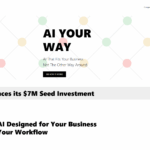
Featured image: historical Subatomic homepage with a large headline and seed-investment announcement. This is an earlier website design, not a current product-interface screenshot.
What it does
Subatomic IQ organizes connected business data, documents and institutional knowledge into a structured layer. The vendor describes a knowledge graph that relates clients, policies and processes, giving its agents company-specific context.
The AI Chief of Staff coordinates the work: routing tasks, applying policy checks, managing priorities and escalating situations that need human judgment. These are vendor-described capabilities, not a guarantee that every output will be correct.
AI Co-Workers carry defined roles. Published examples include meeting preparation, compliance review, client reporting, data analysis and onboarding coordination. Custom roles are discussed around a firm’s workflows and policies, so the relevant scope needs to be agreed before implementation.
Deep Lens is the monitoring component. Subatomic describes task-status visibility, quality scoring, performance metrics and records of decisions, data access and outputs. Ask to see a real task trace during evaluation, including what happens when a source is missing or an answer is disputed.
Access and integrations
The homepage describes an interface delivered through Outlook, Slack and phones, with client-facing or other consequential actions held for approval. It does not establish a downloadable iOS or Android app; confirm the exact phone experience and approval controls for your deployment.
The IQ page names Salesforce, HubSpot and Microsoft Dynamics for CRM; SharePoint, Google Drive, Dropbox and Box for documents; Outlook, Gmail and Microsoft 365 for email and calendars; and SAP, Oracle, NetSuite and Dynamics for operations. It also describes API, database and proprietary-system connections. A product’s presence on this list does not specify connector permissions, supported editions, write-back actions or setup costs.
Pricing and terms
No numeric public plan prices were confirmed as of October 16, 2026. Subatomic directs prospective customers to a consultation. The reviewed pages do not establish a free product tier or a self-service trial.
Its implementation overview compares the cost with staffing rather than a per-seat license, but that positioning is not a price quote. Currency, billing frequency, minimum term, setup fees, included capacity and overage charges remain unconfirmed.
The public Terms of Use concern website access and do not provide customer refund, cancellation or renewal terms. Request a written proposal covering the total commitment, integration work, support, termination notice and what is refundable before signing.
Privacy and security
Subatomic’s security page claims isolated firm data, no model training on that data, role-based permissions, encryption, multifactor authentication and identity-provider single sign-on. It describes SOC 2-compliant architecture; this overview has not verified an independent SOC 2 report or its scope.
The implementation page separately claims zero retention by AI model providers. That does not tell a buyer how long Subatomic retains every category of operational data, logs or backups.
The Privacy Policy, effective April 9, 2026, covers information collected through the website or services. It says personal information is not sold, but permits sharing with service providers and for legal or safety reasons. It describes retention by purpose and legal need, without a fixed deletion period. Those provisions should not be replaced with a blanket claim that no data is ever shared.
Before connecting confidential records, request the deployment-specific data-processing terms, hosting location, subprocessors, model-provider handling, deletion schedule and export procedure. Define who can approve external actions and who reviews exceptions.
A sample workflow
Fictional example: Harbor Advisory wants help preparing its weekly client meetings. It could evaluate Subatomic on ten synthetic client records, an approved meeting-brief template and a short internal procedure.
- Ask for a draft brief that cites the records used and lists unresolved discrepancies.
- Introduce one conflicting date and one missing document to see whether the system flags uncertainty.
- Have a staff member check every fact and approve any proposed follow-up.
- Measure correction time, missing-source flags and accidental actions before considering real client data.
This is a suggested evaluation exercise, not a documented customer result or a test we performed.
Fit and limitations
Subatomic publishes a six-week rollout outline covering workflow discovery, data connections, supervised Co-Workers and expansion. Treat that as a vendor timeline to discuss, not a guaranteed implementation deadline. Your data readiness and agreed scope matter.
It is worth evaluating when a team has repeatable cross-system work, documented procedures and someone responsible for oversight. It is harder to assess if you need an immediate self-service tool, fixed public pricing or published usage allowances.
No verified public quota was found for users, tasks, document volume, context size or storage. Put those limits, service levels and failure-handling responsibilities in the proposal. For regulated or client-facing work, retain qualified human review; advertised compliance checks do not establish regulatory approval.
To structure that evaluation, adapt our AI assistant acceptance-test worksheet to your own approval and source-checking requirements.