Updated: October 17, 2026
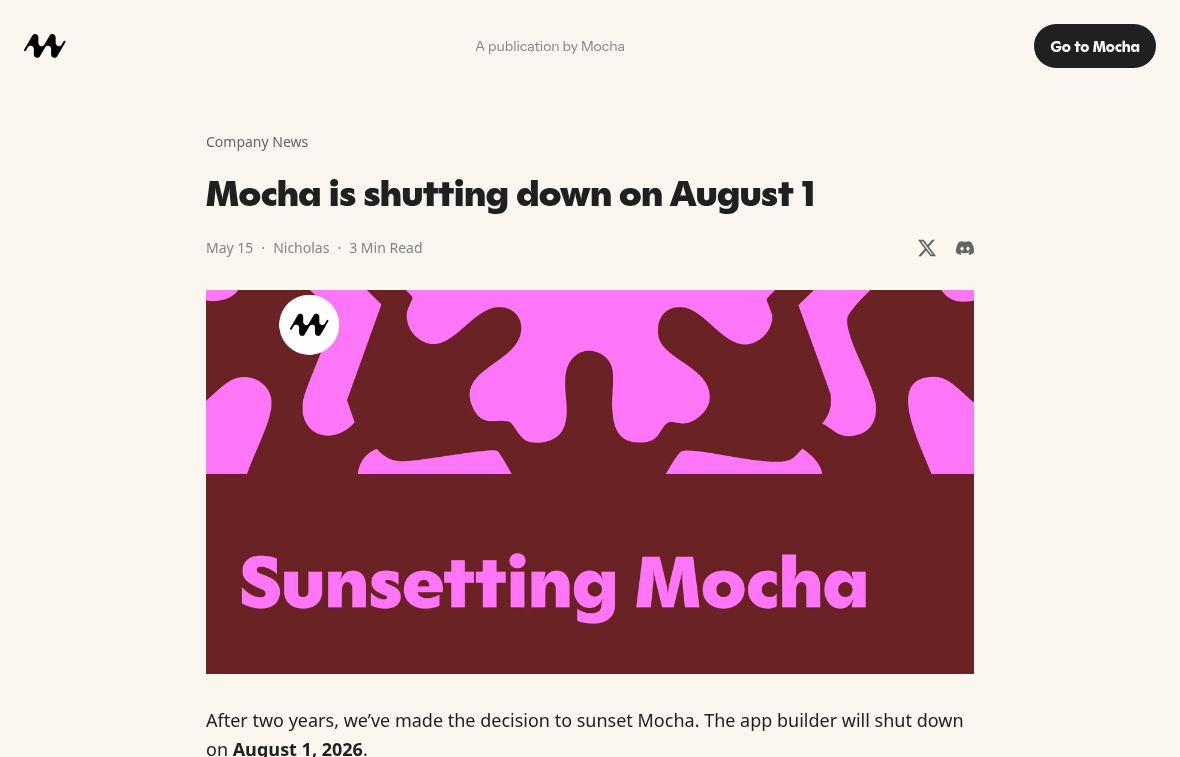
Screenshot of Mocha’s public shutdown announcement, captured October 17, 2026. The notice gives August 1, 2026 as the closure date; no account recovery was tested.
Status update: Mocha, the hosted AI app builder previously associated with the Srcbook name, announced a shutdown for August 1, 2026. Its official closure notice said building, previews and hosted live apps would stop. That date has passed. This page now explains the product’s history and practical checks for former users; it is not a recommendation to start a new Mocha subscription.
We reviewed public sources for this update without signing in, migrating a project or testing an application. Individual account access and recovery options have not been verified.
How Srcbook became Mocha
The company’s June 11, 2025 rebrand account explains that Srcbook began as a TypeScript notebook for developers. User requests led the team toward a browser-based app builder aimed at people who wanted to create software without managing a command-line setup. The company adopted the Mocha name as part of that change.
That history matters when reading older reviews. A hosted Mocha app and a locally installed Srcbook notebook are different things. Instructions, subscription limits and support expectations for one should not be assumed to apply to the other. We retain this article’s original Srcbook URL so readers following older references can understand what changed.
What the hosted app builder offered
The Mocha 1.0 announcement described a conversational builder with user authentication, a database, backend support and publishing, including custom domains. Its intended uses included prototypes, customer portals, booking workflows and internal business tools.
These are historical product descriptions. They do not establish that the service is available today, that a particular generated app was secure, or that complex business logic worked without review. The original article’s promises of instant generation and broadly secure, scalable infrastructure have therefore been replaced with a more limited account of what the provider offered.
Pricing and migration: what still needs checking
The closure notice said active subscriptions would cancel automatically on August 1 and billing would stop after that date. It also described code/data export and migration to Anything, with the migration link and export tool remaining available for 30 days after shutdown. That published window has now elapsed; the notice is not proof that a particular account was refunded, successfully migrated or remains recoverable.
The Anything migration page is still publicly accessible. It describes signing into Mocha, authorizing transfer and subscribing to a paid Anything account. Its continued presence does not confirm that an old project can still be transferred. Check present eligibility, costs and access directly before relying on the workflow or authorizing data movement.
We are not presenting the old Starter, Bronze, Silver and Gold prices or credit allowances as current offers. An old pricing table is useful historical context, but it cannot establish a live subscription or replacement-platform entitlement after closure. Likewise, a migration promotion is not a guarantee of free ongoing hosting.
A practical checklist for former users
Hypothetical example: you once used Mocha for a small club’s equipment-booking app and already have an export. Before rebuilding or moving it, work through a limited recovery plan:
- Inventory what you have. Keep the original export unchanged. Identify source code, database files, uploaded assets and setup instructions; do not assume a code folder contains the application’s live data.
- List essential behavior. Record who can sign in, who can change bookings, how conflicting reservations are handled and which messages the app sends.
- Use sample records first. Have a qualified developer inspect the export and test a copy with fictional members and bookings before importing personal information.
- Check dependencies and costs. Identify required hosting, databases, authentication and external services. Compare the replacement’s actual limits rather than the old Mocha plan.
- Validate before switching users. Test permissions, booking changes, error handling and backups. Plan domain changes and user communication only after the replacement works for your needs.
If you do not have an export, ask the relevant provider what recovery remains possible. Do not assume that a public migration page means your files still exist. This checklist is planning guidance, not a report of a successful recovery.
The separate open-source Srcbook project
The Srcbook repository describes a locally running TypeScript notebook and explicitly states that it is not under active development. It lists an Apache-2.0 licence and an API-key requirement for AI features. This is not a maintained drop-in replacement for Mocha hosting, and its software licence does not provide hosted service, support or free model usage.
The repository also has its own privacy notice about behavioral analytics. Do not transfer that notice’s statements to the former hosted service or a migration destination. We could not retrieve Mocha’s current hosted privacy and terms pages during this review, so post-closure retention and deletion arrangements remain unverified.
For a new project, compare an actively supported service’s export options, data handling, operating costs and access controls before committing. Our AI tools directory provides other product overviews; verify each provider’s current status and terms for your own use case.