| Name | Scoopika |
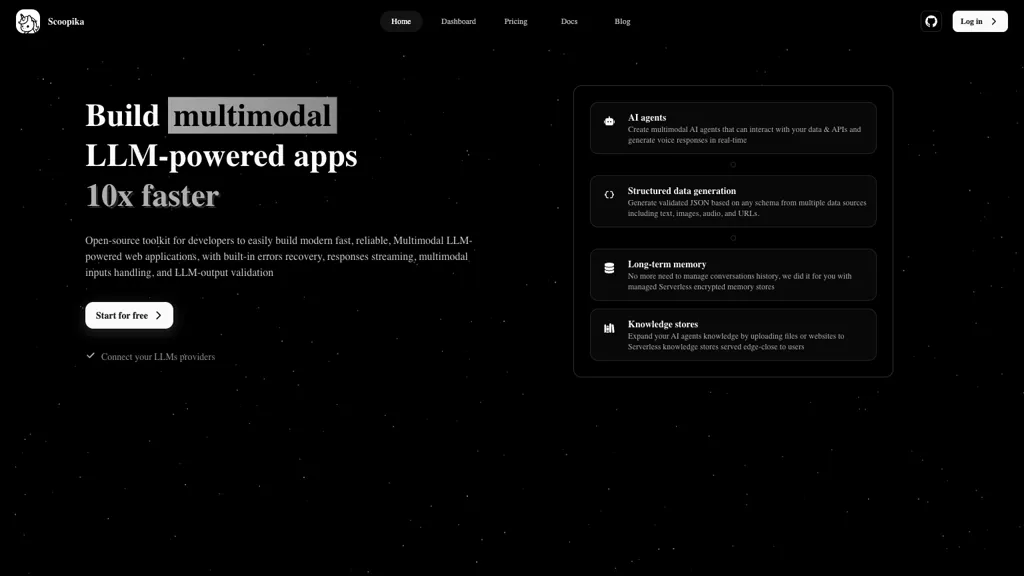
| Overview | Scoopika is an open-source toolkit designed to help developers create multimodal applications powered by large language models (LLMs). It allows for efficient integration of diverse data types, such as text, audio, and images. These features are designed to help developers manage queries and responses; reliability depends on the model and implementation. Its capabilities include built-in mechanisms for error recovery, real-time response streaming, and validation of LLM outputs. Additionally, Scoopika supports the creation of AI agents capable of interacting with different data sources and APIs, generating schema-validated JSON objects whose contents still require review, and utilizing managed serverless storage for long-term memory. The toolkit connects to multiple LLM providers; Scoopika says its managed knowledge and memory stores are served from 26 global regions. Developers can leverage its documented installation, customizable AI features, and published SDK and community links to build automation tools and conversational agents. |
| Key features & benefits |
|
| Use cases and applications |
|
| Who uses? |
|
| Pricing | The provider describes a free-forever plan for core features on your own servers, with paid options for managed long-term memory and knowledge stores. Charges from your chosen LLM provider remain separate.
** Pricing packages are subject to change. Verify pricing information here. |
| Tags | AI, LLM, multimodal integration, automation tools, developer toolkit |
| App available? | Developer toolkit for building web applications; a separate native mobile app was not verified. |
Historical Scoopika homepage screenshot; capture date unknown. The displayed “10x faster” statement is the provider’s claim, not our benchmark.