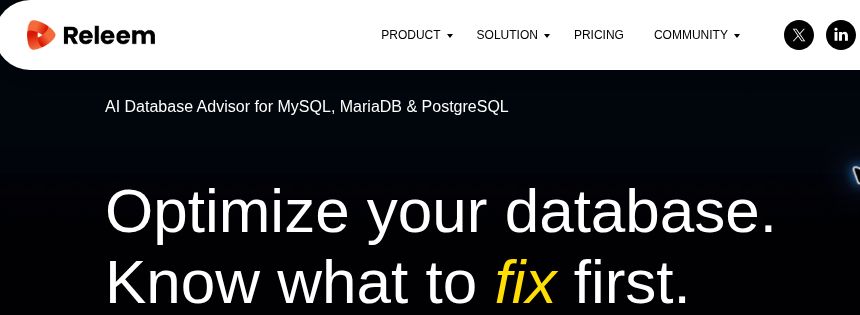
Releem logo and database-advisor headline on its official homepage
Databases

Releem AI

Visit website

Review Releem AI’s database monitoring and tuning recommendations, current server-based pricing, supported deployments and approval-controlled changes.

Releem logo and database-advisor headline on its official homepage

Updated on October 20, 2026.

Featured image: screenshot of Releem’s official homepage, captured October 20, 2026. It shows the public provider presentation. Database-engine support and testing limits are described below.

Name Releem AI
Overview Releem AI is a database performance advisor for MySQL, MariaDB and Percona, including supported managed-cloud deployments. Its open-source agent collects telemetry for a cloud dashboard that identifies issues and recommends configuration, query and schema changes. Current materials also cover PostgreSQL, but the pricing FAQ describes that support as selected validation paths, so confirm your exact deployment with Releem. Recommendations and approved apply workflows should not be confused with unrestricted autonomous production tuning.
Key features & benefits
  • Configuration recommendations: Compare suggested settings with the current configuration and apply approved changes. The vendor’s benchmark gains are workload-specific, not a promise of a 290% improvement for your database.
  • Query optimization: Highlights slow, resource-intensive queries with suggestive indexing.
  • Schema analytics: Detects duplicate/unused indexes and suboptimal engine choices.
  • Health monitoring: Tracks database health signals. Releem says Health Checks run twice daily and notify users when metrics fall outside acceptable ranges; underlying telemetry collection schedules differ by metric.
  • Open-source agent: The GPL-3.0 agent collects telemetry and can apply recommended settings through approved workflows. Open source is not by itself a security guarantee.
Use cases & applications
  • Web app developers: Investigate database performance with guided recommendations; production changes still need appropriate review.
  • DBAs: Automate routine optimization and free time for strategic work.
  • Hosting providers: Optimize client databases at scale.
  • Cloud engineers: Investigate supported AWS RDS/Aurora deployments and validate changes against their workload.
Who uses it? Developers and DevOps teams, database administrators, hosting companies and SaaS providers, and cloud infrastructure engineers.
Pricing
  • Starter: one server, $49/month or $39/month billed annually ($468/year).
  • Scale: up to five servers, $199/month or $123/month billed annually ($1,476/year). The page lists additional servers at $39; confirm the applicable billing basis.
  • Hosting: $99/month for up to nine servers, plus $11 per additional server; SQL Query Optimization is excluded.
  • Business: custom terms for unlimited database servers, with premium 24/7 email and chat support. Team management and SSO are marked coming soon; confirm deployment requirements with Releem.

Public plans show three months of metric history. A free trial is offered, and a payment method may be required. The former free tier, $79 Pro and $19 usage plan were not reconfirmed. Confirm currency, taxes and renewal terms before purchase.

Tags #MySQL #DatabaseOptimization #AI #Monitoring #QueryTuning #Schema #DevOps
App available? Yes: a cloud dashboard with an agent. Documentation covers Linux, Windows Server, Docker and supported managed databases such as AWS RDS/Aurora. Features and versions vary by deployment; use the current compatibility and installation guides rather than assuming every platform has identical support.

Before connecting a production database

Review the agent’s permissions and collected telemetry with your database owner. The repository describes system metrics, schema and index metadata, query statistics and EXPLAIN plans; it says table contents are not collected. That is narrower than saying no information leaves your server.

Test recommendations on a representative workload, retain a rollback plan and schedule approved changes appropriately. The current pricing FAQ says configuration changes are not applied without approval. Exact database-version lists differ between the compatibility page and repository, so check the intended version and feature path before installing.

Sources checked October 20, 2026: pricing and support scope, compatibility, Health Checks, official documentation, and agent repository and licence. This review did not install an agent, access a database or benchmark performance.

KEEP EXPLORING

More tools to discover.

Alaya AI

Alaya AI is a Web3-native AI data platform leveraging blockchain, gamification, and NFTs to decentralize data collection and labeling for AI training.

DatabasesExplore
OtterTune company closed, with its operating years shown as 2020–2024.

OtterTune has closed. Read its official status, distinguish the research from the former service, and use a practical checklist for replacement tools.

DatabasesExplore
devaten

Review Devaten’s advertised database monitoring and on-premises AI-agent features, with pricing, deployment and source-verification limits explained.

DatabasesExplore
basedash com

Explore Basedash database interfaces, SQL and API Actions, with admin-product prices separated from current AI analytics plans and desktop-access scope.

DatabasesExplore
Historical WebDB database IDE homepage with Node.js, Docker and Angular labels and a demo preview.

Read the historical WebDB database IDE overview and current access limits: the previously linked domain now shows unrelated content, not the database tool.

DatabasesExplore
blazesql

Explore BlazeSQL’s AI SQL queries, dashboards, trial and paid plans, with setup requirements, privacy settings and practical query-review steps.

DatabasesExplore
Find your next starting point