Updated October 16, 2026. Refabric AI is a web-based fashion platform for exploring designs, preparing tech-pack drafts and creating product imagery. Its current offering brings AI Design, AI Photoshoot and AI Tech Packs into one workflow for fashion brands and manufacturers. See Refabric’s official website.
Review method: This is a documentation-based review of Refabric’s public product pages, pricing, policies and developer documentation. We did not create an account, run a generation, purchase a plan or test exports. Feature descriptions below are vendor-documented capabilities; our workflow and buying advice are editorial assessments.
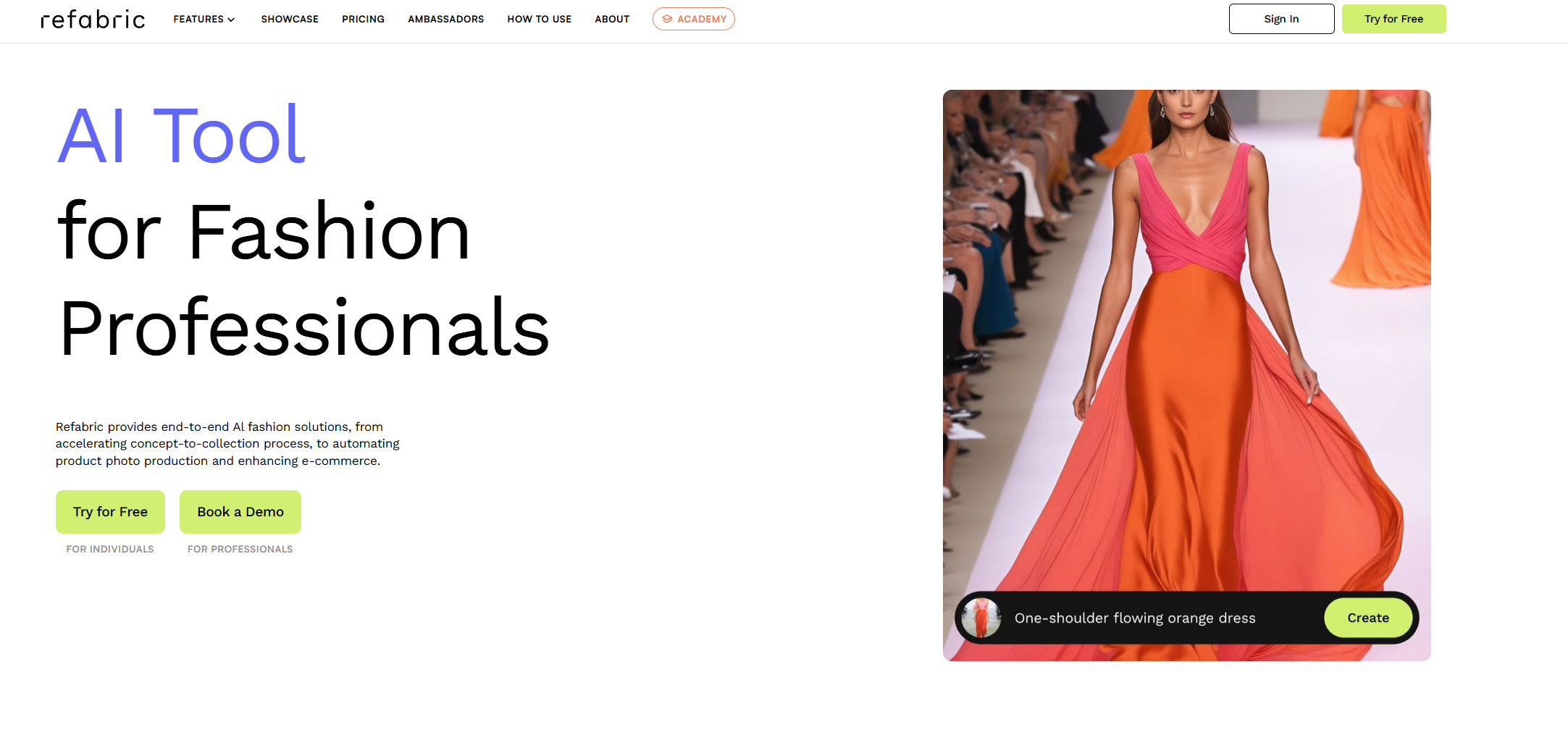
Image note: The retained article image shows an earlier Refabric homepage with an orange-and-pink runway dress, a prompt mockup and “Try for Free” buttons. It is historical marketing imagery, not a result generated for this review or evidence of today’s trial conditions.
What Refabric does
The main appeal is keeping visual exploration and downstream preparation in the same workspace. A design team could compare silhouettes, adjust surface details and prepare a concept for discussion without rebuilding its references in several separate tools. Actual usefulness will depend on how faithfully the outputs preserve the details that matter to your collection.
- Design Canvas: Refabric describes a shared drag-and-drop workspace that accepts prompts, reference images and sketches. Its design tools cover sketch rendering, color and print variations, technical flat drawings and front, back and side views.
- Brand references: Brand DNA uses uploaded collections and other visual assets to guide new designs. The features page also describes trend inputs, fabric references and print placement. Treat these as creative guidance; consistency still needs a designer’s review.
- Photoshoots: The developer documentation describes turning garment photos into images on AI models, with poses, backgrounds and optional product views. These can support catalog or lookbook preparation, subject to checking the depicted product against the actual item.
- Tech packs: Refabric advertises image-based technical-document generation, including flat sketches, materials, measurements and construction information. A qualified technical designer should validate every inferred specification before a supplier uses it.
Sources: AI Design features, photoshoot documentation and AI Tech Packs.
Concepts, fit and production
A convincing garment image cannot establish real fit, seam construction, fabric behavior or manufacturing tolerances. A suggested measurement may look plausible while being wrong for the intended size block. Before production, compare the output with your approved patterns, physical measurements, material specifications and sample.
For sales imagery, inspect logos, prints, fasteners, pocket placement, hems and color against product photography. Review every angle separately: a convincing front view does not verify the back. Avoid presenting a generated styling idea as an exact photograph of an item a customer will receive.
Digital exploration may help a team decide what to sample, but this review does not establish fewer samples, lower costs, reduced waste or any particular environmental benefit. Measure those outcomes against your own existing process, including the time spent correcting unsuccessful outputs.
Plans and pricing
The public pricing page showed these figures on October 16, 2026. Its cards use $ without a currency code. Confirm currency, taxes and checkout total; annual figures are displayed monthly rates billed yearly, not verified annual totals.
| Plan | Monthly billing | Yearly billing, per month | Credits per month |
|---|---|---|---|
| Photoshoot Starter | $45 | $38 | 500 |
| Design Starter | $45 | $38 | 500 |
| Design Pro | $160 | $136 | 2,000 |
| Design Studio | $265 | $225 | 3,000 |
| Creative Suite | $550 | $468 | 6,000 |
Enterprise is custom-priced. Photoshoot Starter covers photoshoots; Design Starter lists design and tech packs. Pro and above combine all three and list Brand Style Training. The cards advertise a three-day trial, once per email.
Choose the workflow you need before comparing credit totals. For a small catalog pilot, define the number of approved images you need and allow room for revisions. Do not budget as though every generated image will be usable.
Credits, renewal and refunds
For API work, Refabric’s credit documentation says costs depend on the task and options, including output count and resolution. Use its request estimator rather than equating one credit with one image. Plan credits renew by billing period; credit packs have their own expiry dates. The API charges for delivered outputs and releases unused reserved credits when a job ends. That release is distinct from a cash refund.
The February 2026 terms provide for automatic renewal and generally nonrefundable fees; prices exclude taxes unless stated otherwise. Section 10.6 forfeits unused credits at renewal but excepts annual subscriptions; confirm your plan’s expiry rules. Section 10.7 combines a 14-day withdrawal provision with immediate-service waiver wording. Do not assume an unconditional money-back guarantee.
Before starting a trial, check whether payment details are required, when charging begins and how cancellation works. We did not enter checkout, so this review does not verify those steps or an individual account’s billing terms.
Downloads and handoff
Refabric’s features page advertises SVG export with editable print layers. The tech-pack page advertises SVG and Excel export and shows a PDF download in its demonstration. These are documented offerings, not files we inspected.
Ask for a representative export before committing a production workflow. Open it in your intended design software or product lifecycle management system, then check scale, units, layer structure, fonts and editable fields. A vector drawing alone does not demonstrate a graded, cut-ready sewing pattern. Confirm which formats and export controls your selected plan includes.
Ownership and client work
The terms assign outputs made from subscriber inputs to the subscriber, subject to pre-generated-model rights. Stock models are non-exclusive; output uniqueness is not guaranteed. You remain responsible for input permissions, output review and required clearances. Models trained from subscriber data remain Refabric’s property; the terms require their deletion after termination. Third-party client work needs particular care: section 6 restricts service-bureau use, while section 9 requires an explicitly agreed Studio License for its limited client sublicensing arrangement.
For an agency, the practical next step is to have Refabric confirm the intended client-delivery workflow in writing. A plan name containing “Studio” should not be treated as proof that a specific contract license has been granted.
Privacy before uploading
Refabric’s pricing-page FAQ says brand assets stay private to the account and are not used to train models for other users. Its February 2026 privacy policy distinguishes account/personal-data processing from customer-uploaded content, which it says is handled under commercial agreements and any applicable data-processing addendum. The policy also permits AI-related improvement using information within its scope. These statements should not be shortened to a blanket promise that no data is used for training.
For API integrations, the separate data-retention documentation says file URLs are public, unsigned and non-expiring. It distinguishes deletable generated outputs from uploads and other retained records. Treat API output links as shareable access to the files; clarify confidential-asset handling and deletion with Refabric before integrating. This describes the documented API behavior, not a test of every in-app sharing setting.
For unreleased collections, obtain the relevant agreement, confirm who can access the workspace and clarify retention, deletion and subcontractor arrangements. A plan’s visible history window should not be assumed to be a complete data-deletion schedule.
A practical evaluation
Fictional example, not a test: Imagine a small label developing a linen overshirt. It wants to compare two pocket layouts before asking its patternmaker for a sample.
- Prepare a controlled reference. Use a sketch and fabric image the label has permission to upload. Record the required collar, sleeve, pocket and fastening details separately.
- Change one variable. Ask for two pocket-layout concepts while holding the rest of the design constant. Save the prompt and mark every deviation from the brief.
- Review the shortlist. Compare front and back details. Reject an attractive image if it adds unrequested seams or changes the garment’s construction.
- Check the handoff. If generating a tech-pack draft, have the patternmaker replace inferred dimensions with approved specifications and inspect an exported file.
- Measure the result. Track credits used, correction time and whether the approved concept actually improves the sampling decision. Keep marketing-image evaluation separate from fit approval.
Bottom line: Refabric is worth evaluating when a fashion team wants connected visual ideation, product imagery and technical-document preparation. Start with one garment and a clear acceptance checklist. The purchase decision should rest on usable exports, reviewed product fidelity and suitable contract terms, rather than the appearance of a single polished render.
Visit Refabric to review the current product and request a workflow-specific demonstration.