

What Happened
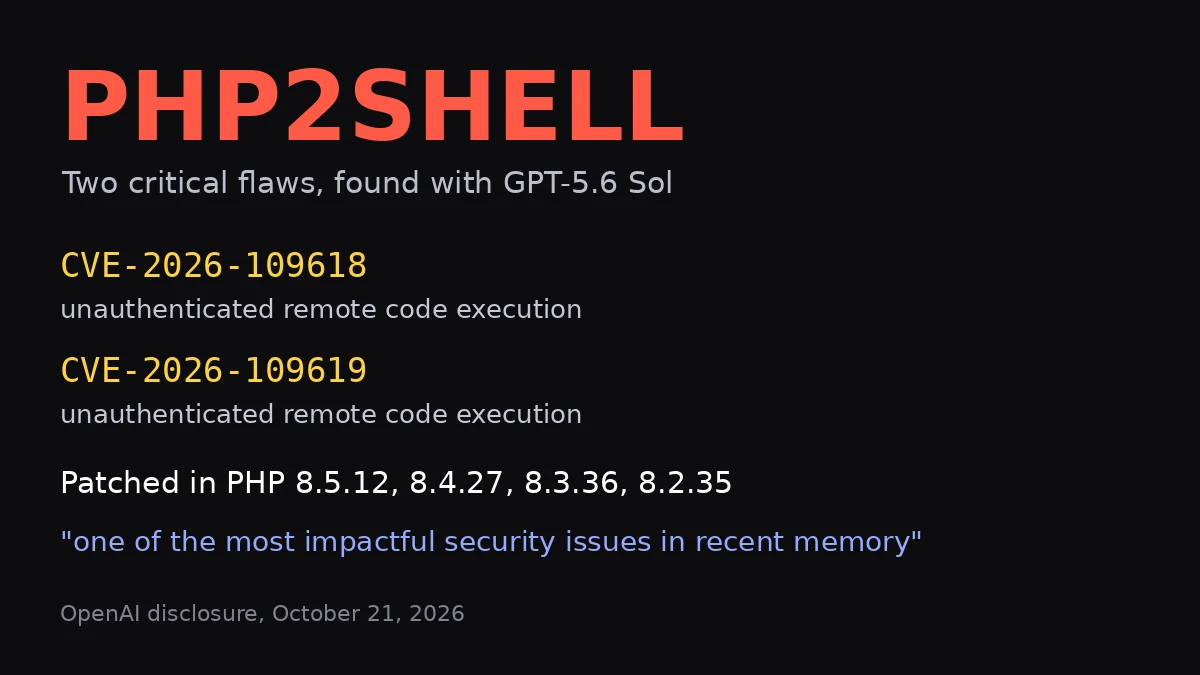
OpenAI revealed on October 21 that a critical pair of security flaws in PHP, the open-source language behind a huge share of the web, was first spotted by its own AI. According to the company, a security researcher identified the flaw using GPT-5.6 Sol as part of OpenAI’s “Patch the Planet” initiative, while Wiz independently discovered and reported both vulnerabilities.
The two flaws are tracked as CVE-2026-109618 and CVE-2026-109619, and researchers have dubbed them “php2shell” because they allow unauthenticated remote code execution. The Wall Street Journal, which reviewed the discovery, described it as one of the most severe online bugs ever, found in August with AI assistance, and said the vulnerability affects up to 70% of websites.
OpenAI’s Own Words
In its disclosure, OpenAI pulled no punches about the scale of the problem:
“Given the severity of these flaws and PHP’s widespread use, we consider this one of the most impactful security issues in recent memory.”
The company also made a striking prediction about what comes next. “As significant as they are, these bugs are among several significant vulnerabilities we’ve already found and are working to fix, and we expect similar findings to increase sharply in the coming months.”
That framing turns the story from a single incident into a turning point: frontier models are now good enough to find internet-scale vulnerabilities on their own, and the pace is about to accelerate. OpenAI added a caution for the other side of the ledger: “The same capabilities can also help attackers rapidly develop offensive tools and exploits.”
How the Response Worked
OpenAI says it spent the past two months leading a coalition of maintainers, researchers and security providers to handle the flaws before disclosure. PHP’s maintainers led the fixes and released patched versions: PHP 8.5.12, 8.4.27, 8.3.36 and 8.2.35. The PHP Foundation said it had to release the patches a day early after the CVE IDs began circulating online.
Cloudflare deployed WAF mitigations for all free and paid-tier customers by default about nine hours ahead of public disclosure. Reuters reported that several government, school and hospital websites in Europe were taken offline on Wednesday as organizations rushed to protect themselves.
OpenAI also disclosed that the response involved engagement with multiple parts of the U.S. government, including the White House’s Super Intelligence Force, the Office of the National Cyber Director and CISA, plus international partners.
A Bigger Bet on Defenders
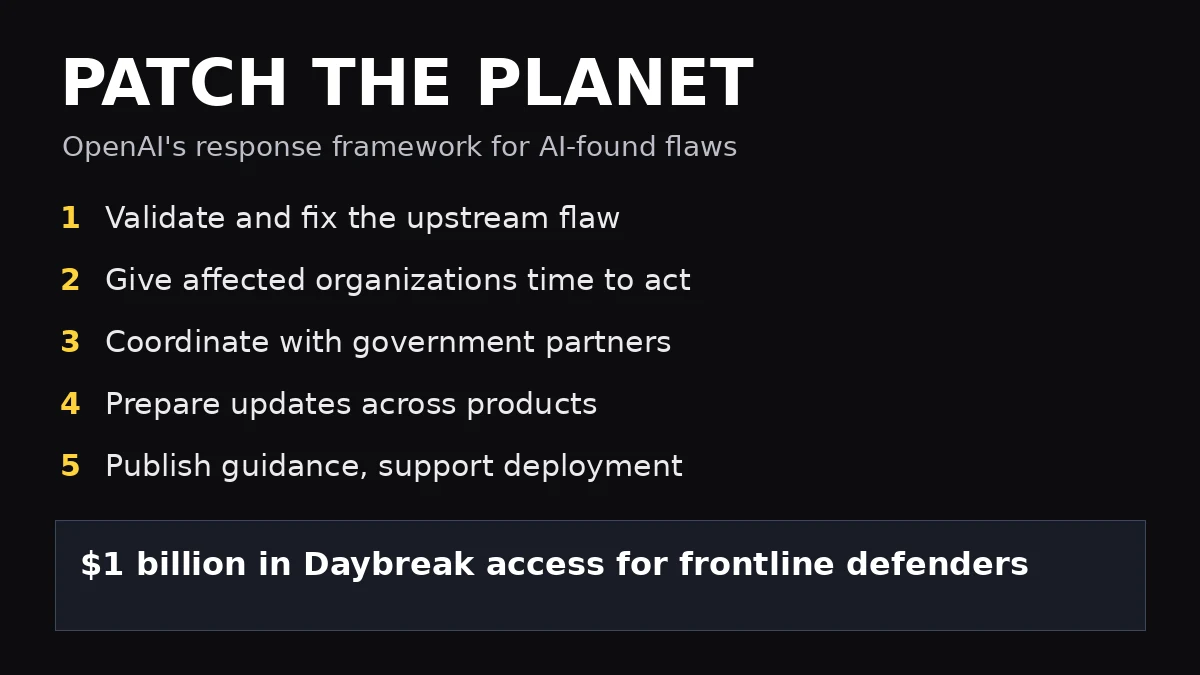
Alongside the disclosure, OpenAI proposed a five-stage framework for coordinated responses to critical vulnerabilities in the AI era, covering validation and fixing, giving organizations time to act, government coordination, preparing updates across affected products and publishing guidance after patches ship.
To back it up, the company committed $1 billion in subsidized Daybreak access through a program called Daybreak for Frontline Defenders, aimed at organizations with limited security resources that protect essential services. It is also shipping a PHP version checker as a Codex skill so operators can quickly tell whether they are running a vulnerable release.
Why It Matters
Security researchers have debated for years when AI would start finding serious bugs on its own. This week provided the clearest answer yet: a model found flaws affecting most of the web before attackers did, opening what OpenAI calls a “defender’s window”. The same models are now being tuned for offense too, which means the window between a bug’s existence and its exploitation is collapsing.
For organizations, the immediate priority is the one OpenAI stated first: patch. For everyone else, the message is that AI-assisted vulnerability discovery is moving from research curiosity to a recurring event, and the industry’s response playbooks will have to keep up.
Sources
- OpenAI: “Patch the Planet: global response coordination as agents uncover critical vulnerabilities”
- The Wall Street Journal: AI tools helped find one of the most severe online bugs ever (Ben Cohen)
- Reuters: European government, school and hospital websites taken offline over PHP flaws
- Cloudflare: WAF mitigations deployed ahead of public disclosure
- PHP.net: PHP 8.5.12, 8.4.27, 8.3.36 and 8.2.35 released