Nvidia has verbally told its cloud computing clients that at least 51% of their services must go to companies that are not Chinese, the Financial Times reported on Tuesday, citing people with knowledge of the matter. The instruction, which Reuters carried but said it could not immediately verify independently, would impose a new majority rule on the businesses that rent out Nvidia’s AI hardware over the internet.
The report lands amid a broader compliance crackdown aimed at keeping advanced AI chips from reaching Chinese entities through side doors. It is the latest sign that Washington’s export-control pressure is pushing from chip sales themselves into the cloud capacity built on top of them.
What Nvidia Is Reportedly Asking
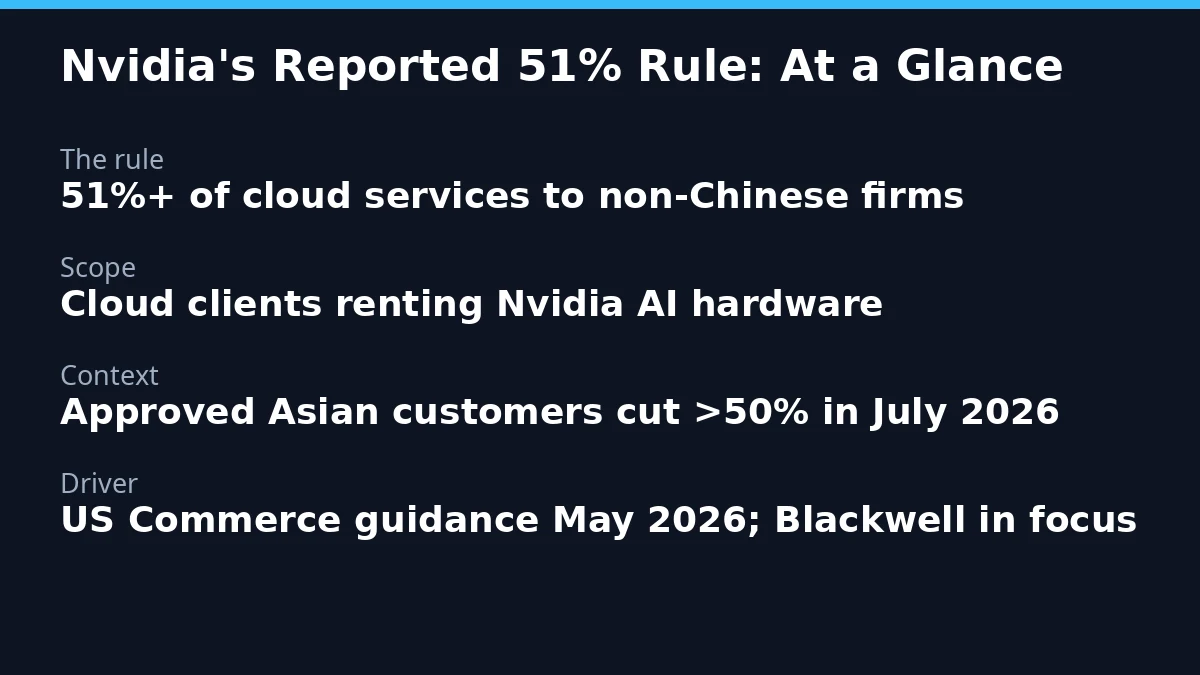
The core requirement sets a floor: a majority of a cloud client’s services must be sold to non-Chinese companies. The 51% threshold matters because it targets a specific gap in export rules. A chip can stay physically outside China while its computing power is rented out to Chinese firms over the internet, and the rule is a direct attempt to put limits on that arrangement without banning Chinese customers from overseas cloud capacity outright.
According to Crypto Briefing’s account of the FT report, the verbal instruction is one of several steps Nvidia has taken to tighten oversight of customers in Asia.

A Widening Compliance Crackdown
The reported instruction follows a series of escalating measures. In July 2026, Nvidia cut its list of approved Asian customers by more than 50%, a move that hit so-called neoclouds in Singapore, Malaysia and Japan especially hard. The company has also modified its revenue reporting for fiscal 2026 to better reflect where its customers are actually located.
These steps follow guidance from the US Commerce Department issued in May 2026 aimed at curbing the diversion of advanced technology to China. The chips most in focus are Nvidia’s Blackwell-series processors, which the effort targets to prevent access by Chinese intermediaries operating elsewhere in Asia. Chinese tech giants such as Tencent and Alibaba are reportedly obtaining hardware through overseas arrangements described as legally compliant, the kind of channel the 51% threshold is designed to constrain.
Why It Matters
The cloud layer has become the soft underbelly of AI chip export controls. Export rules were written for physical goods, but the fastest-growing way to consume AI compute is to rent it remotely, which makes customer mix, not shipping manifests, the decisive compliance question. A majority-non-Chinese rule turns that mix into a contractual obligation for the providers closest to the hardware.
For neoclouds in Southeast Asia and Japan, whose business models were built in part on serving regional demand with Nvidia’s most sought-after chips, the rule could force a painful reshuffling of customer lists. For the broader market, it signals that compliance pressure is moving up the stack, from who may buy a chip to who may rent time on one.
Two caveats apply. The Financial Times cited anonymous people with knowledge of the matter, and Reuters explicitly said it could not immediately verify the report. No public statement from Nvidia on the instruction has been reported. As with any single-sourced report, the details, including how Nvidia defines a non-Chinese client and how the threshold would be measured or enforced, remain unclear.
Sources
- Reuters, “Nvidia orders data centre clients to reduce China exposure, FT reports”, November 3, 2026
- Crypto Briefing, “Nvidia tells cloud clients to sell at least 51% of services to non-Chinese firms”, November 3, 2026
- Techmeme, “Sources: Nvidia verbally told cloud compute clients to sell 51%+ of their services to non-Chinese companies”, November 3, 2026