Notra helps marketing teams see whether AI assistants recommend their brand when potential customers ask relevant questions. It brings answer tracking, competitor comparisons, AI traffic analytics, and content planning into one workspace. The practical starting point is a set of buyer questions: what does each engine answer, which products appear, and what sources support those recommendations?
This overview covers Notra’s published features and pricing, checked on October 27, 2026. It is based on official documentation rather than a hands-on performance test.
What is Notra?
Notra is a generative engine optimization, or GEO, platform. Teams can track prompts across AI engines, inspect the complete answers, and compare mentions, recommendation positions, and share of voice. Competitor tracking helps identify questions where another company appears and yours does not.
The content workflow connects those gaps to proposed articles. Notra can prepare a brief using brand information, a sitemap, and tracked competitors, then produce a draft after approval. This gives content teams a research starting point, but an appearance in the dashboard does not establish that an article will improve future recommendations.
What changed recently?
Notra announced its Composio integration on October 21, 2026. The integration lets supported assistants and custom agents access Notra through one connected account. The company lists 110 tools covering visibility scans, competitor analysis, content gaps, briefs, and related workflows.
A separate October 19 update added coding-agent recommendations to its GEO scans. Notra says it runs sessions with Claude Code, Codex, OpenCode, and Cursor, then records whether a product appears and what is recommended instead. This is particularly relevant to developer-tool companies evaluating how agents discover packages and services. The company labels its fx.sh engine experimental.
Notra pricing and plan limits
The official pricing page distinguishes free traffic analytics from paid answer tracking. Prices below are in US dollars, as checked on October 27, 2026.
| Plan | Monthly price | Included capacity (answers and events per month) |
|---|---|---|
| Free | $0 | 1 million AI traffic events per month and agent feedback |
| Starter | $100 | 2,000 AI answers, 5 million traffic events, 1 project |
| Growth | $250 | 6,000 AI answers, 15 million traffic events, 3 projects |
| Scale | $550 | 12,000 AI answers, 30 million traffic events, 10 projects |
| Enterprise | Custom | Contact Notra for requirements and pricing |
Annual prices are $1,000 for Starter, $2,500 for Growth, and $5,500 for Scale. Starter also includes eight image generations and ten long-form posts per month. Higher plans increase these allowances.
One tracked answer represents a prompt answered by one model in one scan. For example, ten prompts across three models, scanned daily for 30 days, use 900 answers before additional language or conversation runs. Optional zero data retention adds 20% to Starter, Growth, and Scale; Enterprise includes it.
Who might find it useful?
- Content and SEO teams: compare the questions they want to answer with the sources AI engines currently cite.
- Startup marketers: follow a focused set of buyer questions and review how competitors are described.
- Developer-tool companies: examine whether coding agents select their package or an alternative.
- Agencies: separate projects by client while budgeting for scan volume and project limits.
It is less compelling for someone who only needs occasional writing assistance. The paid entry point makes more sense when recurring visibility research is an established part of the marketing workflow.
How to approach a first evaluation
- Choose a small question set. Start with genuine use cases, alternatives, and comparisons that matter to buyers. Avoid measuring only your brand name.
- Select engines and scan frequency. Estimate monthly answer use before enabling more models or languages.
- Inspect the underlying answers. Read the wording and citations behind a score. Check whether a mention is relevant and whether competitors are being compared fairly.
- Review a content brief. Choose one meaningful gap, check the proposed angle, and verify sources and citations before publishing a generated draft.
- Recheck over time. Treat changing answers as observations to investigate, rather than proof that one edit caused a ranking change.
Important limitations
AI traffic analytics and answer tracking measure different things. A crawler visiting a page is not evidence that an assistant cited it or that a customer clicked through. Notra separates these categories, and reports should preserve that distinction.
Traffic measurement also requires website integration, such as installing the supported SDK as middleware or a proxy. Agent integrations need appropriately scoped access: Notra warns that some tools consume credits or perform irreversible actions.
For a preliminary interface review, Notra offers a public demo with fictional data and simulated model responses. It can illustrate the workflow, but cannot demonstrate real AI answer quality. For an actual evaluation, use a small, controlled project and review the evidence behind each result.
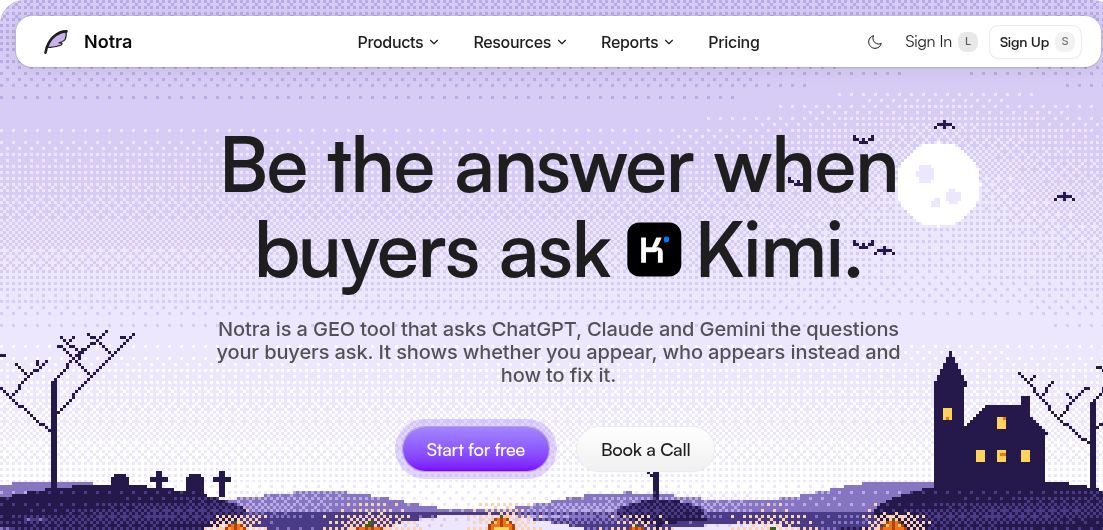
Featured image: screenshot of Notra’s official public website, captured October 27, 2026. It illustrates the website, not a hands-on product test.