Microsoft offered voluntary buyouts to about 60,000 employees on Monday, more than a quarter of its global workforce, as the software giant moves to cut costs while pouring billions into artificial intelligence infrastructure. The Microsoft buyouts cover roughly 27% of the company’s 223,000 employees and arrive just days before Microsoft reports quarterly earnings.
The offer, first reported by Bloomberg and confirmed by a Microsoft spokesperson, went out in a memo from Chief People Officer Amy Coleman. “This offer gives eligible employees who may be considering a future outside the company a new choice to make that transition now with support,” Coleman wrote, according to the Daily Caller. “The Voluntary Exit Offer reflects an important part of how we’re evolving our approach to change,” she added in the memo, which was reported by Engadget.
Who Gets the Offer
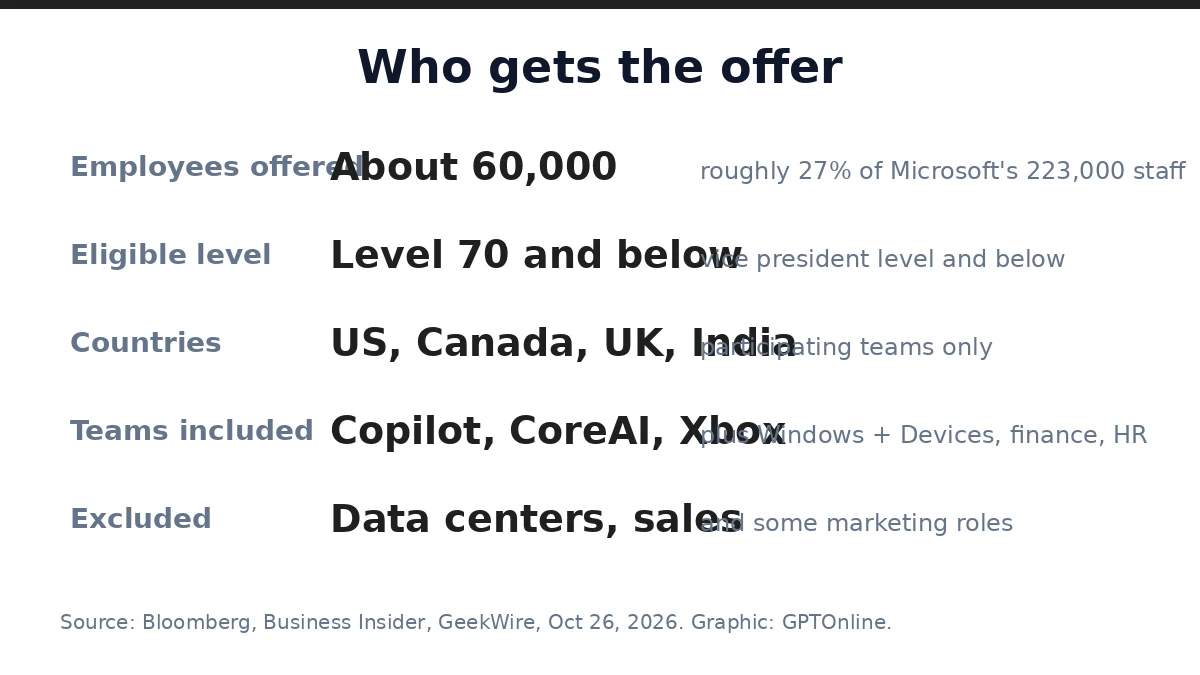
Who gets the offer: about 60,000 employees, roughly 27% of Microsoft’s workforce. Graphic: GPTOnline. Data: Bloomberg, Business Insider, GeekWire.
The buyouts are open to employees at level 70 and below, meaning vice president level and below, on participating teams in the United States, Canada, the United Kingdom and India. Teams receiving the offer include AI experiences, Copilot and CoreAI, along with Windows and Devices, Xbox, finance and HR, with partial inclusion for Cloud and AI and for legal and corporate affairs teams, according to Bloomberg’s reporting.
Not everyone is eligible. Employees working in data centers are excluded, as are sales and some marketing roles. Microsoft said eligibility varies by business priorities, customer commitments and workforce needs, and the company has not said how many of the 60,000 it expects to accept. Employees have until the first week of December to decide, according to GeekWire, and those who accept are expected to leave by December 31. US employees who take the offer will get at least eight weeks’ pay, a Microsoft spokesperson told the New York Post, with benefits similar to the company’s standard severance package.
The AI Spending Behind the Cuts
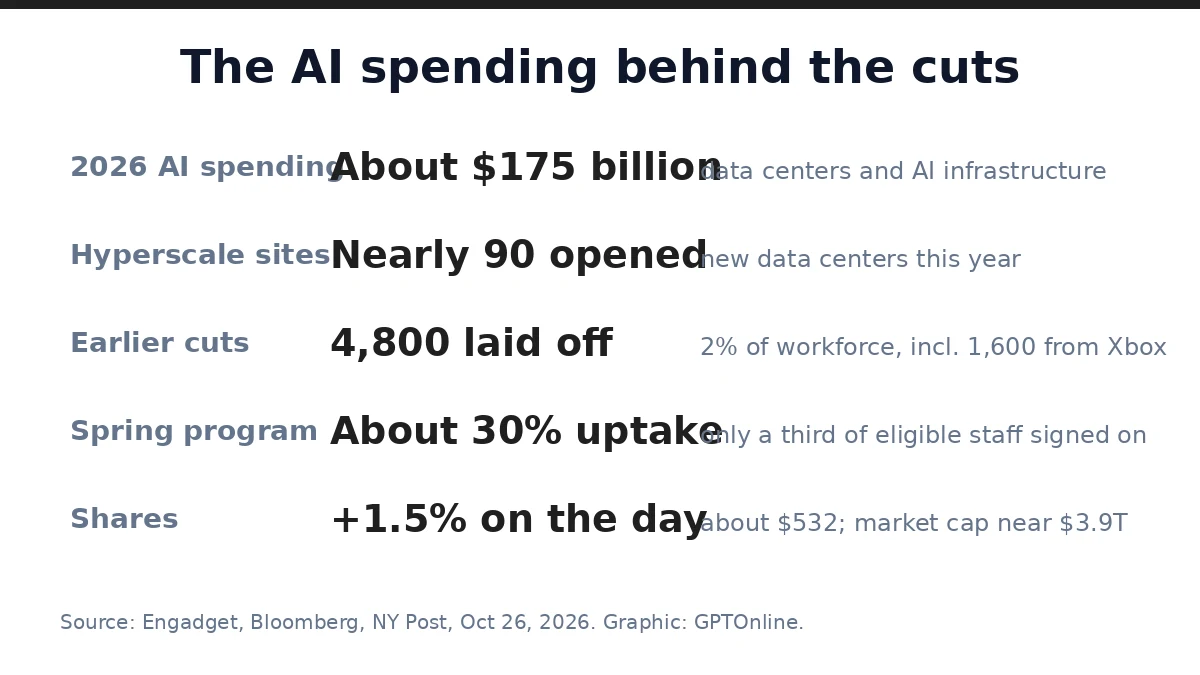
The AI spending behind the cuts: nearly $175 billion in 2026. Graphic: GPTOnline. Data: Engadget, Bloomberg, NY Post.
The buyouts are part of a wider effort to reshape Microsoft’s workforce for the AI era while it spends at a historic pace on the infrastructure that powers it. Microsoft is spending nearly $175 billion on data centers and AI infrastructure in 2026 alone, according to Engadget, and has opened nearly 90 hyperscale data centers this year. The company has said the buildout is needed to train and run increasingly capable models, including its Copilot assistants and the Azure AI services sold to other companies.
That spending is colliding with investor demands for proof that AI investment pays. Microsoft’s shares rose 1.5% on the day of the announcement, to about $532, with the company valued near $3.9 trillion. The buyout program signals management is front-loading cost discipline before investors scrutinize AI returns in the earnings report, a framing echoed by market analysts covering the announcement.
Microsoft has been trimming its workforce for two years. In April it offered a voluntary retirement program that cut about 2,600 roles, and it later laid off about 4,800 employees, or 2% of its workforce, including 1,600 from Xbox. Last year it cut 9,000 jobs. The spring retirement program drew only about 30% of eligible employees, a sign that uptake is far from guaranteed this time: the 60,000 figure counts people offered the choice, not people leaving.
Why It Matters
Microsoft is the clearest example of the tension now running through big tech: companies are spending more than ever on AI while asking whether they need as many people to run the rest of the business. The buyouts touch the very teams building Microsoft’s AI products, including Copilot and CoreAI, which suggests the goal is not to shrink AI work but to reallocate headcount and budget toward it. For employees, the offer is a choice with a deadline. For investors, it is a test of whether Microsoft can keep AI spending high while holding the line on costs. And for the wider industry, where rivals from Meta to Amazon are making similar trade-offs, Microsoft’s move is the largest single workforce reset of the AI boom so far. What happens next depends on how many of the 60,000 say yes.
Sources
- Engadget: Microsoft reportedly offers voluntary buyouts to 60,000 employees as an attempt to trim costs
- New York Post: Microsoft announces buyouts for 60K employees, quarter of workforce, as part of AI transformation
- Daily Caller: Microsoft Offers Buyouts To 60,000 Employees As AI Spending Soars
- Quantli: Microsoft Offers Buyouts to 60,000 Employees Pre-Earnings (summarizing Bloomberg)