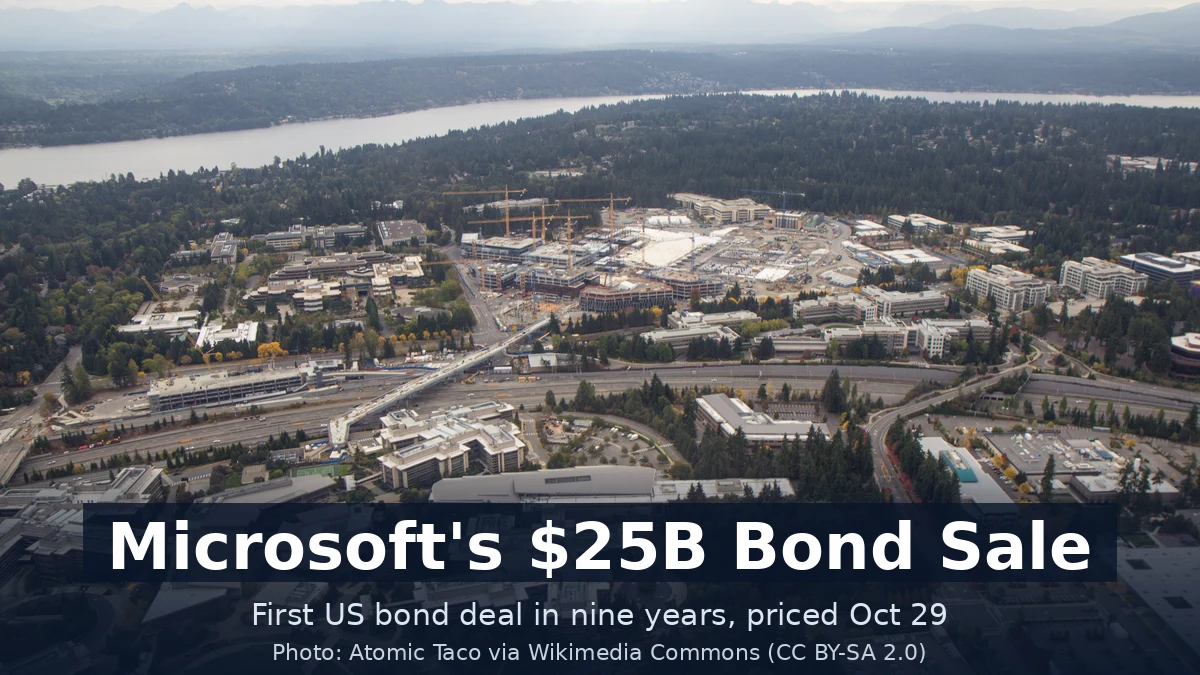
Microsoft is back in the bond market in a big way. The company’s Microsoft $25B Bond Sale, priced on October 29, targets at least $25 billion across as many as 10 tranches, its first US investment-grade bond offering in more than nine years. Investor demand has been fierce: order books reportedly topped $115 billion, more than four times the amount on offer, a sign that the market’s appetite for AI infrastructure debt is alive and well for the right borrower.
The offering was confirmed by Microsoft in a regulatory filing on October 29, one day after the company reported fiscal first-quarter earnings, according to Finimize, citing Reuters and Bloomberg reporting.
What Was Announced?
The sale spans up to 10 tranches of senior unsecured notes, with maturities ranging from two to 40 years, meaning notes due from 2028 to 2066, according to Morningstar/MarketWatch, citing Informa Global Markets data. Two tranches carry floating interest rates and eight carry fixed rates, per the preliminary prospectus described by WinBuzzer. Wells Fargo, JPMorgan Chase and UBS are running the deal as bookrunners. The offering is expected to close on November 4, according to TechStartups.
The last time Microsoft sold US investment-grade bonds was in 2017, when it raised $17 billion. The stated uses of proceeds are broad, covering working capital, capital expenditure, share repurchases, acquisitions and repayment of existing debt, which means the full $25 billion is not formally earmarked for data centers alone. But the timing, one day after Microsoft outlined plans for roughly $175 billion in calendar 2026 capital spending including finance leases, leaves little doubt about the main destination of the money.
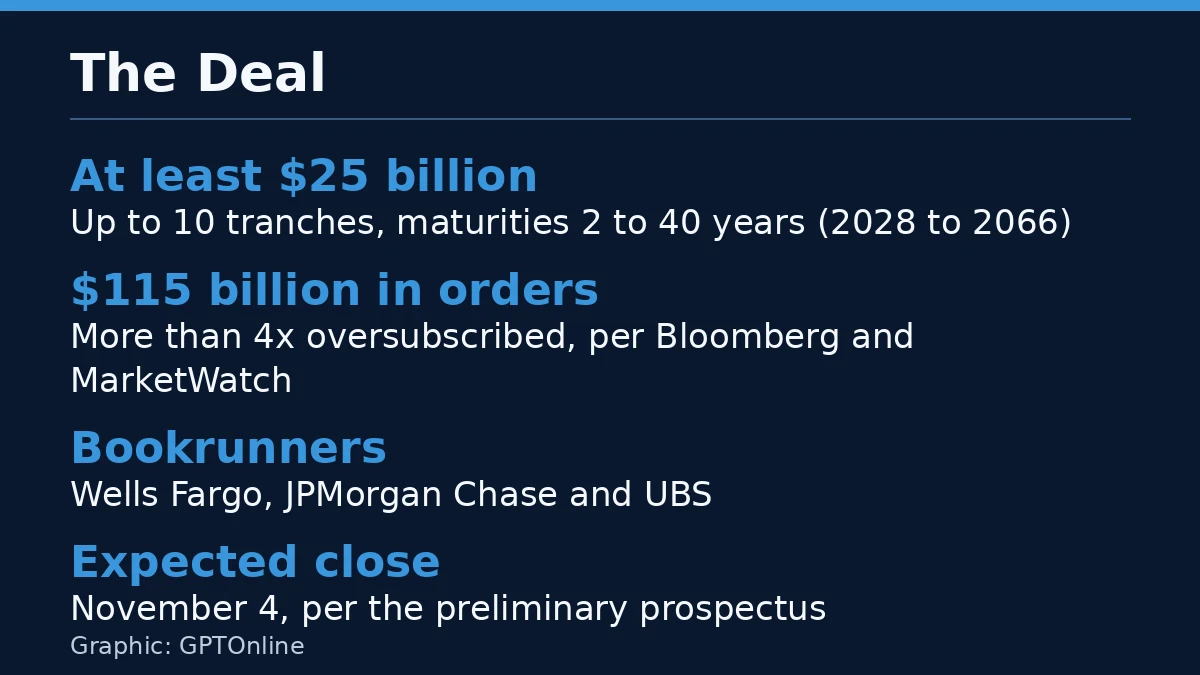
The deal: Microsoft’s $25B bond sale at a glance. Graphic: GPTOnline
Why Now: AI Spending Meets a Picky Bond Market
Chief Financial Officer Amy Hood telegraphed the move on the company’s October 28 earnings call: “We’re fortunate to have access in the debt markets, given where our ratings are. We feel like we have lots of options to be able to tap the financing markets when they make sense and they’re attractive,” she said, per MarketWatch.
Microsoft’s September quarter showed why it can borrow cheaply. Revenue reached $92.28 billion, up 19 percent from a year earlier, while Azure revenue grew 48 percent. The company holds AAA credit ratings from Moody’s and S&P Global, one of the few corporations in the world that does, which lets it borrow at spreads unavailable to lower-rated cloud operators.
The backdrop is a credit market that has grown choosy about AI debt. The 10-year Treasury yield has hit a 24-year high in recent weeks, and bonds of neocloud CoreWeave sold off sharply, with its 2032 notes hitting a 15.3 percent yield before recovering to about 14.2 percent on Thursday, according to MarketAxess data cited by MarketWatch. Spreads on the riskiest junk bonds have blown out. Against that, Microsoft’s deal was the first highly rated hyperscaler bond sale since August and the first US investment-grade corporate financing since Blackstone-backed QTS Realty Trust raised $3.9 billion on August 18, per BofA Global data.
The Haves and the Have-Nots
Analysts say the deal underscores a growing split in how markets fund the AI buildout. “There’s a bifurcating in this AI trade, just like there’s been a bifurcating of consumers and the housing market,” said Byron Anderson, a portfolio manager and head of fixed income at Laffer Tengler Investments. “Everything is the haves and have-nots.”
The numbers explain the urgency. Industry estimates put the capital expenditure needed to build enough data centers for AI models at some $1 trillion in each of the next few years. Investment-grade bond issuance by hyperscalers has already exceeded $313 billion this year, nearly triple the total for all of last year, according to figures cited by The Korea Herald’s business desk. Alphabet and SpaceX both tapped debt markets around August as well.
Other giants are choosing different routes. Meta is raising equity instead, with its $37.5 billion financing program now closing its first phase (see our coverage of Meta’s $37.5B financing close), while Oracle has told investors it will cap new AI funding at $20 billion and lean on customers to place their own hardware in its data centers (see our report on Oracle’s funding cap).
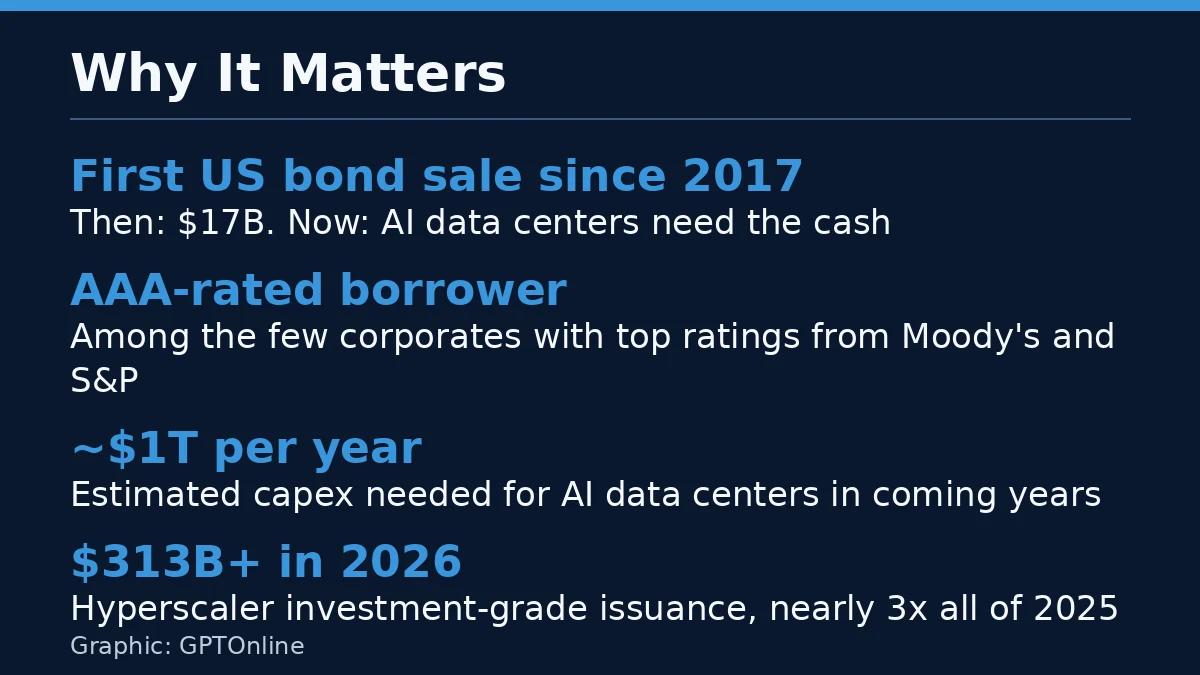
Why Microsoft’s return to the bond market matters. Graphic: GPTOnline
What It Means
Tigress Financial analyst Ivan Feinseth called the offering a “positive development” that will help Microsoft accelerate revenue growth, saying the company is “taking advantage of its AAA credit rating to secure long-term capital, preserve liquidity and accelerate investments in data centers, cloud capacity and AI infrastructure.”
If the bonds price smoothly, the deal could reset the bar for the next wave of AI-related issuance. “As long as capex continues to ramp, I’d expect a hunger for more financing,” said Joseph Bonner, an analyst at Argus Research. Feinseth added that Microsoft’s move could help reopen the market for more hyperscaler debt offerings, while warning that lower-rated borrowers could struggle to raise additional capital as investors grow more selective.
For now, the message from the order book is clear: in the great AI funding race, the strongest balance sheets still get funded first.
Sources
- MarketWatch via Morningstar: Microsoft to raise up to $25 billion in bond market
- Finimize: Microsoft Preps Its First US Bond Deal In Nine Years
- WinBuzzer: Microsoft Seeks at Least $25 Billion in US Bond Sale
- TechStartups: Microsoft to raise $25 billion in debt to fund AI expansion
- The Herald Business: Microsoft issues $25b in bonds for first time in 9 years