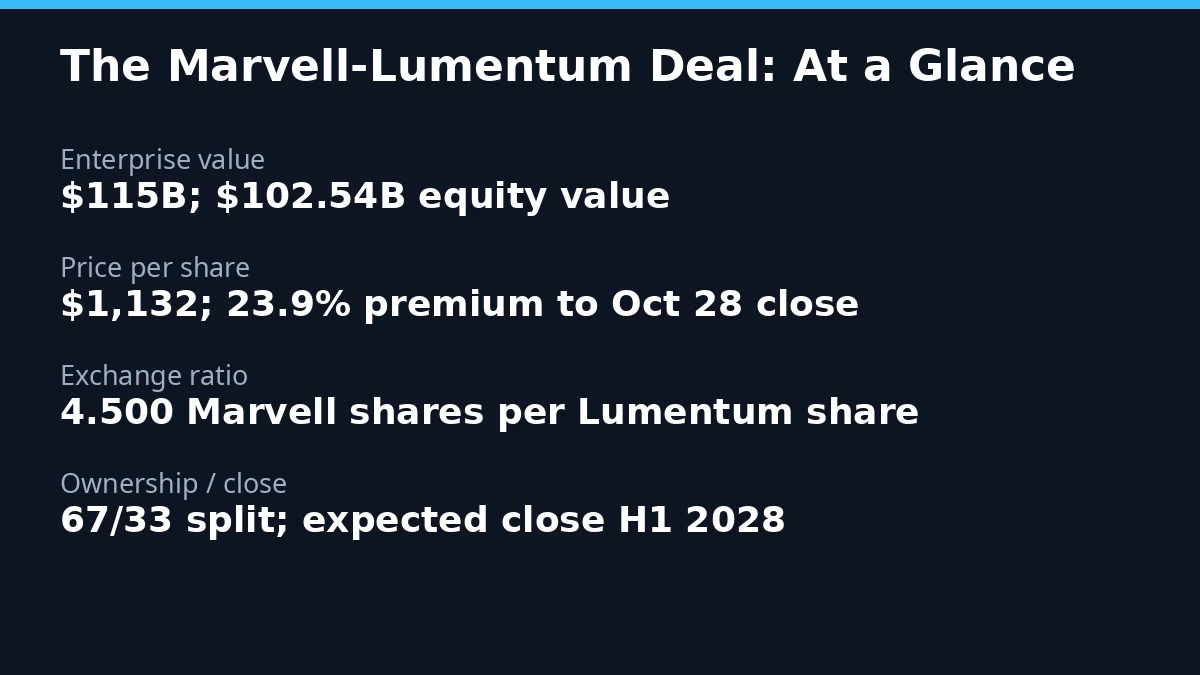
Marvell Technology will acquire optical components maker Lumentum in an all-stock transaction valued at $115 billion, the companies announced on Monday, November 2, 2026. The deal, one of the largest in the semiconductor industry on record, is a wager that the wiring inside AI data centers is moving from copper to light, and that the company best positioned to profit will be the one that designs both sides of that connection.
The transaction carries an implied enterprise value of $115 billion for Lumentum, or about $1,132 per share, a 23.9% premium to Lumentum’s unaffected closing price on October 28, the last trading day before reports of the deal talks surfaced. The equity value of the deal is about $102.54 billion, according to Reuters’ reporting on the announcement.
Under the terms, Lumentum shareholders will receive a fixed exchange ratio of 4.500 Marvell shares for each Lumentum share they own. After closing, current Marvell shareholders will own approximately 67% of the combined company on a fully diluted basis, with Lumentum shareholders holding the remaining 33%.
What Was Announced
The definitive agreement was unanimously approved by both companies’ boards, according to the companies’ joint statement. The deal is expected to close in the first half of calendar 2028, subject to approval by both companies’ stockholders, receipt of regulatory approvals, and other customary closing conditions.
Marvell chairman and chief executive Matt Murphy will continue to lead the combined company, and three Lumentum directors, including Lumentum chief executive Michael Hurlston, will join Marvell’s board, expanding it from seven to ten members.
The companies said the combination should expand the combined company’s total addressable market to $550 billion, generate more than $1 billion in annual run-rate cost synergies, and be accretive to Marvell’s non-GAAP earnings per share in the first full year after closing. Those figures are the companies’ own expectations, not guaranteed outcomes.
Why It Matters
“AI infrastructure is undergoing a fundamental architectural shift toward optical connectivity, creating an opportunity that comes along once in a generation,” Murphy said in the companies’ announcement.
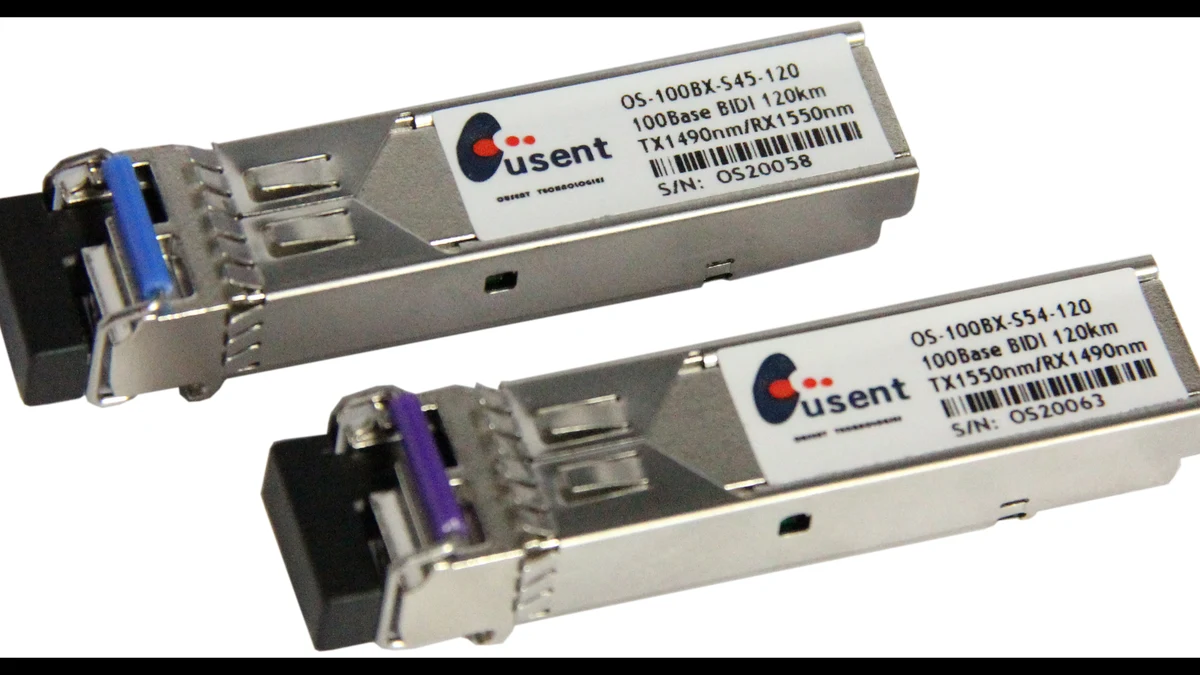
The logic is physical. As AI training clusters grow to tens of thousands of accelerators, the copper cables that carry data between chips and racks are hitting their bandwidth and power limits. Lumentum makes the lasers, optical transceivers, and optical circuit switching gear that replace those copper links with light. Marvell designs the custom chips, network switches, and interconnect silicon that drive them. Put together, one company can co-design the electrical and optical sides of the signal chain, from inside the semiconductor package out to distributed data centers.
The deal also sharpens Marvell’s rivalry with Broadcom, the longtime leader in custom AI chips and networking for hyperscalers. Reuters noted that just three years ago Marvell was a relatively little-known chipmaker; its market value has since climbed past $170 billion on the back of custom AI chip work for customers including Amazon.
Marvell has been building its photonics position all year. It closed a $3.5 billion acquisition of Celestial AI in February, and in August it signed a deal to supply chips that sit alongside Google’s AI processors, an agreement Reuters valued at up to $120 billion in sales through fiscal 2033, with an option for Google to buy a $12.2 billion stake.
The Market Reaction and the Risks
Investors did not greet the deal with applause. Marvell shares fell about 12.7% on Monday as shareholders balked at the dilution and the price paid, and both stocks have slid since the talks were first reported on October 28 amid a broader chip selloff following Intel’s weak forecast.
The all-stock structure means no new debt financing, but it also means the deal’s dollar value will move with Marvell’s share price until closing, a date that is not guaranteed. Regulatory reviews are expected in multiple jurisdictions, and Marvell could face a $5.8 billion termination payment in certain circumstances if the deal falls apart, with Lumentum facing a $2.9 billion payment in comparable cases, according to regulatory details reported by PYMNTS.
One tailwind: Lumentum competes with US-listed Coherent and China’s Zhongji Innolight, and a proposed US ban on new Chinese optical transceivers could shift demand toward domestic suppliers, Reuters reported.