Updated October 31, 2026
Hexstrike AI is a security-tool integration project, not a substitute for an authorized security professional. This overview reviews its public documentation, not a working installation or the results of a security assessment.
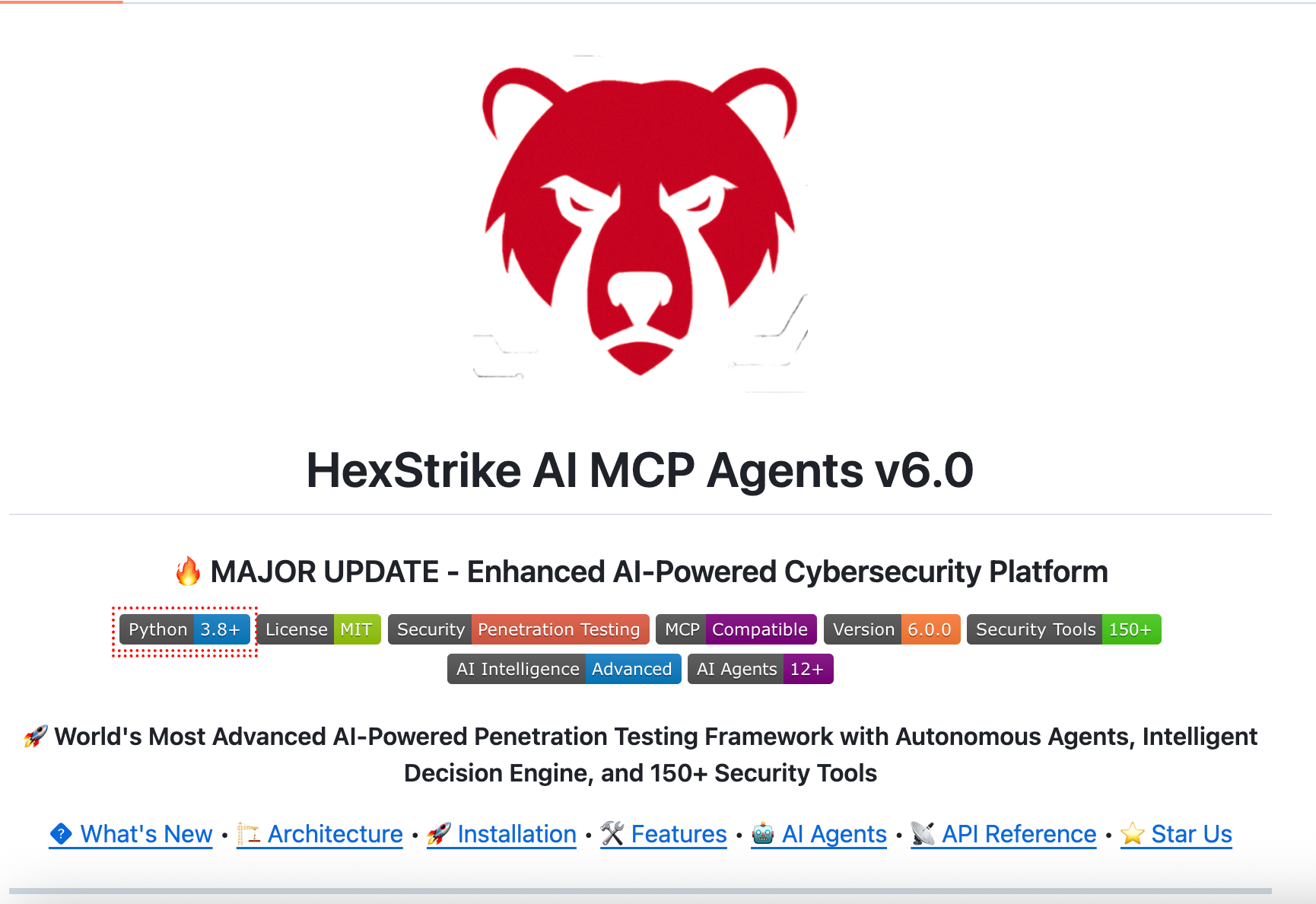
Image context: The retained repository-header screenshot has an unknown original capture date. Its version, tool-count and agent-count badges are historical project statements, and its superlative marketing is not an independent ranking. It does not show a test performed for this review.
| Name | Hexstrike AI |
| Overview | Hexstrike AI connects AI clients to security tools through an MCP server. MCP means Model Context Protocol, not Multi-Agent Command Protocol. The public README describes v6.0 and advertises integrations with 150+ tools and 12+ agents; these are the project’s stated counts, not independently verified coverage or performance measurements. |
| Key features & benefits |
|
| Use cases and applications | Potential uses include authorized security assessments, research on owned systems, CTF learning and work within a bug-bounty program’s explicit scope. These are not permission to investigate unrelated systems. For a defensive evaluation, define the approved environment, responsible reviewer and reporting criteria before considering any automation. |
| Who uses? | Potential audiences include security researchers, AI integration developers, CTF teams and organizational security teams evaluating controlled workflows. It is not presented here as a beginner-friendly substitute for understanding tool permissions, system access and assessment boundaries. |
| Pricing | The repository’s software is offered under the MIT license, rather than a verified hosted subscription plan. The license permits use and redistribution subject to its notice requirements and provides no warranty. Running an evaluation can involve separate model/API, infrastructure and third-party tool costs; the software license does not make those services free or replace their terms. |
| Tags | AI, cybersecurity, Model Context Protocol, security research, authorized testing, automation, self-hosted software. |
| App available? | The documented format is server software connected to an AI client. This review did not verify a standalone mobile app, install the project or test the availability of any advertised dashboard. Check compatibility for the particular client and environment rather than assuming every integration works. |
A defensive evaluation example
A security team considering the project for an internal training lab could first write a review brief: use only a company-owned disposable environment with synthetic records, define which activities are authorized, and require a named reviewer to validate any reported issue. The useful output of that planning exercise is a scope and evidence checklist, not a promise that AI will discover vulnerabilities. This is an illustrative evaluation scenario, not a test we performed.
Permissions, privacy and reliability
The README warns that connected agents can obtain powerful system access and calls for isolation, oversight and written authorization. Keep credentials, customer records and confidential assessment material out of an evaluation unless their handling has been approved. Self-hosting alone does not establish that information stays on the host: review the selected AI client’s data flow, model-provider policies, logs and retention settings separately.
Do not treat an AI-generated finding as a confirmed vulnerability, or the absence of findings as proof that a system is secure. Qualified human review and the applicable assessment scope remain essential. This article provides no exploitation instructions and makes no claim about detection rates, uptime, speed or production readiness.
Sources and review limits
Sources reviewed on October 31, 2026: the official repository and README, its MIT license, and the protocol organization’s archived MCP introduction, used to confirm the acronym rather than current client compatibility. No software was cloned, installed or executed, and no system was scanned.