Updated on October 20, 2026.
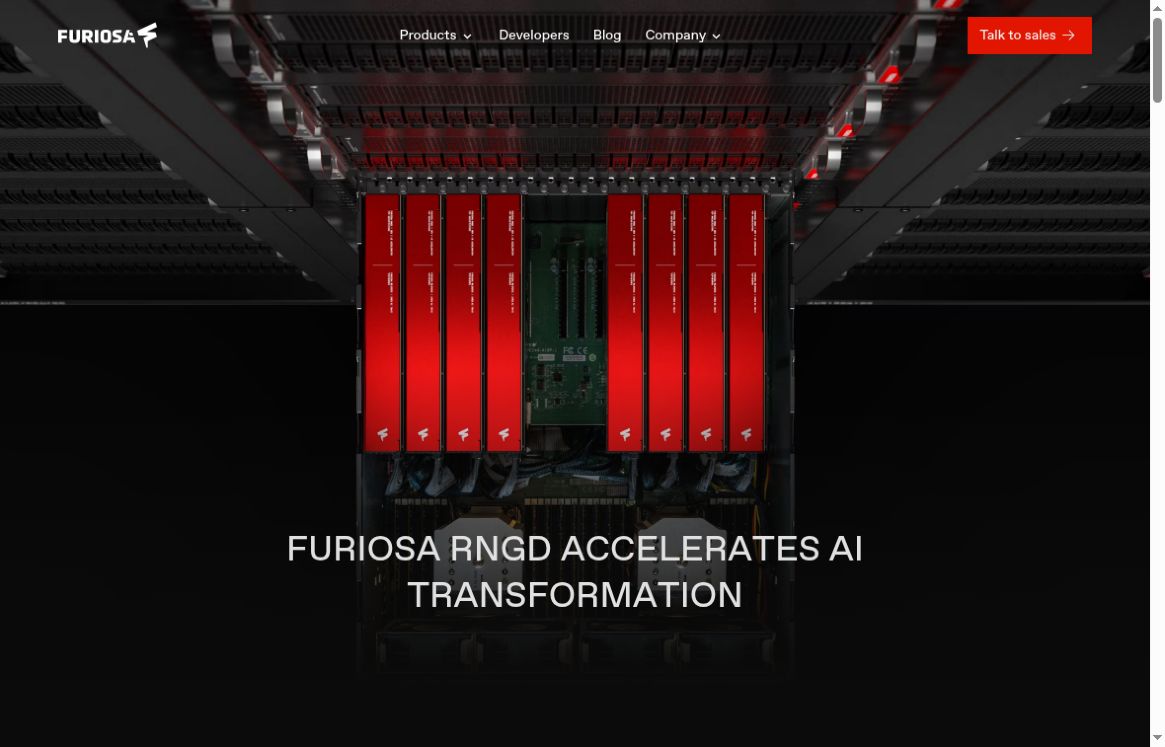
Featured image: screenshot of Furiosa’s official homepage, captured October 20, 2026. Vendor presentation, not an independent hardware benchmark.
FuriosaAI builds processors and software for AI inference. Its current offering centers on the RNGD accelerator and NXT RNGD server for organizations deploying models in data centers. It is infrastructure for developers and operators, rather than a consumer chatbot subscription.
From WARBOY to RNGD
The company began research and development in Seoul in 2017. Its earlier generation focused on vision inference, with a 14nm chip launched in 2021 and volume production in 2023. That history remains relevant to older WARBOY references, but the previous description of the 5nm generation as merely “upcoming” is outdated: FuriosaAI’s timeline records RNGD’s unveiling in 2024, sampling in 2025, and mass production in 2026.
Current hardware
- RNGD PCIe card: the vendor lists 48 GB HBM3 memory, 1.5 TB/s memory bandwidth, 256 MB on-chip SRAM, peak FP8 performance of 512 TFLOPS, and 180 W TDP.
- NXT RNGD server: the published configuration combines eight RNGD accelerators, 384 GB total accelerator memory, and a 3,000 W system power specification in an air-cooled 4U rackmount server.
These are manufacturer specifications, not measurements from our own hardware test. Card TDP and whole-server power describe different scopes; neither alone establishes the electricity use or cost of a production workload.
Software and model support
The current Furiosa SDK documentation covers a workflow from PyTorch models through quantization, serving, and deployment. Furiosa-LLM provides an OpenAI-compatible server with chat, completion, response, and embedding APIs, subject to the selected model. Deployment requires the appropriate software prerequisites and a compatible Furiosa Executable Bundle; gated models can have additional access requirements.
The supported-model documentation includes language models, embeddings, rerankers, and vision-language architectures. Examples include Llama, Qwen, EXAONE, and GPT-OSS families. Architecture support is not a promise that every model variant has equal performance: the documentation separately tracks functionality, correctness, and performance validation, with some performance entries still experimental.
Who should evaluate it?
FuriosaAI is relevant to enterprise inference teams, cloud providers, and developers operating model-serving infrastructure. Older generic references to edge systems, autonomous applications, or universal framework compatibility should not replace checking the current hardware and SDK against a specific project.
For an evaluation, use the model, precision, context length, concurrency, and output-quality requirements you actually need. Compare latency and sustained throughput against a GPU-based or managed inference alternative under the same workload. Include host power, support, integration work, and model maintenance in the comparison, rather than relying only on peak arithmetic specifications.
Pricing and access
The reviewed product pages direct buyers to sales rather than publishing a fixed card or server checkout price. FuriosaAI also advertises evaluation access through bare-metal hardware or an OpenAI-compatible endpoint, available worldwide. Ask about eligibility, scheduling, charges, deployment configuration, and support before treating an evaluation as a free trial or a production service.
This is a source-based product overview, not a hands-on benchmark. Sources checked on October 20, 2026: company timeline, RNGD specifications, NXT server and evaluation options, developer documentation, supported models, and server requirements and APIs.