Updated October 15, 2026.
Grok is a conversational AI assistant for research, writing, coding help and creative tasks. It is the product associated with xAI and available at grok.com. Current official pages use SpaceXSI branding, and the consumer terms identify the provider as SpaceXAI LLC. This guide covers that assistant, including its mobile apps and access through X.
Review method: this is a documentation-based guide. We checked official product pages, help documentation and app-store listings. We did not sign in, run prompts, generate media, purchase a subscription or test the API. The example below is fictional.
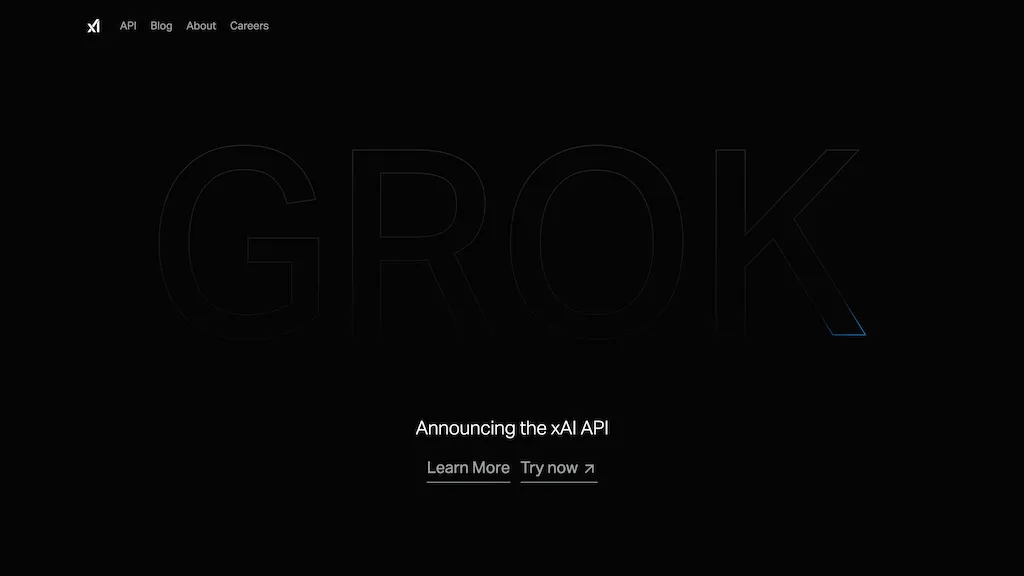
Image context: the featured image is retained from this listing, first published in December 2024. Its xAI API announcement and interface are historical, not a current product screenshot. The capture date is unverified.
Where to use Grok
- Web: start at grok.com. The official app FAQ recommends this address rather than the older grok.x.ai host.
- iPhone and iPad: the official Grok AI App Store listing is free to download with in-app purchases. The US listing names X Corp. as seller and requires iOS or iPadOS 17 or later.
- Android: the official Grok Google Play listing, linked from x.ai, names SpaceXAI and includes in-app purchases. It describes chat, voice, research and media creation.
- Within X: open the Grok entry in X on the web, iOS or Android. X says this access is available where X is available; that statement does not establish identical standalone-app features or billing in every country.
Use those official links to avoid similarly named apps. Check your local store and account for availability. The new subscription’s terms allow geographic restrictions, so an announcement of a global rollout should not be treated as a country-by-country guarantee.
What it can do
The official Grok product page describes these capabilities:
- Search and research: retrieve material from the web and public X posts, with source links for checking claims.
- Writing and coding: develop outlines, revise text, explain code and propose changes.
- Documents and images: summarize files and discuss photos, screenshots or diagrams.
- Voice and media: hold spoken conversations and use Imagine for image or video creation and editing.
These are documented functions, not measured quality results. For research, open the cited page and check the date and supporting passage. For code, review the changes and run tests. For documents, compare extracted numbers with the original. A fluent answer or a detailed explanation is not evidence that the underlying conclusion is correct.
File handling also has practical boundaries. The file FAQ says supported formats and limits vary by platform or subscription; long files may be processed in sections. It warns that images embedded in non-PDF documents may not receive visual analysis and that audio/video transcription quality varies. Start with a small, non-sensitive sample before relying on a larger workflow.
Plans and pricing
Pricing changed shortly before this update. The October 12, 2026 announcement introduced The X Subscription, combining Grok, Cursor and X benefits, with a rollout over the following days. New self-serve pricing should therefore be checked against the live pages rather than an older SuperGrok comparison.
The live pricing page and subscription pricing documentation displayed these individual list prices when checked:
| Plan | Monthly | Annual total |
|---|---|---|
| Free | $0 | $0 |
| Plus | $8 | $80 |
| Premium | $30 | $300 |
| Super | $100 | $1,000 |
| Ultra | $200 | $2,000 |
These are the dollar-denominated figures displayed publicly. The reviewed consumer pages did not explicitly identify the currency code, and we did not verify a localized checkout total. The pricing page excludes applicable taxes and fees. Annual totals are yearly charges, not monthly prices. Confirm currency, tax, renewal amount and included features before paying.
The live page describes limited free usage, a shared allowance on paid tiers, and larger allowances on higher tiers. Premium adds Grok Bot and access to the latest Grok models; availability in a particular app still needs checking. Usage documentation explains that eligible Grok and Cursor activity draws from a weekly pool, with different activities consuming different amounts. Additional usage and third-party models can cost extra. Review the account’s usage meter and spending controls rather than assuming a fixed number of daily messages.
Already subscribed? Existing SuperGrok, Cursor and X Premium plans can continue. The switching guide says migration is optional but a completed switch cannot be reversed. The US App Store still lists SuperGrok purchase names, so store entries and new web tiers should not be treated as interchangeable. Read the offer attached to your account before changing plans.
Paid subscriptions renew automatically. The subscription terms require cancellation at least 24 hours before renewal and generally exclude refunds, subject to applicable law and stated exceptions. Manage cancellation through the channel that billed you, such as the web, Apple or Google Play.
Models and API access
A model name, subscription tier and app are different things. For example, Grok 4.7 was announced on September 21, 2026, with availability described for Cursor, Grok Build and the API. That announcement alone does not prove that every free Grok chat or mobile session uses 4.7. Check the model options actually offered in your account. Grok Bot is also a separate agent product, as the product FAQ explains.
Developers should budget separately. The current pricing FAQ says paid plans include API access, but API usage is billed at model rates outside the subscription usage pool. Access does not mean prepaid API calls.
As one developer reference, the API price list explicitly uses USD: standard short-context Grok 4.7 text requests list $2 per million input tokens and $6 per million output tokens. Long-context pricing and other products have different rates. Check the exact model, context threshold, endpoint and tool charges before estimating a bill; consumer subscription prices do not provide that estimate.
A practical example
Imagine an editor at the fictional Harbor Cycle shop preparing a short cycling-news email. A useful research prompt could be:
Find three official cycling-infrastructure announcements published this week in my city. Give the issuing organization, publication date, original link and one-sentence summary. Separate confirmed changes from proposals. If you cannot verify a claim from the original notice, mark it unverified. Do not invent opening dates or quotations.
This is a suggested workflow, not a prompt we ran or an observed Grok response:
- Replace the city and time window, and request original public sources.
- Open each result. Check whether the date refers to publication, construction or an actual opening.
- Give Grok only the verified facts and ask for a 150-word draft in the shop’s tone.
- Check every name, date and quote against the source before publishing.
- Record whether the result saved editing time and whether the available usage allowance was sufficient.
This small evaluation is more informative than paying for a high tier before knowing which tasks you will use regularly. Keep customer records and private business details out of the trial.
Privacy controls
Training choices depend on where you use Grok. The consumer FAQ says prompts, interactions and responses may be used for training. On grok.com, look under Settings, then Data, for “Improve the Model”; on mobile, check Settings and Data Controls. Opting out applies to new conversations. Voluntarily submitted feedback may still be used for training.
The same FAQ says Private Chat excludes its content from training. Training opt-out, chat history and personalization are separate controls. Review each, including the option to personalize Grok using X data. Logged-out use may lack a training opt-out in some regions outside the EU and UK.
A shared conversation link can be read by its recipients and may be indexed if posted publicly. The consumer FAQ also says authorized staff may review chats for specified business purposes. Review shared links as well as saved history.
Private Chat is not an immediate-erasure promise. The privacy policy says these conversations are normally deleted within 30 days, with legal, compliance or safety exceptions. Deleted chats are also subject to retention exceptions. It describes collection of account information, user content and technical data. Avoid uploading secrets, sensitive records or material you lack permission to share.
For Grok inside X, use X’s own privacy controls: Privacy and safety, then Data sharing and personalization, then Grok & Third-party Collaborators. Review training/data-sharing and personalization separately. X says submitted conversation feedback can still be used for training after an opt-out. Changing a standalone-app preference should not be assumed to change the X setting.
The API has its own policy. Its security FAQ says API inputs and outputs are not used for training without explicit permission, while default request retention is 30 days for abuse auditing. Do not apply that API policy to ordinary consumer chats.
Limits and fit
Grok can produce inaccurate, incomplete or inappropriate material. Its consumer terms require users to evaluate outputs and make clear that generated responses are not professional advice. Access to recent web pages or X posts does not establish that a claim is true, representative or complete.
A generated explanation cannot certify fairness, safety or compliance. High-stakes decisions require appropriate evidence, testing and qualified human oversight.
Our editorial assessment: Grok is worth evaluating when your work combines public-source research, drafting, document discussion and occasional creative tasks. Start with the free access available to you, test one repeatable task and upgrade only if the additional features or allowance solve a demonstrated need. If you are comparing assistants, our Qwen guide provides another product to investigate; compare both on your own task, source quality, privacy requirements and total cost rather than assuming one is universally better.
Sources were checked on October 15, 2026. Prices, model access, regional availability and interface labels can change; the live official pages and your account’s purchase screen govern the offer available to you.