
Updated October 15, 2026. This guide is based on official product pages, app listings, pricing documentation and model licenses. We did not sign in, run prompts, benchmark models or make API calls.
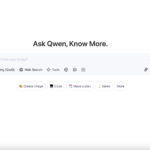
Image note: the retained screenshot shows the older Qwen2.5-Max chat interface, including Thinking (QwQ) and Web Search controls. It is an archival illustration, not a view of the current product.
Qwen is Alibaba’s AI model family and the name used for its consumer AI assistant. The practical starting point depends on your goal: use the hosted assistant for an individual task, choose a model API for an application, or evaluate downloadable weights for a deployment you operate. Those routes have different costs and terms. The Qwen team’s official repository links its assistant and model releases.
Which way should you use Qwen?
- For occasional writing, brainstorming or a question: start with Qwen’s hosted assistant. You can evaluate whether its answers fit your task before planning an integration.
- For a feature inside your own software: investigate a specific API model and its billing rules. Record the full model identifier, region and intended input type before estimating costs.
- For a model you operate: inspect the exact downloadable release, its license and deployment requirements. Budget for hardware, hosting and maintenance as well as your implementation time.
Choose the route first, then compare models within it. A phone app subscription, a cloud API bill and permission to run downloaded weights should not be treated as one interchangeable product.
Web access, mobile apps and consumer pricing
The current assistant destination is chat.qwen.ai; the older chat.qwenlm.ai address redirected there during this update. Qwen’s official app download page also provides a mobile download route.
There are listings for Android on Google Play and iPhone and iPad on Apple’s Canadian App Store. The Android listing describes chat, file-related tasks, translation and image/video features. These are developer-described capabilities, not results from our testing.
The Canadian Apple listing is free to download and includes in-app purchases. That does not establish a universal free allowance or subscription price. Check the offer, renewal period, limits and currency displayed in your own account and storefront. A complete current consumer plan comparison was not verified for this guide, so we do not quote monthly chat prices or team tiers.
Alibaba Cloud API pricing
Alibaba Cloud Model Studio bills model API usage separately. Its official inference pricing page, updated October 15, 2026, lists standard pay-as-you-go rates. One example is qwen3.8-max, Singapore region, International deployment scope: in the published 0–1M input-token pricing tier, the listed price is US$2 per million input tokens and US$6 per million output tokens, in either thinking or non-thinking mode.
Illustrative arithmetic: 100,000 input tokens plus 20,000 output tokens at those rates costs US$0.32. This is a calculated example, not a measured session or invoice. It excludes caching adjustments, promotions, extra tools and other charges; billed thinking output can also matter. Other models and regions have different rows, and some use input-length tiers. Recheck the selected row before enabling billing. A consumer chat entitlement does not establish an API allowance.
Downloadable models and licenses
Downloading weights is a separate option from using the hosted assistant. As one concrete example, the official Qwen3.6-27B model card lists Apache-2.0 and documents deployment with supported inference frameworks. This is an example release, not a claim that it is the newest or the right size for your computer.
Terms can differ across the family. The official Qwen-Image-2.1 license grants use of the model materials for research or evaluation and requires a separate license for commercial use. That restriction concerns this release’s materials; it should not be generalized to every Qwen model or to all hosted-service outputs.
Before choosing a download, save its exact repository name and version, read its license, and check the required memory and supported runtime. Confirm where prompts actually go in your chosen setup. Running a local application alone does not prove that every feature stays on your device. Our Ollama guide is a useful next read if you are exploring local-model workflows; check compatibility for the specific model you want.
A practical example to try
Imagine a fictional stationery shop called Paper Lantern. Its owner needs a short description of a notebook but wants to avoid invented product claims. A useful starting prompt would be:
Write two product descriptions for Paper Lantern, a fictional stationery shop. Use only these facts: an A5 notebook, 120 dotted pages, a blue soft cover, and a price of $12. Make one version under 40 words and the other under 80 words. Do not invent paper weight, environmental certifications, shipping terms or customer reviews. List any missing facts you would need for a fuller listing.
This is an original illustrative prompt, not a Qwen-generated result. Judge the response against the supplied facts: did it preserve the page count and price, respect both lengths, and avoid adding unsupported claims? Revise the prompt if needed. If you later automate this workflow, use a small set of examples with known answers and review failures before publishing anything automatically.
What to check before relying on it
- Task fit: try your own representative inputs. A general benchmark ranking does not establish accuracy for your documents, language or codebase.
- Review effort: verify names, calculations, citations and product details. Run and inspect generated code in an appropriate test environment.
- Data handling: review the terms and privacy settings of the actual service you use before uploading confidential information. Do not assume the consumer app, an API provider and a self-managed deployment share one policy.
- Spending: define a budget, inspect usage and confirm which account or service is charging you. Avoid choosing a paid plan solely because it carries the Qwen name.
Bottom line: the hosted assistant is the simplest starting point for a personal trial. Developers should compare a named API model or downloadable release against a concrete workload, with its own cost, license and review checklist.