| Name |
GLM-4.5 AI |
| Overview |
GLM-4.5 is an open-source large language model (LLM) from Z.AI (Zhipu AI), designed for complex reasoning, coding and agent-oriented applications. Built on an efficient Mixture-of-Experts (MoE) architecture, GLM-4.5 is designed for a new generation of AI applications that require models to act as autonomous agents, capable of breaking down and executing multi-step instructions. Its hybrid reasoning system offers a “thinking” mode for deeper analysis and a “non-thinking” mode for direct replies; response time depends on the task and deployment. The model weights are released under the permissive MIT license for commercial use and customization, subject to the license terms. Self-hosting still involves hardware, setup and operating costs. |
| Key features & benefits |
- Open Model Weights (MIT License): The weights permit commercial use, modification and distribution under MIT. The official code repository uses Apache 2.0; hosted services and other components have separate terms.
- Mixture-of-Experts (MoE) Architecture: Uses 355 billion total parameters with 32 billion active per forward pass. This selective activation does not remove the memory and deployment requirements of the full model.
- Advanced Agentic Capabilities: Designed for multi-step task planning and function calling. Browsing and other actions require an application to connect and execute the appropriate external tools.
- Coding Capabilities: Supports full-stack development tasks, from frontend UI to backend logic and databases. Z.AI reports strong results in its release-era evaluations; these are not a guarantee of current leadership or working applications from every prompt. Review and test generated code.
- Hybrid Reasoning System: Users can switch between a “thinking” mode for complex, analytical tasks and a “non-thinking” mode for fast, conversational replies, optimizing for either depth or speed.
- Usage-Based API Pricing: Costs depend on the selected model, input and output tokens, cache hits and any separately billed tools. Compare the current rates below with your own workload rather than assuming a fixed saving against other models.
- Long Context Window: Supports up to a 128K context window, allowing it to process and analyze large documents, codebases, and lengthy conversations in a single pass.
- Smaller Variant (GLM-4.5-Air): Uses 106 billion total parameters with 12 billion active. It offers a smaller self-hosting option, but still needs suitable hardware; requirements vary with precision, context and offloading. Do not assume ordinary phone or laptop support.
|
| Use cases and applications |
- Automated Software Development: Creating full-stack web applications, interactive games, physics simulations, and standalone software artifacts (HTML, SVG, Python).
- Autonomous AI Agents: Building intelligent agents that can perform research, analyze data, manage workflows, and automate business processes.
- Advanced Content Creation: Generating high-quality, long-form articles, technical documentation, marketing copy, and presentation slides.
- Sophisticated Chatbots: Powering next-generation multilingual customer support bots and personal AI assistants that can handle complex queries.
- Complex Data Analysis: Analyzing large datasets, identifying trends, and generating insightful reports from unstructured text.
|
| Who uses? |
- Software Developers & AI Engineers: Who need a powerful, flexible, and affordable model to build AI-powered applications.
- Startups and Small Businesses: Who want to leverage cutting-edge AI without the high costs associated with proprietary models.
- Enterprises: For creating custom, in-house AI solutions and automating complex internal workflows. Privacy and control depend on hosting, logging and connected tools; hosted services have separate policies.
- Researchers and Academics: For exploring the frontiers of AI and pushing the boundaries of what LLMs can do.
- Hobbyists and Creators: Who are experimenting with AI for personal projects, from creating games to building creative tools.
|
| Pricing |
Z.AI’s current API table lists GLM-4.5 at US$0.60 per million input tokens, US$0.11 per million cached input tokens and US$2.20 per million output tokens. GLM-4.5-Air is US$0.20 input, US$0.03 cached input and US$1.10 output per million tokens. These are usage charges, not monthly subscriptions; third-party providers may charge differently.
GLM-4.5-Flash is listed as free in the API table, subject to service limits. Confirm the exact model and endpoint before use; a current web chat interface may offer different models. Downloadable weights have no model license fee, but self-hosting hardware and operating costs remain.
|
| Tags |
LLM, AI, Open-Source, Mixture-of-Experts, Agentic AI, Code Generation, Natural Language Processing, Zhipu AI, Z.ai |
| App available? |
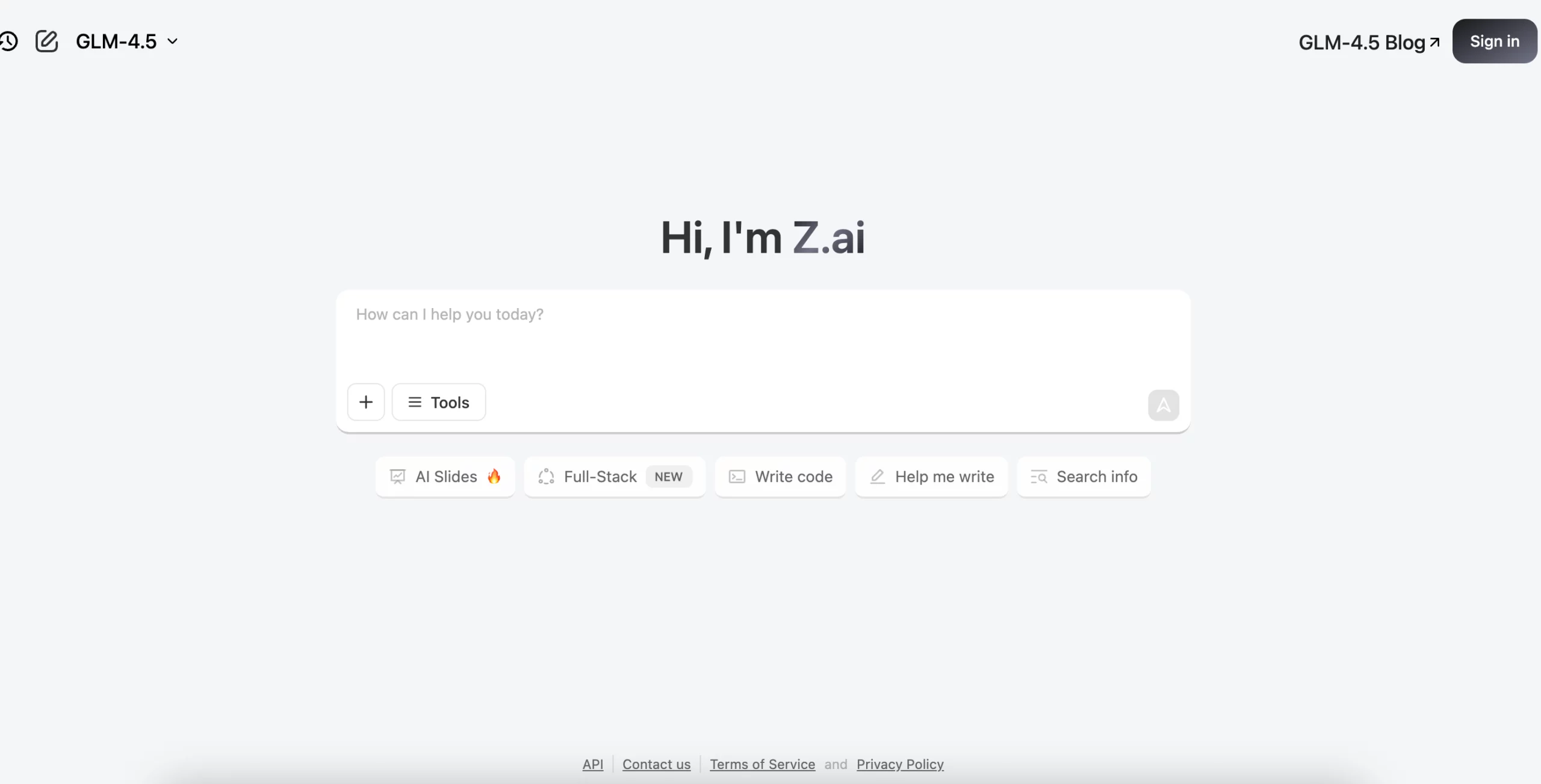
Access options include Z.AI’s API and downloadable model weights from the official Hugging Face repository. Web chat, third-party providers and compatible local clients may offer different models or versions. Confirm that the chosen interface supports GLM-4.5; this review did not establish a complete native-app availability list. |