Updated October 16, 2026. This is a documentation-based review of Flutch’s public website, product pages, and developer guides. We did not create an account, deploy an agent, or test its integrations, accuracy, speed, or support.
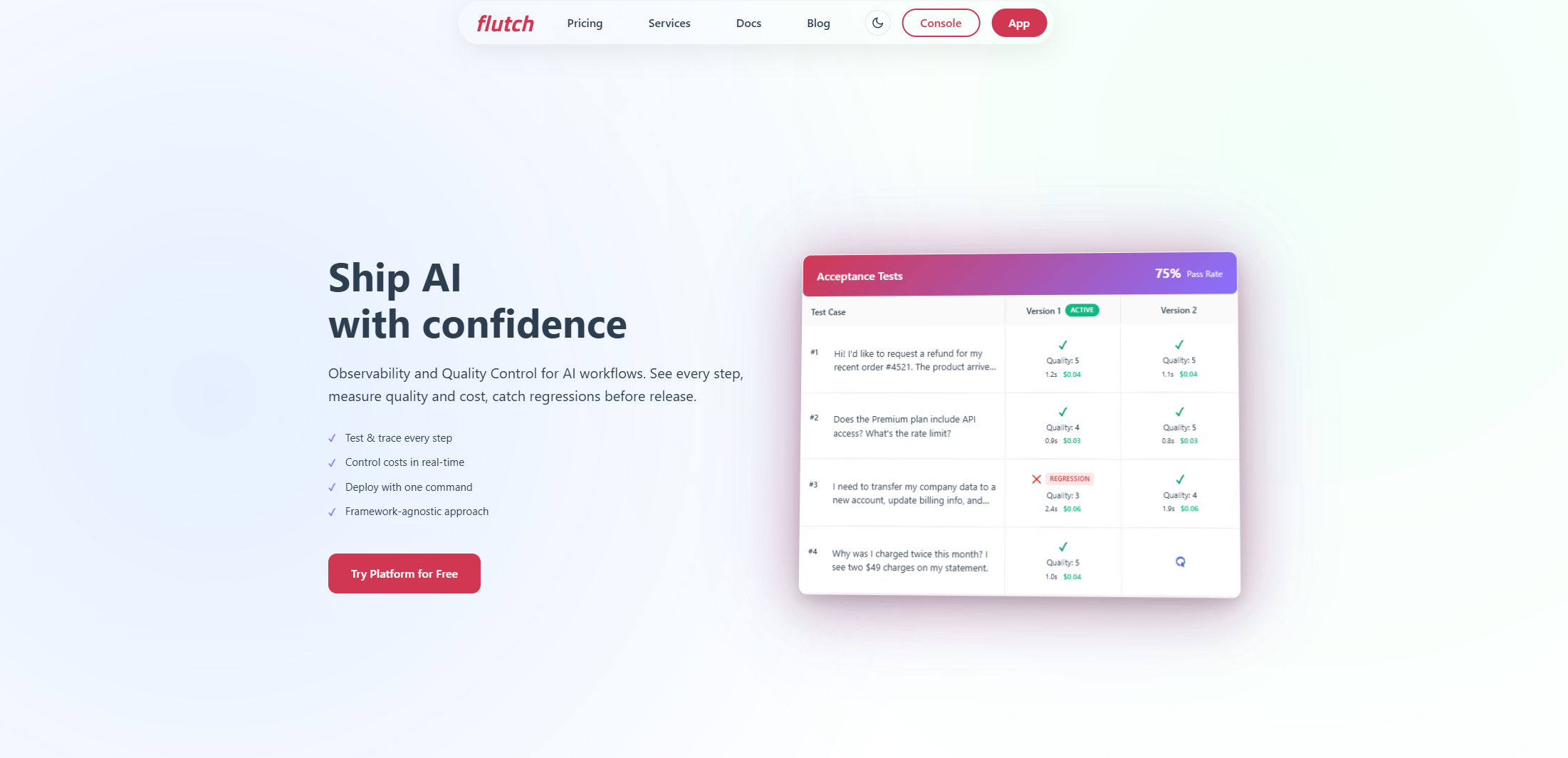
Archival vendor illustration: the retained image shows an earlier Flutch homepage, a free-offer promotion, and an acceptance-testing mockup with a 75% pass rate. These are historical marketing elements, not our test results or evidence of current pricing or performance.
What is Flutch AI?
Flutch currently presents itself as a sales-automation service: responding to inquiries, qualifying prospective customers, following up, and encouraging repeat orders. Its official website emphasizes website chat, Instagram, WhatsApp, and email, with conversations and contacts passed to a CRM. Named CRM examples include HubSpot, Pipedrive, and Salesforce.
Developer infrastructure remains documented alongside that business-facing offer. The product directory points developers toward documentation for its SDK, open-source runtime, gateway, and management tools. Readers arriving from an older description of Flutch as an agent-deployment platform should distinguish these technical components from the current sales service. Public pages remain available; this review does not establish account-level service availability.
Sales features
The qualification page describes configurable questions, required fields, disqualification conditions, and handoff rules. Businesses supply approved information and decide what makes an inquiry worth routing to sales, such as service area, budget, and timing. This makes the quality of the business’s source material and qualification criteria central to the result.
For unanswered inquiries, the recovery page describes adjustable follow-up timing and messages. Its example cadence is days two, five, and ten. It says a representative taking over ends the automated sequence, and channel-specific messaging rules apply. Those are vendor-described behaviors, not verified delivery or conversion results.
A sensible evaluation should check whether the agent recognizes exceptions, avoids unsupported promises, and hands conversations to the correct employee. A convincing demo is less useful than a trial using your actual service boundaries, unavailable products, ambiguous questions, and escalation needs.
Developer options
Flutch’s developer overview names LangGraph, LangChain, LlamaIndex, and Haystack. It describes acceptance testing, conversation and token analytics, version rollback, persistent state, a command-line interface, and local development. These are documented capabilities, not evidence that every framework version or deployment configuration will work unchanged.
The n8n guide requires an active workflow with a publicly reachable HTTPS production webhook. It explains returning responses and optionally providing trace information. This is an integration with a separately running workflow, so allow time for authentication, error handling, and testing. We did not verify a current Make.com-specific integration in the reviewed materials.
Channels and access
The distribution guide describes browser chat and an embeddable, mobile-responsive widget, plus Telegram and Discord bot setup. Its Slack guidance is inconsistent: one section labels Slack forthcoming, while another calls it a manually configured beta. Confirm present availability before selecting Flutch for a Slack-dependent project.
Browser access and messaging integrations do not establish that a standalone Flutch iOS or Android app exists. They also should not be read as proof that every channel is included in every commercial arrangement. Ask for a demonstration of the specific channel, CRM, permissions, and handoff you need.
Pricing needs clarification
The homepage advertises five free leads, then prepaid packages of $250 for 50 leads, $600 for 150, or $1,500 for 500. Balances remain until used rather than resetting monthly. It defines a billable lead by shared contact details. An order paid through a Flutch-sent payment link or checkout incurs 10% of the order amount instead, restoring that lead to the package.
The separate pricing calculator shows $990 one-time core setup and, in its displayed configuration, $600 for one service line. Monthly support is Self-service $99, Managed $1,500, Operational Partner $3,500, or Full Ownership $7,500. The latter three include 8, 15, or 40 work hours, with extra hours at $300, $200, or $150 respectively; ad-hoc Self-service help is $500/hour. AI tokens are additional, billed at provider cost monthly. The page also lists a $2,500 one-time OSS deployment/migration option.
The terms identify fees as USD, excluding applicable taxes. Get a written quote explaining how lead packages, sales commissions, setup, support, and usage charges interact. Confirm depleted-balance behavior and any other limits.
Privacy and security
Flutch’s legal page identifies SAB Core LLC as the operator. Its privacy policy includes prompts and conversation history among collected data, gives conversations a two-year retention period after last activity, and describes model training as opt-in. It names external AI providers and US infrastructure.
The same page makes encryption and SOC 2 claims, with audit evidence available by request. We did not inspect an audit report or independently verify these controls. Ask for current documentation, retention and deletion terms, data-processing arrangements, and deployment-specific safeguards before sharing customer records. An open-source deployment option alone does not establish compliance.
An example to evaluate
Fictional, untested scenario: A bicycle repair shop wants to handle evening inquiries. It could prepare approved prices, opening hours, and repair exclusions, then evaluate whether an agent asks for bike type and problem details without promising an appointment. Staff would review the resulting contact and transcript before confirming work.
Include difficult cases: a repair the shop does not offer, a customer outside its service area, a request to stop messages, and an incorrect price in an old document. Define pass criteria before testing. Measure useful handoffs and mistakes rather than assuming more conversations mean more sales.
For a structured way to record expected behavior and review results, use our AI assistant acceptance-test worksheet.
Bottom line
Flutch merits consideration when sales intake and follow-up are the main problem, or when its documented developer tools match a specific technical need. Start with a narrow pilot, verify the integrations, and resolve the pricing arrangement before committing. Visit Flutch’s official website for the current offer.