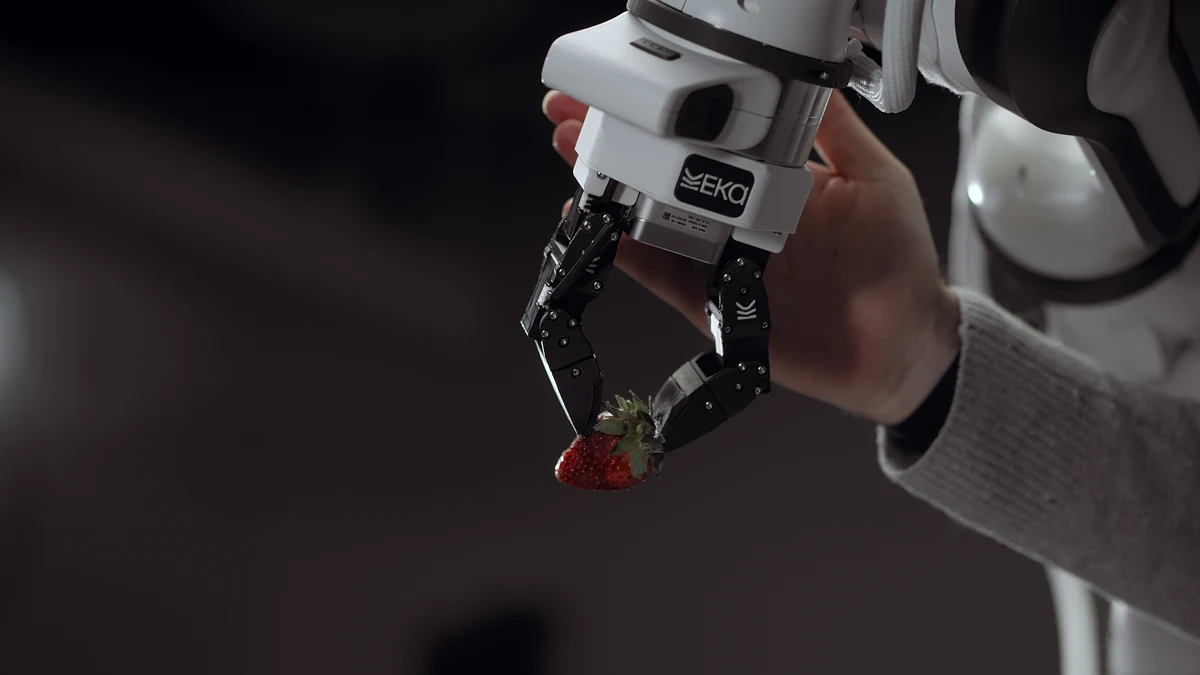
Robots are still surprisingly bad at picking things up. Eka Robotics, a startup founded by an MIT professor and a former Google DeepMind researcher, thinks it has cracked the problem, and investors just bet $150 million that it is right. The company closed a Series A on October 20 that values it at $1.45 billion post-money, led by Andreessen Horowitz (a16z) and F-Prime.
Unlike most robotics startups, which train their systems on videos of humans performing tasks, Eka takes a different route. Its robots learn inside physics simulators, generating what the company describes as thousands of hours of robot experience in minutes through reinforcement learning. The approach is closer to how AlphaZero taught itself chess than to the imitation learning behind today’s most common robot models.
Vision-Force-Action, Not Vision-Language-Action
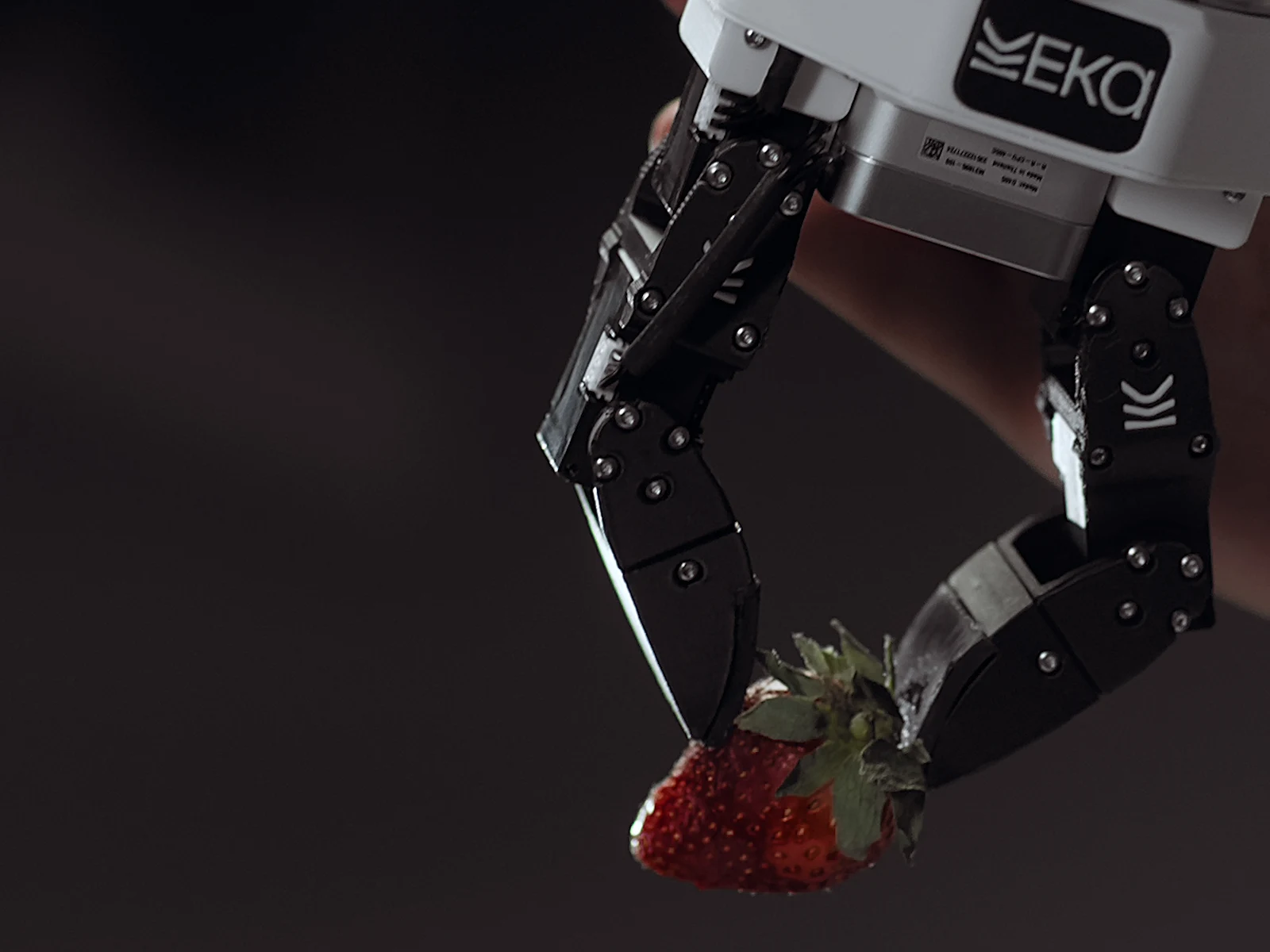
At the center of the announcement is Eka’s Vision-Force-Action (VFA) foundation model. Most generative AI robotics models today are built on a vision-language-action architecture, trained to connect language, visual inputs and actions. Eka’s schema instead focuses on the relationship between language, force inputs and actions, treating touch as the core signal for physical interaction.
“Vision is not the primary way in which you close this last millimeter problem,” co-founder Pulkit Agrawal told TechCrunch. “Vision tells you roughly where the object is, what the pose is, but the actual grabbing, the actual searching is happening through forces.”
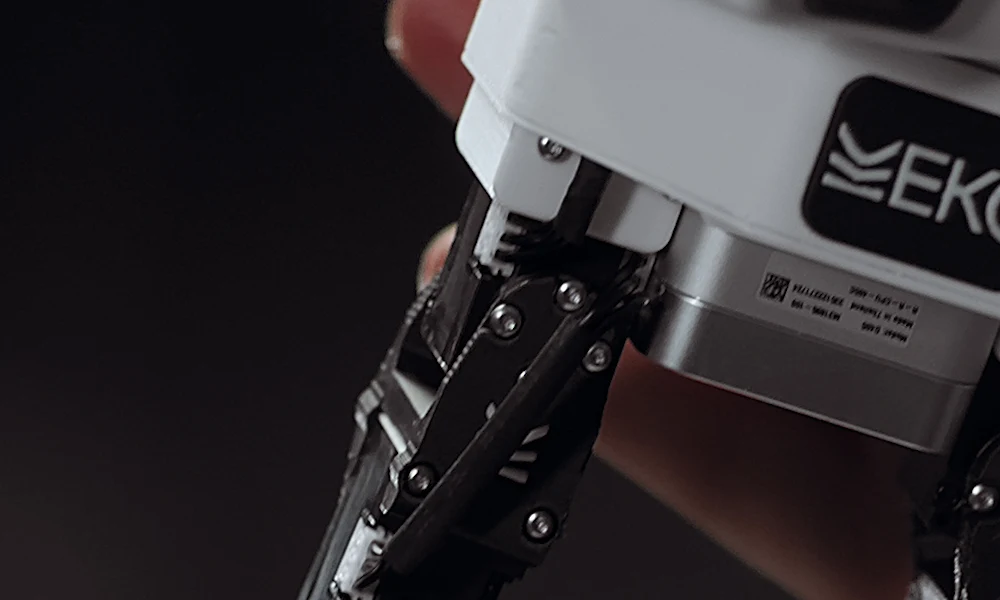
To make that work, Eka had to design its own hardware: a flexible gripper, packed with force sensors, that reacts to contact. The company says the gripper costs under $1,000 to manufacture and is rated for 5 million duty cycles, with a goal of reaching the 20 million-cycle benchmark set by standard industrial arms.
The Numbers Investors Are Betting On
In physical tests, Eka says its robot can pick up about 1,500 objects weighing up to 1 kilogram in an hour, compared with about 600 for a human, and picks up objects successfully more than 95% of the time. The company is running industrial pilots involving pick-and-place and wire manipulation tasks.
“They are already exceeding superhuman performance for certain tasks, and so we think over the next few months there will be superhuman performance in many dexterous manipulation tasks,” said Raghu Raguram, the a16z general partner who co-led the round.
Experts Are Impressed, With Caveats
What stands out about Eka is the reaction from veteran roboticists. Kris Hauser, a professor at the University of Illinois Urbana-Champaign, said the demo had a “wow factor” compared with other robot demonstrations he has seen recently. The Eka robot “was able to adapt to a large number of different objects without retraining,” Hauser said, adding that it had an aspect of “humanness, creepy humanness that it would try over and over again if it failed the first time.”
Another roboticist, who asked for anonymity because of their work at a frontier lab, told TechCrunch that seeing Eka’s robot in action was an emotional experience, comparable to when robots first achieved reliable legged locomotion five to ten years ago.
The caveats are real. Hauser noted that running on an assembly line without breaking for an entire year will be the true test, and the founders are deliberately vague about exactly how the system works. Still, the direction has prominent backers: critics of the current wave of generative AI robotics, like Rodney Brooks, have argued that such models will fail without an attempt to represent force and touch, and Eka’s results suggest those critics have a point.
Why It Matters
Dexterous manipulation has resisted decades of investment: robots can weld car doors all day but still struggle with a grape. If Eka’s simulation-first, force-driven approach generalizes the way its demos suggest, it would unlock automation across warehouses, factories and food production, industries where objects constantly change and fixtures cannot hold every part in place. With $150 million in fresh capital and a $1.45 billion valuation less than two years after founding, Eka now has to prove its robot hands can survive the factory floor, not just the demo table.
Sources
- Eka is worth $1.45B thanks to a physical AI model that has experts raving, TechCrunch, October 20, 2026
- Eka Robotics Secures Series A Funding Led by Andreessen Horowitz, Unite.AI, October 20, 2026
- ekarobotics.com, Eka Robotics official site