Updated: October 29, 2026
Subject-driven generation and requirements
| Field | Details |
| Name | DreamBooth |
| Overview | DreamBooth is a method for personalizing text-to-image diffusion models with a small set of reference images of a subject. It generates new images of that subject in different contexts; it is not a facial-recognition or identity-verification system. The original research used Imagen, while this listing links to Shivam Shrirao’s community Stable Diffusion notebook. |
| Key features & benefits |
Training requires technical setup and suitable compute. Reference-image quality and training settings affect results; overfitting and inaccurate generated details are possible. |
| Use cases and applications |
Use images you have permission to process and obtain appropriate consent when depicting people. Follow the selected model’s licence and hosting rules; do not present synthetic scenes as documentary evidence. |
| Who uses? |
|
| Pricing | The linked notebook is publicly available source code, not a paid DreamBooth subscription. Google Colab offers free and paid compute options, but free GPU access and sufficient runtime are not guaranteed. Local hardware or hosted GPUs may incur costs. Check current resource limits and model terms before training. |
| Tags | Text-to-Image, Subject-Driven Generation, Model Fine-Tuning, Stable Diffusion, Google Colab |
| App available? | The linked implementation is a Google Colab notebook, not a dedicated mobile app. Other implementations of the DreamBooth method have their own interfaces and requirements. |
Using the linked notebook
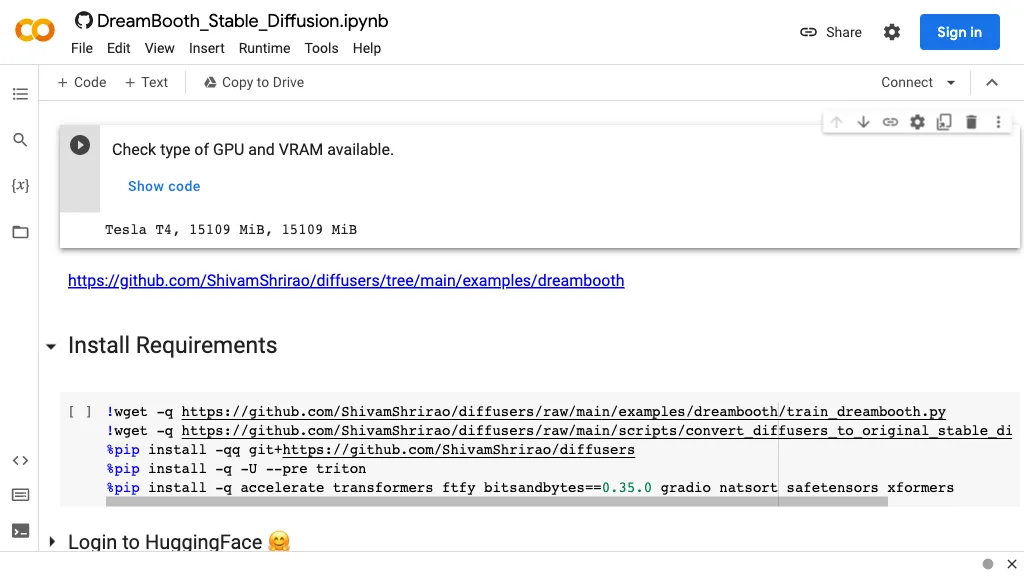
The original Colab link points to a community implementation. Its notebook source remains publicly available, but it was not installed or executed for this review. Dependency compatibility, model access and successful training were not verified. Consult the current Hugging Face Diffusers guide for maintained training guidance.
Code, pretrained model weights and reference images have separate licensing conditions. Public source availability does not give permission to use every image or model without restrictions. Colab’s usage rules also apply, including restrictions on deepfakes and on bypassing notebook or resource limits.
The featured image is a historical view of the linked Colab notebook, including previously saved GPU output; it is not a training run performed for this review. Google Colab is a Google LLC product. This independent article is not affiliated with or endorsed by Google.
Sources checked October 28, 2026 (UTC): DreamBooth research project, research paper, notebook source, Diffusers documentation and Colab FAQ linked above.