Updated on October 20, 2026.
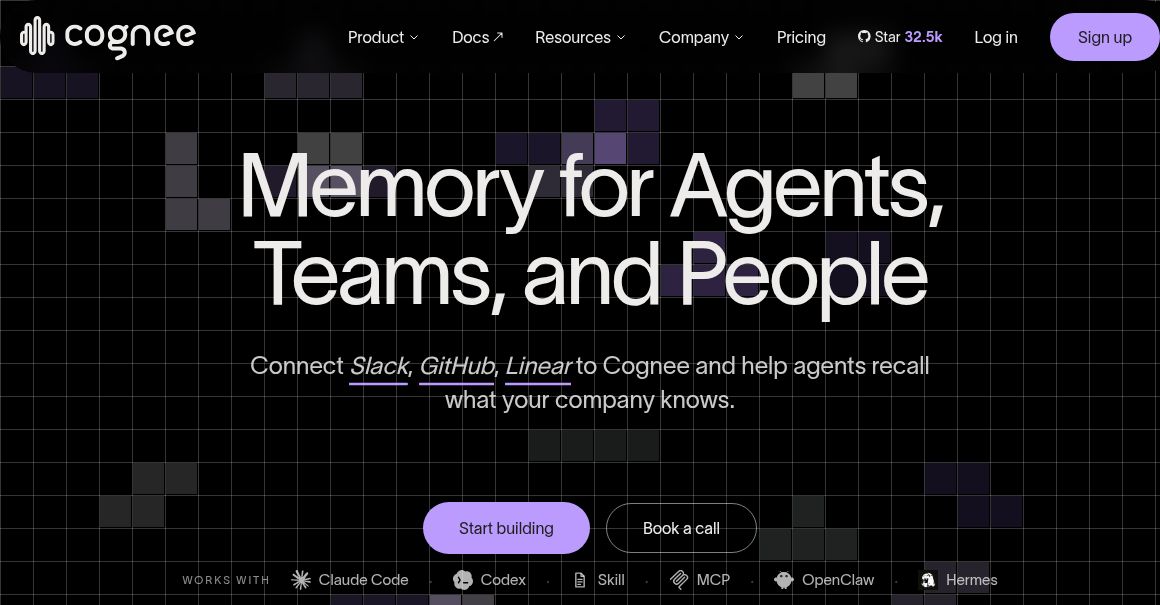
Featured image: screenshot of Cognee AI’s official website, captured October 20, 2026. Vendor presentation, not a hands-on test.
Cognee AI is an open-source memory engine for AI agents and applications. It organizes documents and conversations into information that an agent can retrieve across tasks. Developers can run the engine themselves, while Cognee Cloud provides a managed option with a web interface.
The useful idea behind Cognee is persistent, connected context: a support assistant can retrieve relevant product documentation, a coding assistant can consult project knowledge, and an internal search system can connect information across documents. These are possible applications, not a guarantee that every generated answer will be correct.
How Cognee’s memory works
The architecture documentation describes three complementary stores:
- Relational storage tracks documents, chunks, and provenance, including the source of a piece of information.
- Vector storage supports similarity searches for passages related in meaning.
- Graph storage represents entities and relationships, so retrieval can follow connections between concepts.
Cognee can combine graph and vector retrieval. Its local defaults provide a starting setup, and supported backends can be substituted as requirements grow. The relational layer keeps source context available alongside semantic and structural search.
In practice, a memory pipeline still needs appropriate source material, a sensible knowledge structure, and evaluation. Adding more documents does not automatically improve an assistant if they contain stale, conflicting, or inaccessible information.
Self-hosted engine, Cloud, and integrations
The current documentation presents a Python-based self-hosted engine with CLI, HTTP API, and MCP access. Its memory operations are described around remembering, improving, and recalling information. Cognee Cloud manages storage and pipelines and adds a web interface and dataset permissions. The same interface can also be run locally without a cloud account.
The website’s current offering includes integrations for agent tools such as Claude Code, Codex, and MCP clients. Paid Cloud features list data sources including Slack, Notion, Linear, and Google Drive, plus repository indexing. Check the documentation for a specific connector, file type, or backend before designing an ingestion pipeline around it.
Research teams and developers may prefer self-hosting for customization. Organizations that need a supported deployment can evaluate Cloud or the enterprise bring-your-own-cloud offering. A custom ontology or domain-specific evaluation remains implementation work, not a feature that makes every dataset useful without configuration.
Current pricing
The pricing page now lists the following dollar-denominated offers. Confirm the currency, tax, and billing terms before committing:
| Option | Displayed pricing | Important scope |
|---|---|---|
| Open-source engine | Free to self-host | Your infrastructure and any model-provider usage can still cost money. |
| Cloud Free | $0 per month | One workspace and 1 million tokens included; no card required. |
| Cloud Standard | $1 per 1 million tokens processed | Additional workspaces cost $5 each per month. |
| Enterprise | Custom quote | Bring-your-own-cloud engagement with support and deployment scope agreed separately. |
The free card advertises unlimited users and API calls, but its included tokens are a separate limit. It does not state a reset period for that 1-million-token allowance, so do not assume it replenishes every month. The previous €8.50-per-million Cloud price and €1,970 monthly on-premise price are not the current public offers.
Deployment and evaluation checklist
- Choose one bounded use case, such as answering questions from a maintained product manual.
- Keep a small set of known questions and expected sources to test retrieval quality.
- Check whether the returned context is current, relevant, and permitted for the requesting user.
- Inspect source provenance and test what happens when documents disagree or are removed.
- Measure ingestion cost, retrieval latency, and answer quality before expanding the dataset.
For production, review the security documentation, including authentication, dataset permissions, file-access controls, and telemetry. Self-hosting alone does not prove that no data leaves a system: configured language models, embeddings, connectors, and telemetry must be assessed too.
This overview is based on official documentation, not a deployed benchmark or hands-on accuracy test. Memory retrieval can support grounding, but it does not eliminate model errors. Sources checked: October 20, 2026. Explore related LLM tools.