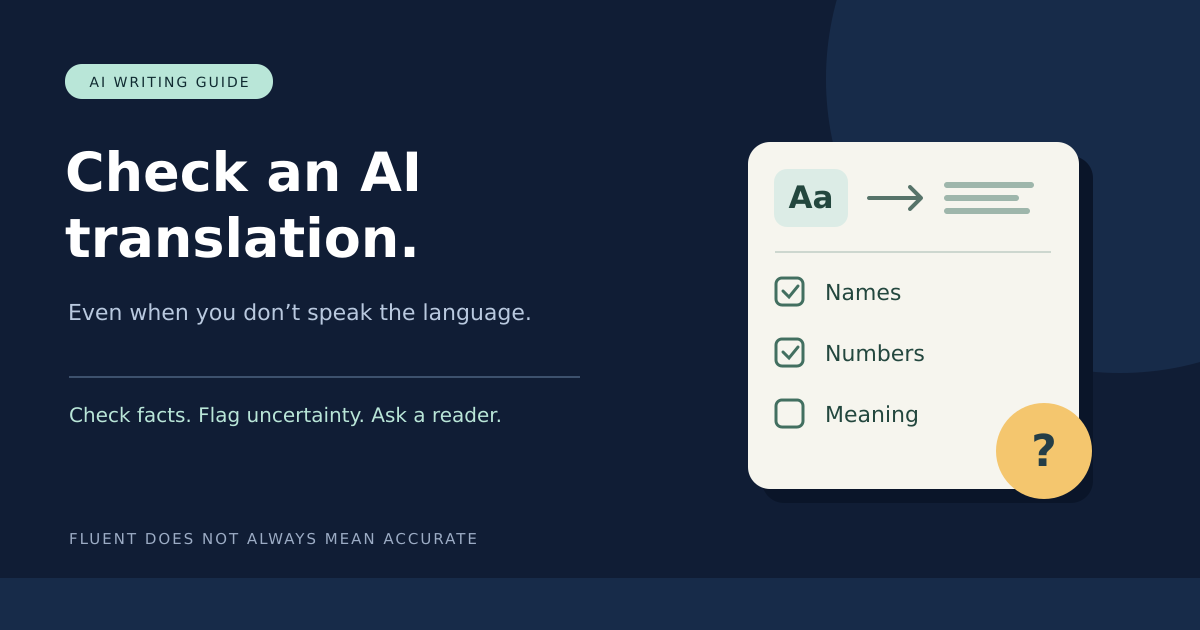
You can check an AI translation for missing information, changed numbers, and obvious inconsistencies even when you do not speak the target language. You cannot independently confirm its naturalness, tone, or full accuracy. Use a structured check to find problems, then involve a competent speaker when the message matters.
The useful question is not “Does this look fluent?” It is “What must stay true, and what evidence do I have that it did?” Here is a practical process for checking a short message before you send it.
Start with an unambiguous source
Keep a copy of your original message. Write dates as “6 November 2026” rather than “06/11/26,” spell out the currency, and identify whose time zone applies. Replace idioms and unclear pronouns with direct wording. Decide whether a term is a person’s name, a product name, or an ordinary word before asking for a translation.
Specify the audience and regional variety, such as “Spanish for an adult workshop attendee in Spain, friendly and direct.” If your message contains private information, remove unnecessary sensitive details before submitting it. Restore any placeholders carefully after review.
Build a short list of facts that cannot change
Consider this fictional workshop message:
Hi Ana Rivera. Our workshop is on 6 November 2026 at 14:30 Madrid time in Room 12. Please bring 3 printed copies, not 30. Registration costs 15 euros. Do not send payment before I confirm your place.
Now imagine receiving this Spanish version. It contains deliberately planted mistakes for illustration; it is not the output of a tested product:
Hola, Ana Rivero. Nuestro taller es el 11 de junio de 2026 a las 14:30, hora de Madrid, en la sala 12. Trae 30 copias impresas. La inscripción cuesta 50 euros. Envía el pago antes de que confirme tu plaza.
Your checklist gives you something concrete to investigate:
| Detail | Original requirement | Problem in the example |
|---|---|---|
| Name | Ana Rivera | Rivera changed to Rivero |
| Date | 6 November 2026 | Changed to 11 June 2026 |
| Time and room | 14:30 Madrid time; Room 12 | Preserved |
| Quantity | 3 copies, not 30 | Changed to 30; exclusion removed |
| Cost | 15 euros | Changed to 50 euros |
| Payment instruction | Do not pay before confirmation | Reversed to pay before confirmation |
You may spot the name and numeral changes yourself. The date and reversed instruction need language-aware checking. Do not assume that matching digits prove a sentence is correct: “do not bring 30 copies” and “bring 30 copies” contain the same number.
Ask for a comparison, not a confidence score
Put the original and translation in clearly labeled sections. Ask the system to identify omissions and changes before rewriting anything:
Compare this translation with the original. For each sentence, list the names, dates, times, quantities, conditions, and instructions expressed in the translation. Explain them in English. Flag omissions, additions, and reversed meanings. Quote the target-language words behind each finding. Do not repair the translation during this check. State uncertainty rather than guessing.
Compare that report with your own checklist. An AI-generated explanation is another output to check, not independent proof. A neat table or a “99% confident” answer does not establish accuracy. For the fictional example, hold the message: five required details have changed. Request a corrected version, then repeat the comparison against the original.
Use backtranslation as a warning system
Backtranslation means translating the target text back into a language you understand. You can try it in a separate session or another tool, providing the translated text without the original so it cannot simply echo your source. Investigate disagreements rather than choosing whichever version sounds nicest.
A matching backtranslation cannot certify fluency or correctness. In a 2021 experiment involving English-to-Czech and English-to-Estonian translation, backtranslation feedback increased user confidence without increasing objective translation quality. That finding supports caution, not a claim that every current tool behaves identically. See the original NAACL research paper.
Treat agreement between tools as a useful clue, not a vote that settles the wording. Neither a reassuring paraphrase nor matching English sentences lets you judge how the target text sounds to its intended reader.
Get the right human review before consequential use
For consequential communication, ask a native speaker with relevant writing competence and strong command of the source language, or a qualified translator, to compare both versions. Native fluency alone does not establish translation expertise. For important public-facing material, use a professional reviewer familiar with the subject.
Give them the audience, purpose, full message, and checklist. Ask two separate questions: “Does every fact and instruction match?” and “Does this sound appropriate to the intended reader?” The European Commission similarly distinguishes bilingual revision for accuracy and completeness from target-language review for clarity, tone, and audience suitability. See its translation quality guidance.
Finally, inspect the exact version you will send: restored names, links, line breaks, dates, and numbers. The same final-send check used for AI email rewrites helps here. Passing these checks reduces obvious errors; if you cannot verify a consequential passage, keep it unsent until someone competent can review it.