
Amazon has a secret plan to make sure shoppers never need to leave its site: own the product information for nearly everything for sale on Earth. The initiative, called World Product Graph, would gather data on virtually every item sold anywhere, whether Amazon stocks it or not, according to an internal document reviewed by Reuters.
The plan targets the rise of AI shopping agents, software that can complete purchases on a shopper’s behalf, and the flaws in Amazon’s own AI search tool. Reuters reported the story on November 13, based on the internal document and people familiar with the matter.
What Is World Product Graph?
World Product Graph is laid out in an internal Amazon document known as a PR/FAQ, a six-page memo sketching the rationale and business case for a new product. It carries an aspirational release date of October 1, 2027, though Reuters could not determine whether or when the plan will be implemented. Not every PR/FAQ leads to a service, and the people familiar with the project said it could be modified or abandoned.
The project sits in Amazon’s Selection and Catalog Systems unit, organized under vice president Robert Tekiela. Amazon is already shuffling staff internally to get it off the ground, according to one person familiar with it, though Reuters could not determine whether the October 2027 date is realistic.
According to the document, World Product Graph “depends on discovering how brands organize their products on their own websites.” Some brands and retailers would contribute product data continuously, while Amazon would also independently crawl other retailers’ websites. Reuters could not determine how Amazon planned to crawl the sites or whether it would need permission in all cases.
Amazon has already signed up Coca-Cola and Bayer to contribute product data, the document says, and the company held a “CEO-level P&G/Amazon summit” for a trial with Procter & Gamble.
Amazon pushed back on the document’s status in a statement to Reuters: “Draft, outdated documents often paint an incomplete picture and the existence of a brainstorming document such as this one doesn’t necessarily reflect our current plans. We’re constantly working on new ideas and technologies to make Amazon’s product catalog comprehensive, accurate, and helpful for customers.”
Why Amazon Wants Every Product’s Data
The document is blunt about the gap Amazon wants to close. “Amazon cannot be the go-destination for every shopping mission if customers must leave to research product relationships on Google, brand websites, and review sites,” it says. “These answers exist, but the only way to find them has been to leave Amazon for painstaking research on brand websites, third party review sites and tech forums.”
With more complete data, Amazon could help shoppers pin down the most recent model or colorway of a vacuum cleaner or tablet, and guide them toward more subjective choices based on their shopping history. As Tekiela put it in the document: “Customers have always been able to find products on Amazon. What’s been missing is understanding: how do these products relate to each other, which one is right for me, and what else should I consider?”
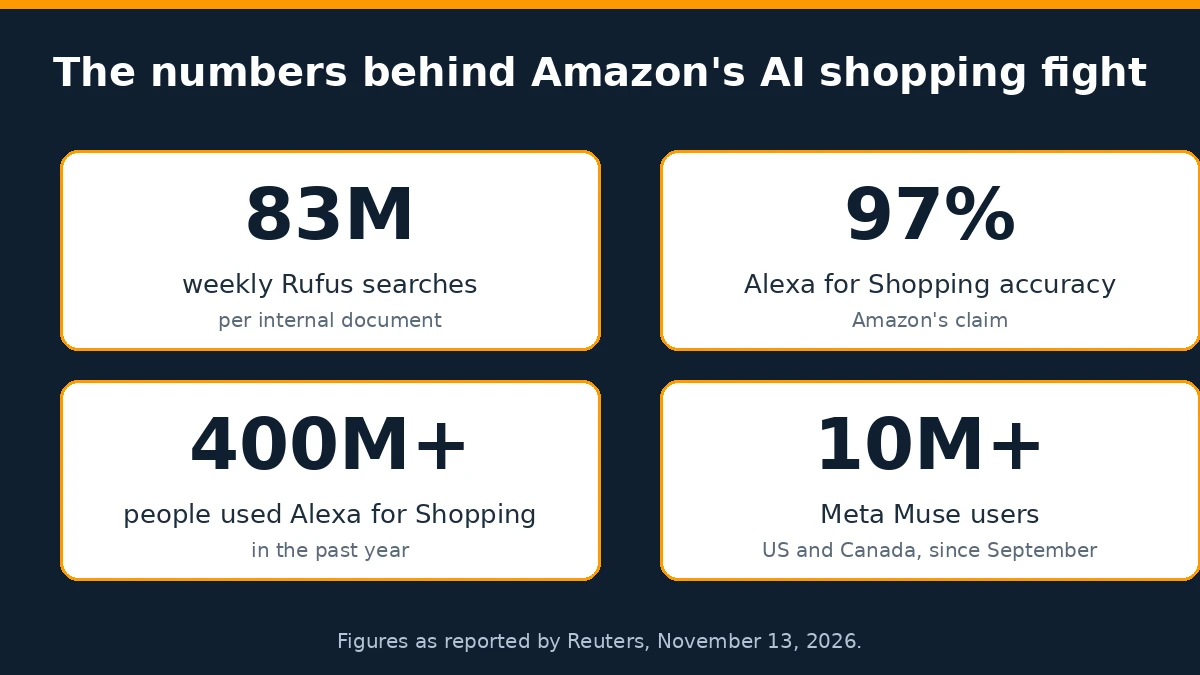
The data would also address problems with Rufus, Amazon’s AI-powered search engine, renamed “Alexa for Shopping” in May. “Many Rufus answers are factually wrong or incomplete, but customers lack expertise to detect these errors,” the document says. Users run about 83 million Rufus searches a week, and running them is “expensive.” More data would let Amazon use cheaper models more efficiently.
Amazon disputed those figures, telling Reuters the usage numbers are “significantly outdated” and that its data shows Alexa for Shopping is roughly 97% accurate globally.
A 2025 Morgan Stanley report cited by Reuters found only 16% of online shoppers start product research on Amazon, dwarfed by Google’s 57%. But when shoppers know exactly what they plan to buy, Amazon leads: 41% of searches start there, against 23% for Google and 18% for Walmart.
Battling AI Shopping Agents
World Product Graph would also help Amazon fend off rival AI shopping agents, the people said. Chief executive Andy Jassy downplayed the threat on the third-quarter earnings call, saying “few customers are doing much shopping this way yet” and that Amazon’s ads business has been minimally affected.
But Amazon executives have grown wary of agents that may send shoppers to sites with greater or more complete data. Meta’s Muse agent has drawn more than 10 million users in the US and Canada since its September launch. Amazon blocked Muse from its retail site that same month and sued Perplexity last year to prevent similar access, a case still ongoing. After a post said xAI’s Grok agent was blocked on Amazon, Elon Musk wrote on X: “Maybe we should start a competitor to Amazon.”
JPMorgan said Muse “has the potential to become the most widely used consumer AI application since ChatGPT.” Amazon says Alexa for Shopping has been used by more than 400 million people in the past year.
By building the world’s most extensive storehouse of product data, Amazon could ensure AI agents working for shoppers seek products out on Amazon.com rather than on rivals’ sites, the people said. That would also protect Amazon’s growing advertising business.
Why It Matters
Employees have described World Product Graph as the start of an effort to make Amazon a one-stop shop for buying anything imaginable. It would extend existing services known as “Buy for Me” and “Shop Direct,” which list products sold on other sites on Amazon and let customers buy them with Amazon as an intermediary.
For now, the plan remains a document, not a product. Reuters could not confirm it will be built, and Amazon stresses that brainstorming documents do not necessarily reflect current plans. But the memo shows how seriously Amazon takes the agent threat: the company that spent three decades becoming the everything store now wants to own the information about everything, so neither shoppers nor their AI agents need to go anywhere else.