DeepSeek has moved the capabilities behind its consumer chatbot into its developer API. Announced on November 13, the update lets developers switch on web search, URL reading, document analysis, content safety checks, automatic conversation titles and user context with a few parameters, or call standalone services for search, page retrieval, OCR, speech-to-text and text-to-speech. All of it runs on the deepseek-flash model.
DeepSeek summed it up on X: “The full DeepSeek App experience, now via API. Search, files, links, safety, and voice.” Its API changelog entry for November 13, titled “Releasing the full suite of application APIs,” puts it this way: “In the DeepSeek App (including the web version), web search, file input, URL reading, voice interaction and safety work together with model inference to form the conversation experience users know.”
New Features in the API
The update adds several built-in tools to chat requests. The deepseek_web_search tool connects answers to live web results: with thinking mode off, the model runs web or image searches and answers with citations, and with thinking mode on, it searches and reads links on its own over several reasoning steps. The deepseek_read_url tool reads pages from links a user pastes into the conversation, so an app can summarize articles, compare product pages or answer questions about specific web content.
Document uploads are now part of the API chat experience as well. Supported formats include PDF, DOC, DOCX, PPT and PPTX files, plus images. Developers can choose text extraction or layout-aware recognition that preserves charts, tables and images. Each file can be up to 100 MB with up to 1,000 pages, and a single request can reference up to 20 documents, as long as the total extracted text stays under 8 MB.
A new safety_check option reviews model inputs and outputs for potentially harmful content. If an input fails the check, the request is rejected with an HTTP 400 error; if risky content appears in the output, the model returns a refusal marker. DeepSeek says public-facing applications must enable this control, while operators still need their own moderation policies and must meet local rules on content review, model registration and AI labeling.
Two smaller additions round out the chat experience: an automatic title option that names a conversation after the first response, and a latest_reminder option that passes context such as the current date, location, platform and language so the model can tailor its answers. The new features work with deepseek-flash, which runs on DeepSeek-V4.1-Flash-1017, through three API shapes: the Messages API, the Responses API and the Chat Completions API. The model offers a context window of up to one million tokens and a maximum output of 384,000 tokens.
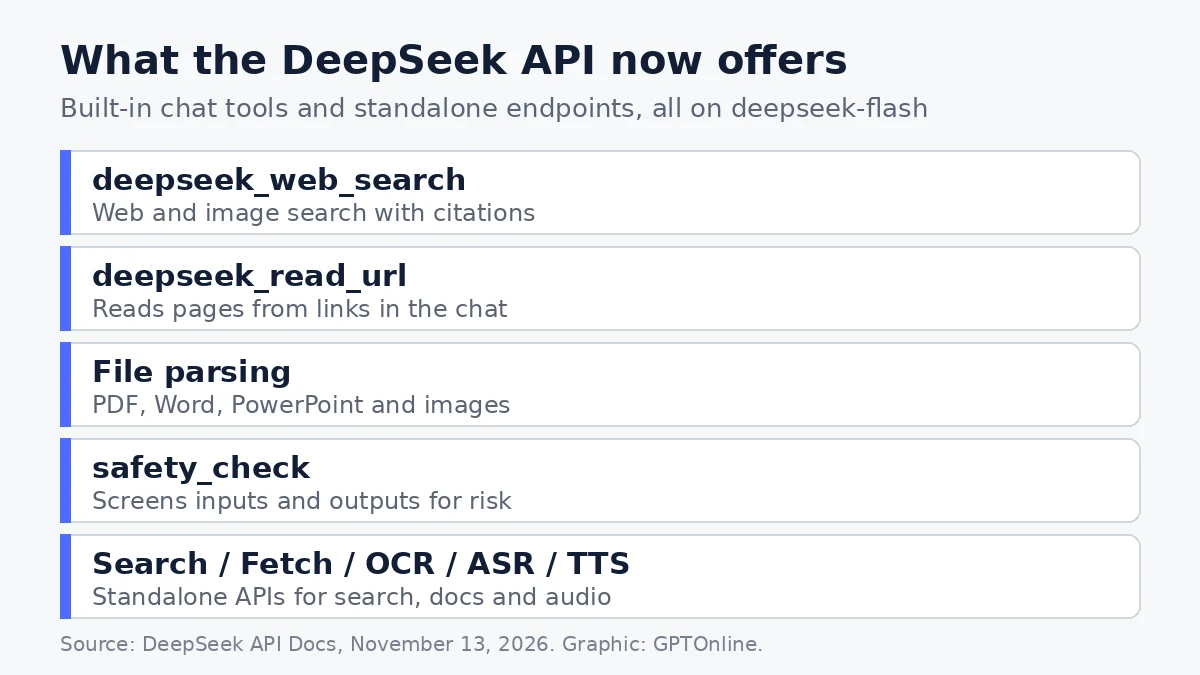
What the DeepSeek API now offers. Graphic: GPTOnline, based on the DeepSeek API Docs.
Standalone APIs for Search, Documents and Audio
Alongside the in-chat tools, DeepSeek now offers five standalone services for developers who want individual capabilities rather than the full chat flow. The Search API runs queries through DeepSeek’s own search engine at up to 100 requests per second, and the Fetch API returns a web page as Markdown at up to 25 requests per second. The OCR API extracts text from images and documents page by page, the ASR API turns audio into text in 21 languages, and the TTS API turns text into speech in 10 languages, with two voices, Stella and Tide, and streaming over WebSocket.
Search and Fetch were already available as standalone endpoints after the October 17 model update; the November 13 release completes the set with OCR, speech and the in-chat tools, and adds an open-source chat interface that developers can use to test them.
Pricing
DeepSeek bills the tools separately from model use. Search and Fetch cost $0.75 per 1,000 successful requests, file analysis and OCR cost $0.225 per 1,000 pages, ASR costs $0.116 per hour of audio and TTS costs $0.45 per 10,000 characters. Model pricing for deepseek-flash is $0.30 per million input tokens on a cache miss, $0.006 on a cache hit and $1.20 per million output tokens, with prices halved during off-peak hours. ASR and TTS carry a temporary 50 percent discount. Failed Search and Fetch requests, and requests that return no results, are not billed.
An Open-Source Chat Demo
DeepSeek also published an open-source chat interface built around the new capabilities, under the MIT license, with a browser demo. Developers can enter an API key and test web search, deep search, URL reading, file and image uploads and conversation management, and can import chat history exported from DeepSeek Chat. The demo keeps keys and conversations on the device, so DeepSeek describes it as a reference prototype rather than something for production use.
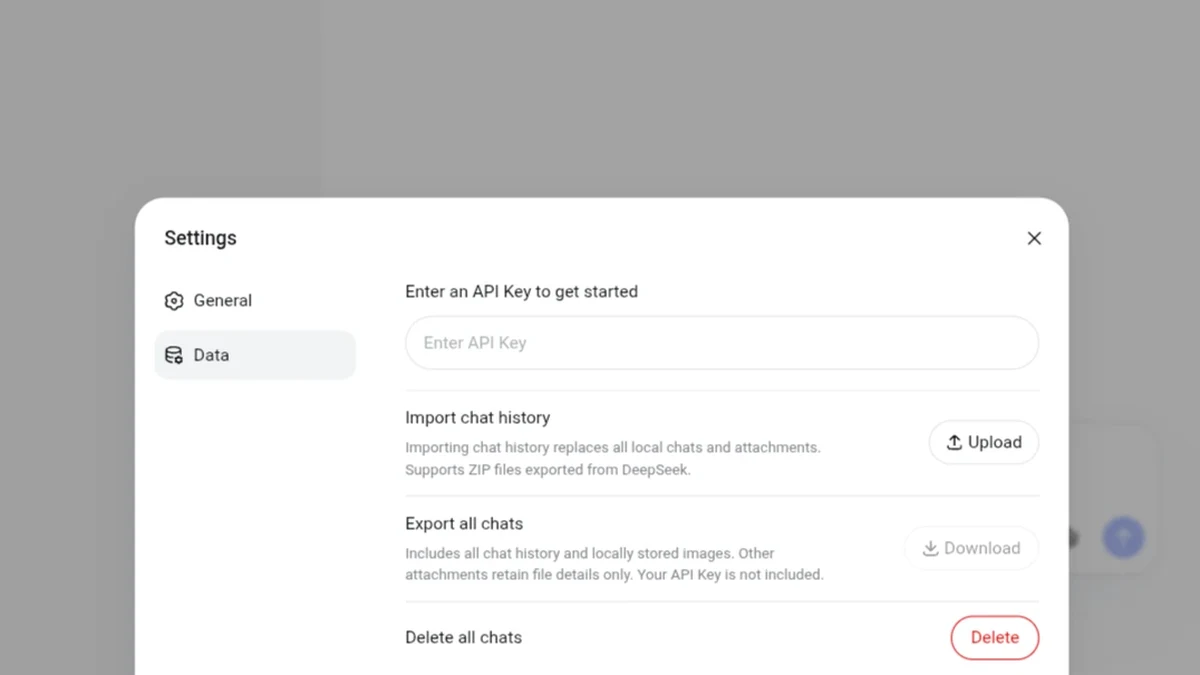
DeepSeek’s open-source chat demo, which developers can use to test the new API features. Image: DeepSeek, via AIARABAI.
Why It Matters
Until now, building a chatbot with live search, document reading and voice meant stitching together several vendors. DeepSeek now offers the whole stack through one API, which lowers the integration work for small teams and for apps that combine web research with document analysis and spoken answers. The trade-offs shift to managing latency across multi-step tool calls and keeping per-tool usage costs predictable, since each service bills on its own meter.
The move also sharpens DeepSeek’s position as a low-cost platform. At $0.30 per million input tokens, deepseek-flash undercuts most frontier models on price, and the new tools make it a more complete alternative for developers who previously needed a separate search, OCR or speech provider. For a company that built its name on open weights and cheap inference, selling the app itself as an API is a logical next step.