Sber unveiled Kandinsky 6.5, the next generation of its image and video generation models, at the AI Journey conference on November 26, 2026. The release doubles the maximum video length to 10 seconds, adds multi-reference scene building and first-and-last-frame control, and arrives with an open-source upscaler, Kandinsky SR 2.0.
What Was Announced?
Kandinsky 6.5 comes in two parts: Kandinsky 6.5 Video and Kandinsky 6.5 Image. Both are available now inside GigaChat, Sber’s AI assistant. Images are generated in the chat itself, while video lives in a separate Video tab. Sber did not announce a standalone API or downloadable weights for 6.5, a change from Kandinsky 6.0, which arrived in October as downloadable MIT-licensed models.
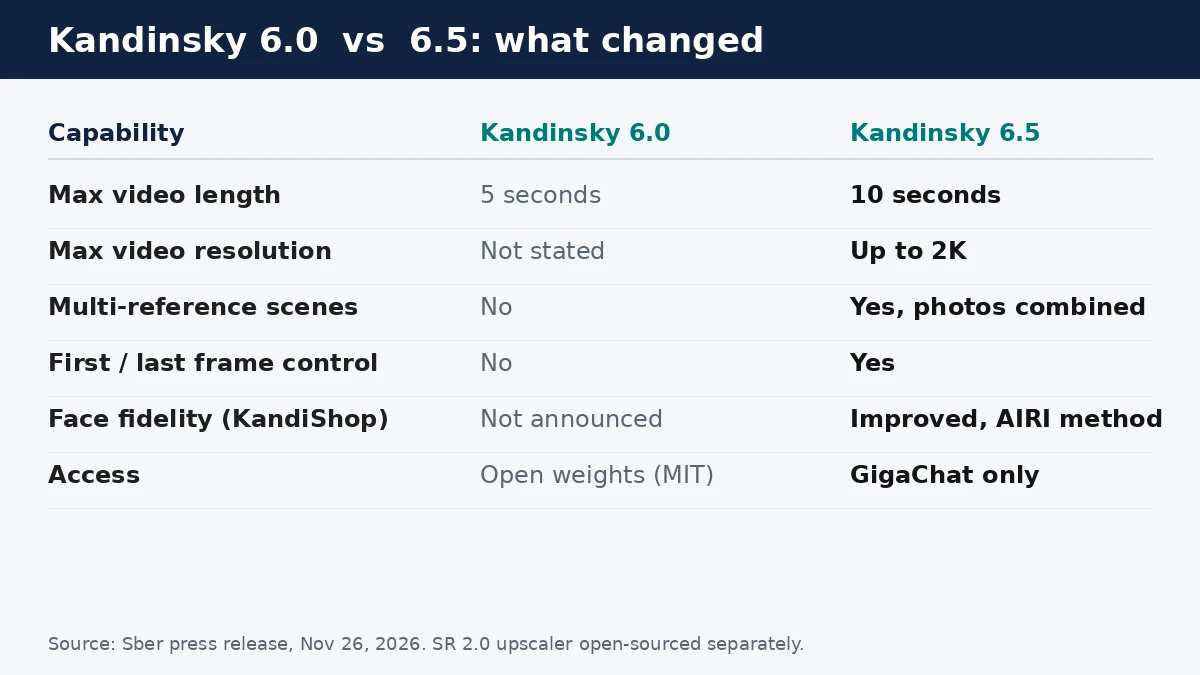
Graphic: GPTOnline, based on Sber’s announcement
Kandinsky 6.5 Video: Longer Clips, Consistent Characters
The headline change is control. Kandinsky 6.5 Video can take separate photographs, a presenter, a product and a store interior, for example, and build a single scene in which the presenter shows the product in that location, holding each subject’s appearance across the clip. Characters introduced in earlier videos are meant to stay recognizable in new ones.
Users can also fix the first and last frames and let the model generate the action between them, a mode Sber pitches for before-and-after product shots and for stitching clips together, where one clip’s final frame becomes the next clip’s opening frame. The modes can be combined, so a referenced character can enter midway through a sequence.
The maximum video duration has doubled from 5 seconds to 10 seconds, with resolution reaching up to 2K, and Sber says sound effects and music quality have improved significantly.
Kandinsky 6.5 Image: Faces, Text and Infographics
The image model follows the same reference-first logic. Its KandiShop method, developed with the AIRI institute, carries a face from a reference photo into new scenes while preserving the scene’s lighting and color, so the same person stays recognizable across a series of images. Sber also claims broader recognition of famous people and fictional characters, better text rendering for captions and headlines, and simple infographics, at 2K native resolution. Images can be upscaled to 4K inside GigaChat, which Sber says is enough for high-quality printing, large banners and book covers.
The Open Release Is the Upscaler, Not the Generator
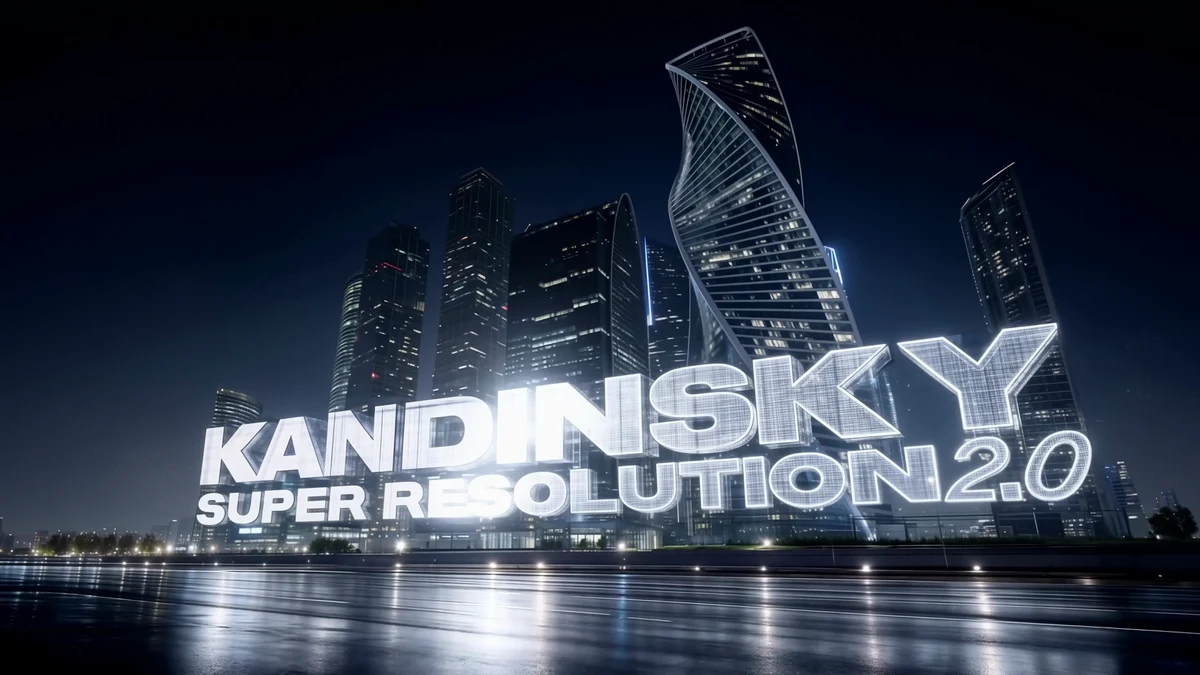
The open-source part of the announcement is Kandinsky SR 2.0, a pair of super-resolution models for images and video. The image model upscales to 8K, and both models are published under the MIT license on Hugging Face. Inside GigaChat, Kandinsky SR raises generated images to 4K and videos to 2K.
Image: Sber / Kandinsky
Sber says both models outperform competitors in internal benchmarks, without naming the competitors or the tests, and the announcement gives no parameter counts, benchmark table, price or weights date for 6.5 itself.
Why It Matters
Kandinsky 6.5 is a practical upgrade for GigaChat users and a strategic shift for Sber. Version 6.0 was an open-weights story; 6.5 is a product story, with the new generator available only through GigaChat. Developers who downloaded 6.0’s weights get an upscaler this time, not the new generator.
For marketers, creators and small businesses, the multi-reference video and face-consistent image tools target one of the most common failures of AI video: subjects that change appearance from shot to shot. Whether that consistency holds up in real use is the test that matters now that the models are live.
Sources
Sber press release, “Sber unveils next-gen Kandinsky 6.5 models for generating images and videos,” November 26, 2026: Sber press release (syndicated)
Kandinsky SR 2.0 model card, Hugging Face: Kandinsky-ImageSR-2.0 on Hugging Face
ALFW, “Kandinsky 6.5 Video: Up to 10 Seconds and 2K, GigaChat-Only”: ALFW analysis
Startrise AI Model Release Tracker: Startrise tracker