SenseTime has released the full version of SenseNova-RoboRSI-27B, an open-weight vision-language model that controls robot arms, and says it learned the job entirely in simulation before moving the same weights onto physical robots. Announced on November 25, the 27-billion-parameter model scored 34.7 on the RoboDojo robotics benchmark, up from 10.0 for the October preview version.
In SenseTime’s comparison, that puts the open model ahead of OpenAI’s GPT-6 Astra, which scored 27.6, and GPT-6.1 Sol at 33.7, though still behind Anthropic’s Opus 5.5 at 40.7. The comparison used the same harness and no task-specific skills for every starred model, at seed 0 and layout 0, according to the company’s chart.
Two ways to move an arm, chosen by the model
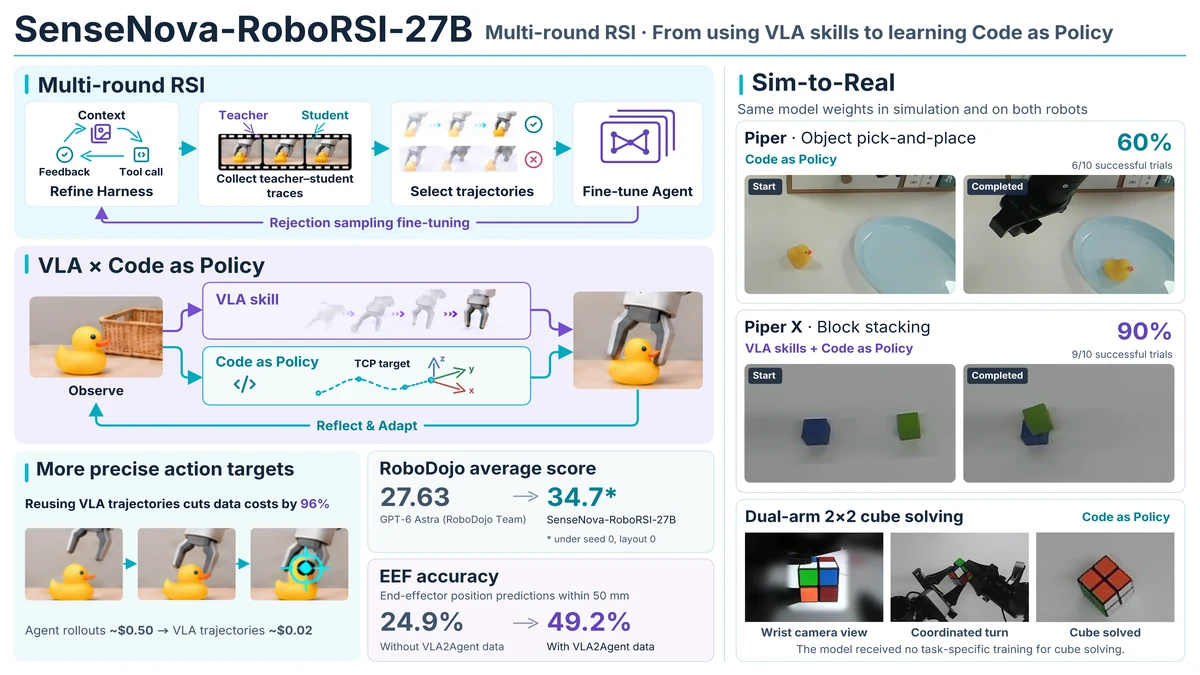
The preview version relied mainly on a vision-language-action (VLA) model to execute tasks. The full release can decide for itself when to invoke VLA, when to control the arm directly through code, and how to adjust its strategy from execution feedback. SenseTime calls the code route “Code as Policy”: the model writes a program to calculate a target position and drive the gripper, which suits tasks with explicit spatial constraints such as stacking blocks, placing objects precisely, and pressing number keys.
Across tasks, VLA accounted for 41.9% of executed environment steps and Code as Policy for 58.1%. To stack bowls, for example, the model first uses VLA to grasp a bowl, then switches to code to adjust the gripper based on the bowl’s position relative to the target.
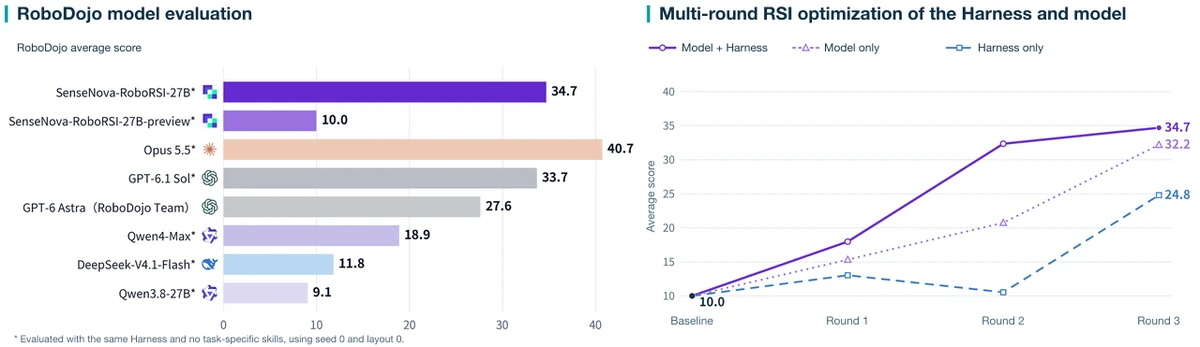
RoboDojo scores: RoboRSI-27B at 34.7, ahead of GPT-6.1 Sol and GPT-6 Astra, behind Opus 5.5. Image: SenseTime
Three rounds of recursive self-improvement
The gains came from multiple rounds of Recursive Self-Improvement (RSI), in which the model and its execution framework, the Harness, evolve together. A teacher model, GPT-6 Astra, explores tasks with the current toolset and uses outcomes and feedback to identify problems; the Harness expands its tools and capabilities; and rejection sampling selects high-quality interaction trajectories for supervised fine-tuning of the 27B model.
After three rounds of joint iteration, the average RoboDojo score rose from 10.0 to 34.7. Updating the model alone reached 32.2, and updating the harness alone reached 24.8, so iterating on both together worked better than either in isolation, SenseTime says.
The team also attacked the model’s weak spatial precision, deriving single-turn action supervision from existing open-source VLA training data. The share of end-effector position predictions with errors of 5 mm or less rose from 4.3% to 15.5%, while the median position error fell from 119.7 mm to 51.6 mm. Accuracy on predictions within 50 mm rose from 24.9% to 49.2%. Reusing VLA trajectories also cut data costs sharply: agent rollouts cost about $0.50 per target, against about $0.02 for VLA traces, a reduction of roughly 96%.
Same weights, from simulation to real robots
The strongest claim is the transfer. The full release uses the same model weights on two physical robotic arms, Piper X and Piper, as in simulation benchmarks, with no real robot data used for training or fine-tuning. Only the observation, state, and control interfaces were adapted.
In real-world trials, Piper X combined VLA and Code as Policy to stack blocks in 9 out of 10 trials, a 90% success rate, while Piper picked and placed objects in 6 out of 10 trials, 60%. The preview version managed 3 and 2 successes on the same tasks, and an untrained control model failed both. The model also solved a dual-arm 2×2 cube with no task-specific training for cube solving.
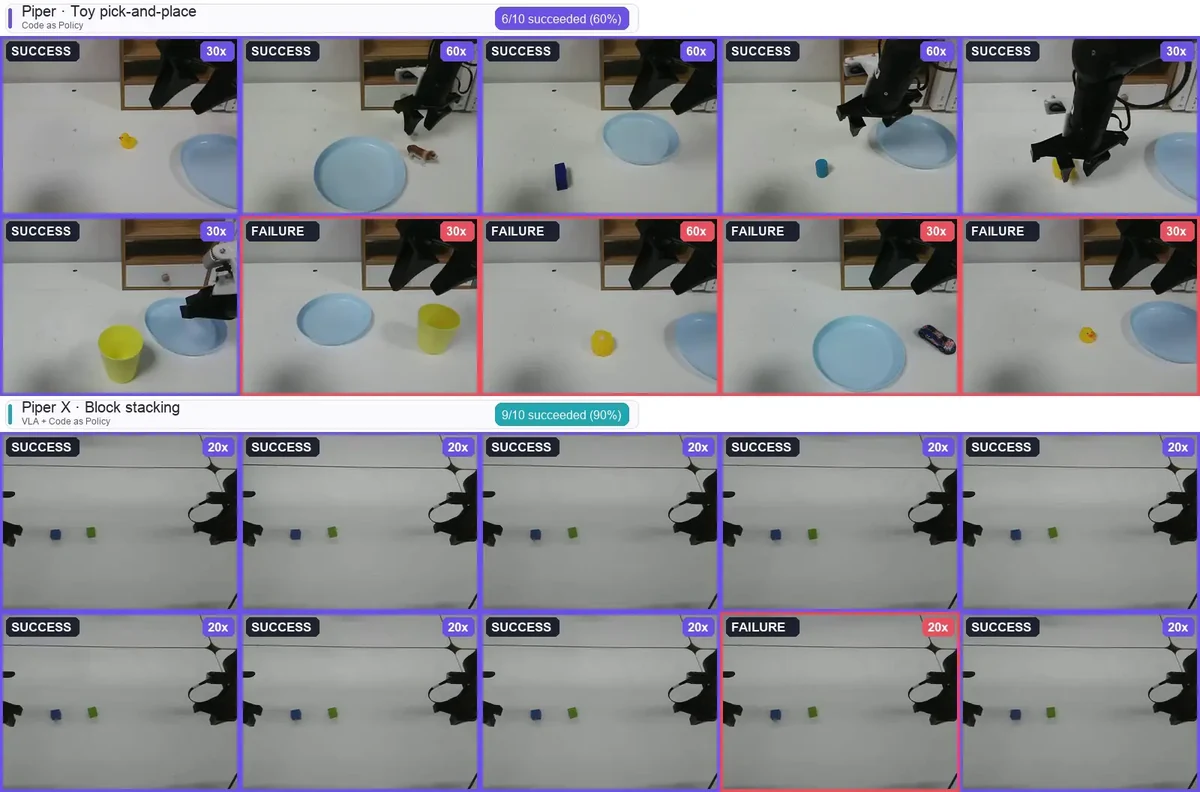
Real-robot trials on Piper and Piper X, including failures: 6/10 pick-and-place successes and 9/10 block-stacking successes. Image: SenseTime
Why it matters
RoboRSI-27B is a case study in getting more from a smaller model. At 27 billion parameters, built on Alibaba’s Qwen3.8-27B and released under Apache 2.0, it beats much larger closed models on this benchmark by combining two execution strategies and improving the model and its harness together, rather than by scaling up. And because the skills were learned in simulation, the approach sidesteps the most expensive part of robot AI: collecting real-world manipulation data.
The limits are visible in SenseTime’s own numbers. Six out of ten is not a reliable pick-and-place system, and all of the figures above are the company’s own measurements under the RoboDojo protocol it describes. Still, a 3.47x jump from preview to full release, with the same weights running on real hardware, is the kind of sim-to-real result the field has been waiting to see from an open model.