NVIDIA has opened up the training materials behind Nemotron 3.5 Parse, its compact document model, publishing three synthetic datasets, a fine-tuning recipe, and a faster inference speculator. The company described the release in a November 26 post on Hugging Face, building on the recent launch of Parse 3.5, a model that turns page images into structured data for retrieval-augmented generation (RAG) and agents.
Parse 3.5 reads a document page and returns its content in reading order, with headings, paragraphs, tables, and charts labeled and located by bounding boxes. Tables and charts become structured records that downstream applications can use directly.
Three open datasets, about 18.9 million examples
NVIDIA is open-sourcing the three datasets it used to train Parse 3.5, all released under a CC BY 4.0 license:
- Synthetic Charts V1, 9.98 million examples: rendered charts with structured annotations for categories, series, and numerical values.
- Synthetic Tables V1, 1 million examples: rendered HTML tables with targets that preserve rows, columns, headers, and cell relationships.
- OCR Synthetic Multilingual v2, 7.9 million examples: synthetic document pages with Parse-format targets across varied fonts and layouts.
Each release includes images, annotations, generation documentation, and the training format. Teams can use the pairs to fine-tune document models or create variations for a target document type or language. The data is synthetic, so the counts describe generated examples, not real documents.
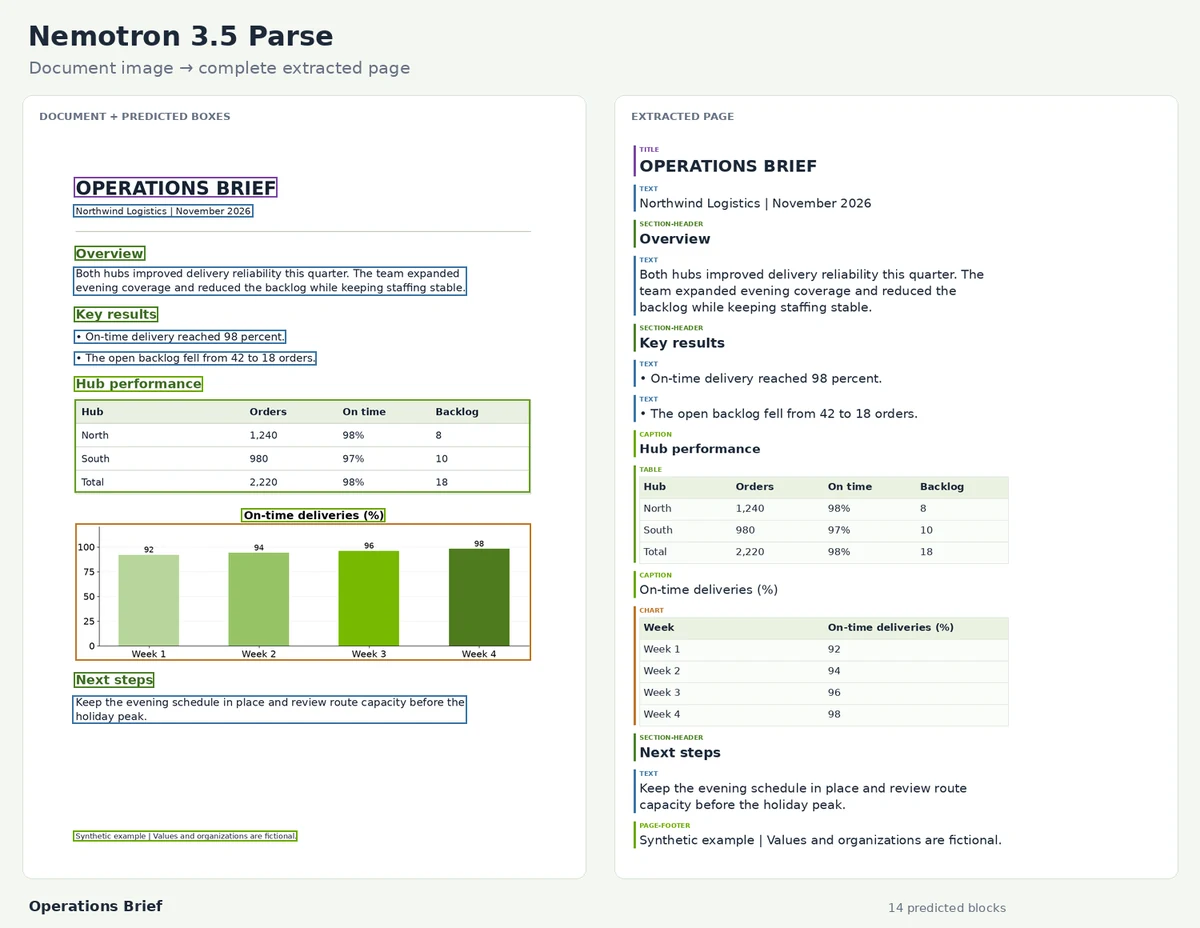
Parse 3.5 turns a page image into structured data, with content classes and bounding boxes. Image: NVIDIA
Training in two phases: SFT, then reinforcement learning
NVIDIA trained Parse 3.5 in two phases. Supervised fine-tuning (SFT) across text, layout, tables, charts, and multilingual documents taught the model to produce structured output. The team then continued with reinforcement learning with verifiable rewards (RLVR), using Group Relative Policy Optimization (GRPO), where rewards check the quality of sampled extractions.
In a matched comparison of development checkpoints, the second phase cut loop-flagged outputs from 126 to 29 pages, about 77% fewer, and outputs hitting the 9,000-token limit from 185 to 35. The overall ParseBench score rose from 66.24 to 71.38, including +5.18 points on tables and +4.15 on charts.
The new version is also better at the hard cases, NVIDIA says. It can recover values from bar charts that print no numbers at all, inferring them from the axes and bar heights, and it handles tables where a shifted row or column changes the meaning.
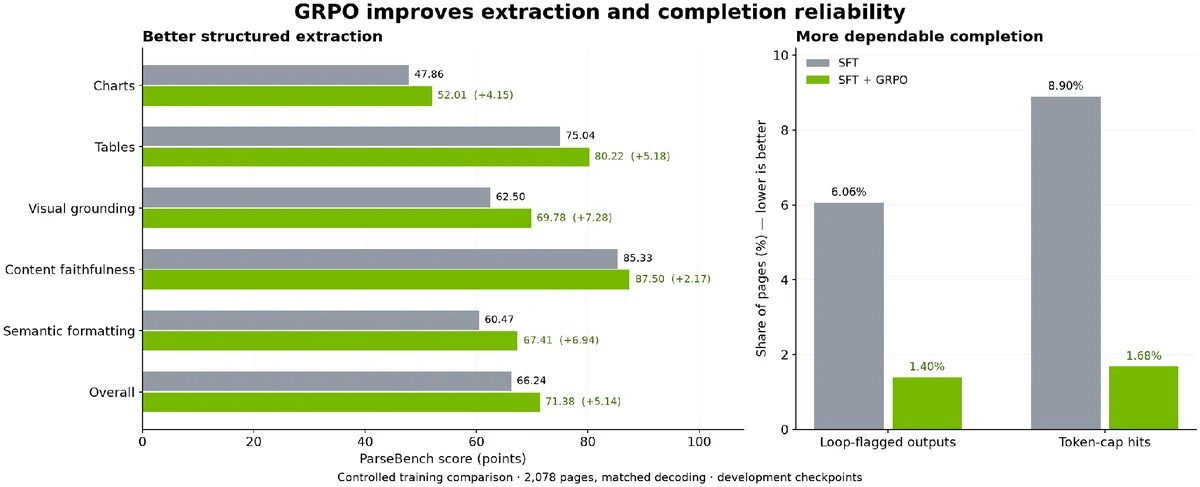
GRPO reinforcement learning improved extraction quality and cut looping and unfinished outputs. Image: NVIDIA
Faster inference with DFlash2
Parsing a page means generating a lot of text, so NVIDIA also reworked how Parse 3.5 processes images and decodes output. NaViT dynamic rectangular inputs replace the fixed 2048 x 1664 canvas of Parse 2.0, a visual adapter compresses the image sequence, and grouped-query attention with eight key/value heads (GQA-8) trims decoder memory.
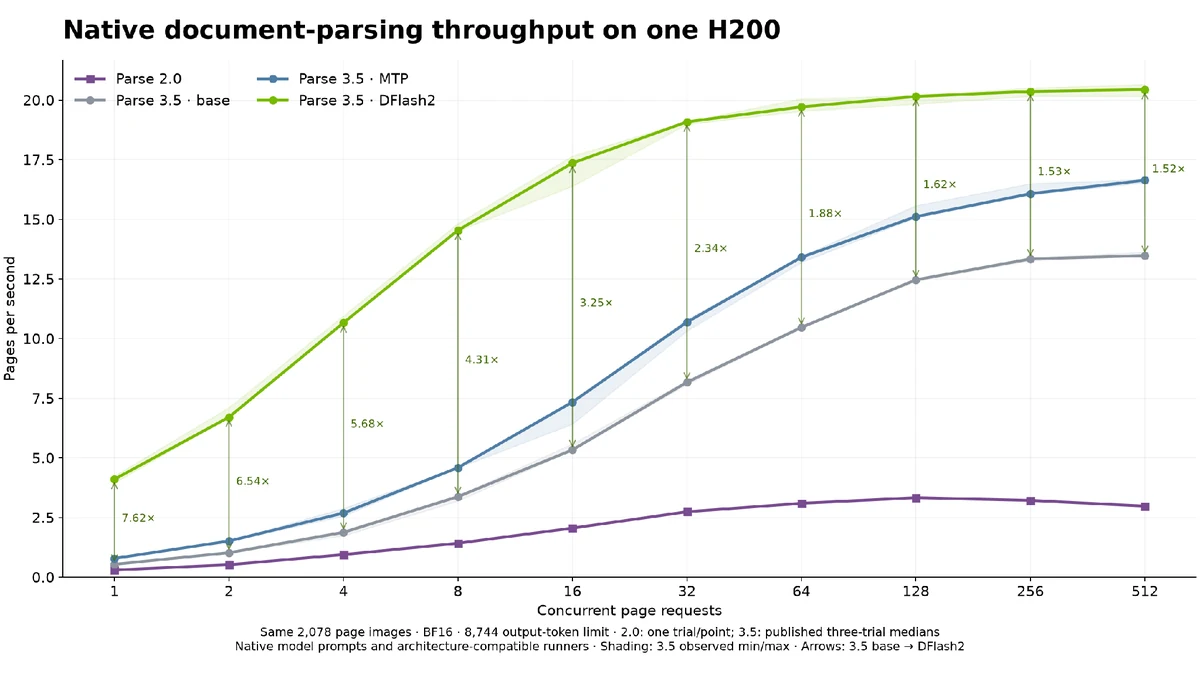
The headline change is DFlash2, a speculative decoder. A small draft model proposes up to 32 tokens ahead, and Parse verifies them together, averaging about 14 accepted draft tokens, or roughly 15 tokens of progress per verification step. In NVIDIA’s benchmark on one H200 GPU in BF16 over 2,078 pages, DFlash2 raised throughput 7.62x at concurrency 1 and 1.52x at concurrency 512. At 512 concurrent requests, Parse 3.5 reached 20.44 pages per second, against 13.48 without speculation and 2.98 for Parse 2.0.
Teams that want more accuracy can also run extra passes. A double pass that re-parses cropped table and chart regions adds 2.18 ParseBench points, and a triple pass with an independent region detector adds 2.46 points, trading some throughput for better extraction on difficult pages.
Why it matters
Document parsing is the unglamorous bottleneck for RAG systems and document agents: if the model misreads a table or a chart, everything downstream inherits the error. By releasing the training data and the recipe, NVIDIA lets teams adapt Parse 3.5 to their own documents, invoices, forms, or charts, without building a dataset from scratch. The worked example in the recipe makes the point concrete: on a synthetic dental form, the base model read the printed tooth numbers but missed the intended procedure table, while the adapted model reached an estimated first-attempt success rate of 96.58%, up from 0.00% before fine-tuning.
The community has already extended Parse for Thai, Persian/Farsi, and Arabic, NVIDIA says, and the new datasets should push that further. The release is a follow-up, not a new model, but for teams building document pipelines, open training data and a 7.62x faster decoder are the parts that change what they can ship.