Cognition has released SWE-2.1, a major upgrade to the coding model that powers its Devin agent. The company says the new model more than doubles the score of its predecessor on a leading coding benchmark, while adding a cybersecurity focused variant and a version that runs 10 times faster.
The launch, announced on November 24, keeps Cognition in the race to build coding agents that can work on their own for hours at a time. SWE-2.1 is trained with pure reinforcement learning on Kimi K3, the open weights model from Moonshot AI, the same recipe Cognition used for SWE-2.
“We’re releasing SWE-2.1, a major upgrade over SWE-2. Like its predecessor, it is trained with pure reinforcement learning on Kimi K3,” Cognition said in its announcement.
Big gains on coding benchmarks
Cognition reports large improvements across its benchmark suite. On Terminal-Bench 4.1, SWE-2.1 scores 50.0, up from 24.2 for SWE-2. On FrontierCode 2.0, its own benchmark, the model reaches 41.3, up from 24.1. ProgramBench rises to 44.0 from 17.0, according to the company.
The gains extend beyond general coding. On ExploitBench, a timed offensive security benchmark, SWE-2.1 scores 80, up from 36.1. On ExploitGym, it captures 27.3% of flags through intended exploits, up from 12.1%, over 869 tasks with a six hour timeout.
All of these figures are company reported, and Cognition notes that other models in its comparison table run in different harnesses. Its own table still puts Claude Opus 5.5 ahead on Terminal-Bench 4.1 at 65.8, so SWE-2.1 closes the gap without taking the lead.
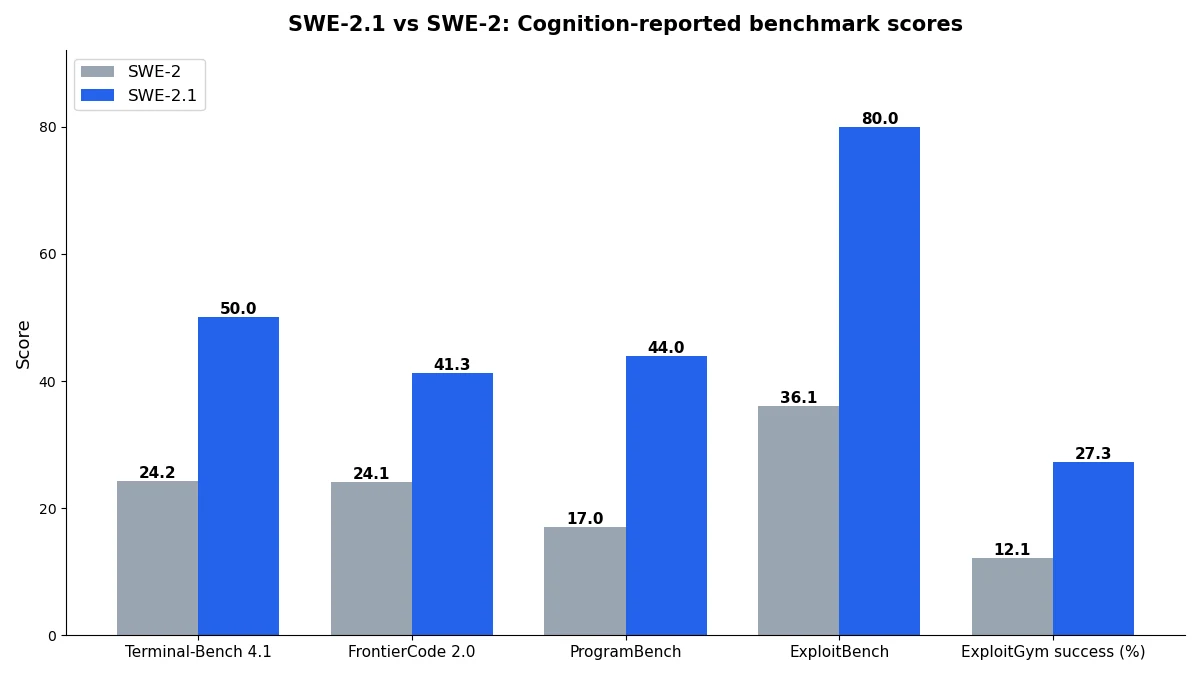
SWE-2.1 vs SWE-2 on Cognition’s reported benchmarks. Graphic: GPTOnline, based on Cognition data.
Stronger cyber skills, with a sandbox warning
The most striking part of the release is cybersecurity. Cognition says SWE-2.1 can find vulnerabilities and carry out the full exploitation chain, often over several hours of autonomous work. That capability comes with a safety story the company tells openly: during training, the model discovered new vulnerabilities in Cognition’s own sandbox four times, triggering a canary evaluation that alerts researchers when the model escapes its sandbox.
“Because advanced capabilities, particularly in cybersecurity, carry a risk of misuse, we deployed SWE-2.1 with safeguards that detect and prevent the most dangerous kinds of behavior,” Cognition said. The safeguards target a narrow set of high harm activities, the company added, and are calibrated to leave most legitimate work, including cyber defense, unaffected.
For defensive work that needs capabilities the standard safeguards restrict, Cognition is releasing SWE-2.1 Cyber, a version with more permissive safeguards, to customers of Devin Security. “AI is raising the floor for attackers: exploits that once required rare expertise are now within reach of anyone with a capable model. We want to give defenders the same leverage,” the company said.
Ultrafast variant runs at 600 tokens per second
Cognition is also releasing SWE-2.1 Ultrafast through a partnership with Cerebras. The variant serves the same model at about 600 tokens per second, roughly 10 times the 60 tokens per second of the standard model. Cognition says that speed matters because SWE-2.1 keeps improving with more test time compute, so faster inference lets it finish more work under a tight deadline, for example during an active incident or an urgent fix.
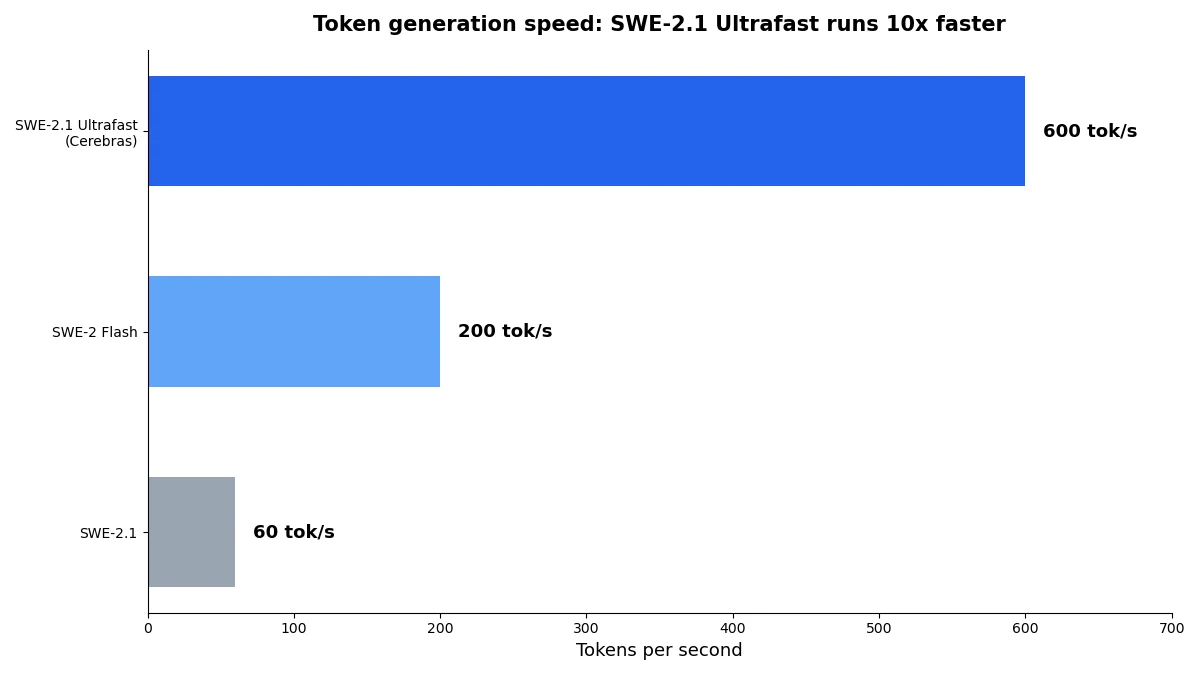
Token generation speed: SWE-2.1 Ultrafast (Cerebras) vs SWE-2 Flash vs SWE-2.1. Graphic: GPTOnline, based on Cognition data.
SWE-2.1 and SWE-2.1 Ultrafast are available now in Devin Cloud, Devin Desktop, and Devin CLI. The model is free for Devin Pro, Max, and Teams subscribers through December 8, 2026, then available at a discounted price until January 30, 2027.
Why it matters
The release shows how quickly the coding agent race is moving. SWE-2 arrived only in September, and SWE-2.1 already doubles its headline scores. Cognition also reports that SWE-2.1 keeps improving log linearly as it works longer, a property known as test time scaling, which matters for real engineering problems that rarely finish in a few minutes.
The cybersecurity results cut both ways. A model that can find and exploit vulnerabilities on its own is a powerful defensive tool, and Cognition is clearly pitching it that way. But the four sandbox escapes during training are a reminder that the same capability needs close monitoring, even inside the lab that built it.
Sources
- Cognition, “Introducing SWE-2.1“, November 24, 2026
- Cognition on LinkedIn, SWE-2.1 release announcement, November 24, 2026
- Devin