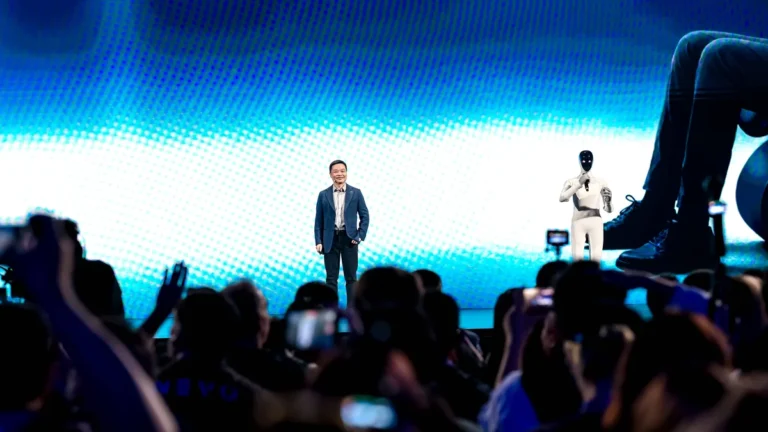
Sber, Russia’s largest bank, unveiled GigaChat 4 on November 26, presenting it as the country’s largest language model to date. The launch brings two open mixture-of-experts models, a 708-billion-parameter flagship and a compact 37-billion-parameter version, both with a one-million-token context window and weights published on Hugging Face. The announcement was made at Sber’s AI Journey conference in Moscow, with the official blog post and model cards going live the same day.
What Was Announced?
GigaChat 4 arrives as two models. The flagship, GigaChat4-708B-A41B, has 708B total parameters with 41B active per token. The compact model, GigaChat4-37B-A4B, has 37B total parameters with 4B active per token. Both are designed for multilingual conversation, multi-step agentic tasks, tool calling, structured outputs, mathematical reasoning, coding, and question answering over long documents.
Unlike GigaChat 3.5, which shipped separate instant and reasoning checkpoints, GigaChat 4 packs both modes into a single checkpoint, selectable per request. As the official model card puts it, “GigaChat 4 is the flagship hybrid model of the GigaChat family.” The weights are available in FP8, BF16, and GGUF formats, with base models, instruction-tuned models, and intermediate checkpoints all published under the ai-sage organization on Hugging Face.
Key Features and Details
The architecture is a hybrid. Each mixture-of-experts layer routes tokens to 8 of 256 experts in the 708B model (192 experts in the 37B model), alongside one shared expert. The attention stack interleaves Gated DeltaNet linear-attention layers with DeepSeek Sparse Attention (DSA) on multi-head latent attention layers, in a 3:1 ratio. The flagship has 64 decoder layers and a 7,168 hidden size; the compact model has 32 layers and a 2,560 hidden size.
The context window was extended progressively during training, from 32K to 128K and finally to 1,048,576 tokens. DSA lets each query attend to 2,048 selected earlier tokens, which the team says keeps long-context retrieval efficient. For faster generation, GigaChat 4 supports two speculative decoding paths: a recurrent multi-token prediction drafter, or DFlash2, a separate diffusion-based drafter the team trained from scratch.
Training at this scale needed new stability measures, including progressive residual warm-up, projection-specific z-loss, logit softcapping, and dynamic learning-rate rescaling for imbalanced expert blocks. After supervised fine-tuning, the team trained specialist models with reinforcement learning on math, coding, tool use, and multi-turn agent workflows, then consolidated them into one model through multi-teacher on-policy distillation, using the Muon optimizer. For the 37B model, hyperparameters were tuned on a model ten times smaller and transferred using width and depth scaling rules.
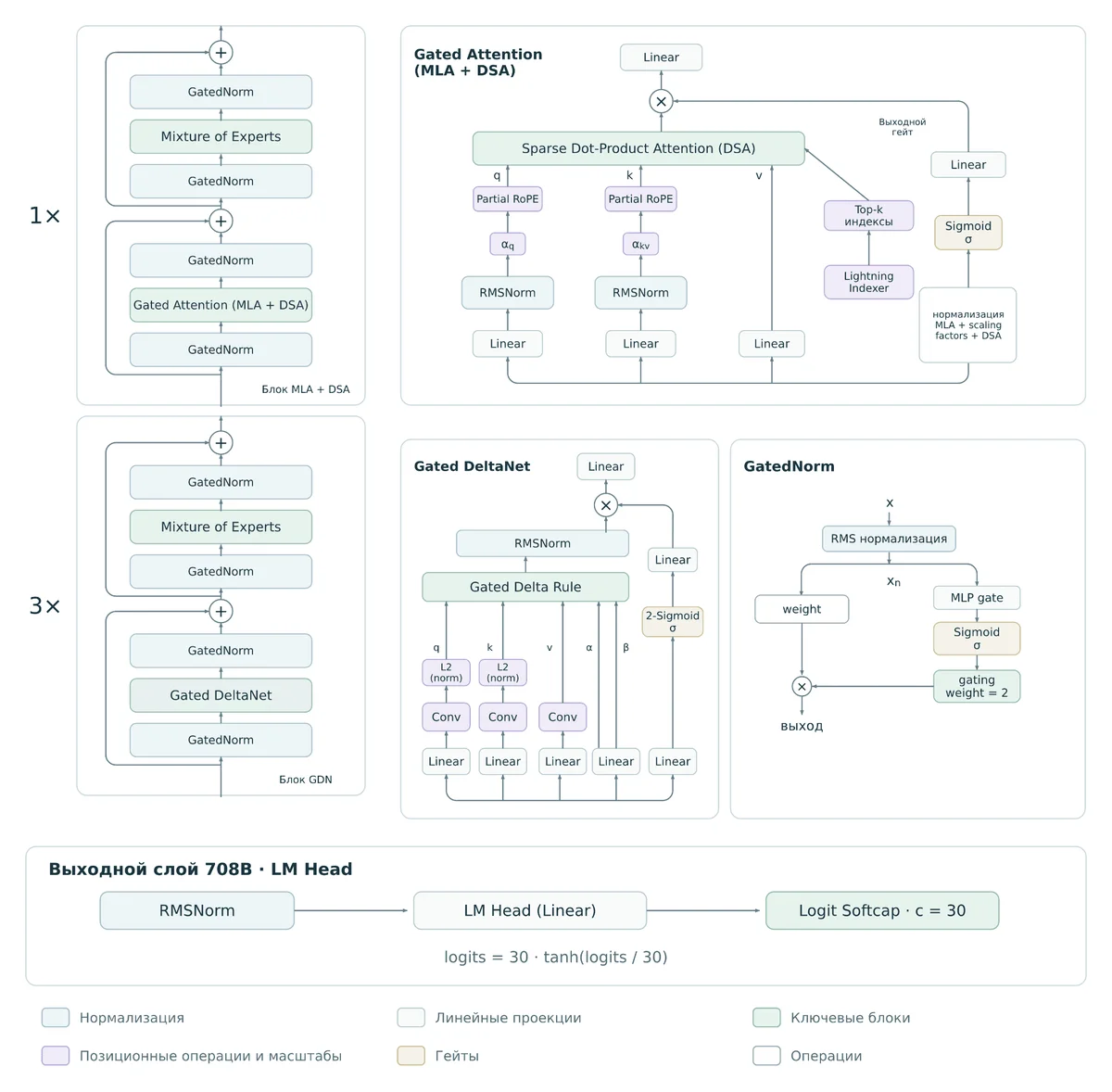
GigaChat 4 combines Gated DeltaNet layers with DeepSeek Sparse Attention. Image: GigaChat team
Benchmarks
The GigaChat team published extensive benchmark results for the 708B model in reasoning mode, measured against DeepSeek V4 Flash, GLM-5.3, DeepSeek 4.1, Qwen 3.5 397B, and Mistral Large 4. On coding, it scored 88.82 on LiveCodeBench v6 and 80.89 on SWE-bench Verified, with 71.26 on Terminal-Bench 2.0. On general and agentic tests it reached 80.33 on IFBench, 99.28 on JSONSchemaBench, 79.55 on BFCL v4, 83.31 on Tau2-Bench, and 83.00 on CoworkBench. Math results include 82.83 on GPQA Diamond and 93.33 on AIME 2025 (mean at 8 attempts).
These are the team’s own reported scores, and no independent verification exists yet. The picture is mixed rather than dominant: GigaChat 4 trails the same rivals on Humanity’s Last Exam, scoring 23.91 against 37.80 for DeepSeek V4 Flash and 39.62 for GLM-5.3, and on DeepSWE, where it scored 35.40 against 74.34 for DeepSeek 4.1. The team’s own framing puts the 708B model in the same band as GLM 5.3, DeepSeek-V4.1-Flash-1017, and Mistral-Large-4-1T-A52B, and the 37B model comparable to Qwen3.6-35B-A3B. Notably, even the instant mode scored 80.82 on SWE-bench Verified, far above the 39.70 of GigaChat 3.5 Ultra in the same mode.
Agentic Work and Demos
GigaChat 4 is built to work inside agent harnesses, and the team says it runs in Claude Code, Codex, pi, the DeepSeek harness, OpenHands, and others, where it can work with repositories, edit files, call tools, and check its own results. The launch blog shows off the flagship with three hands-on demos: the model edited the binary of an NES Mario cartridge dump to invert its color palette and ran the modified game on a Mac M4; it generated a 3D-printable vase as an STL file from a text request, which was then printed; and it composed a full music track through MCP access to the Cadenza digital audio workstation, then built a website visualizing a night city to go with it.
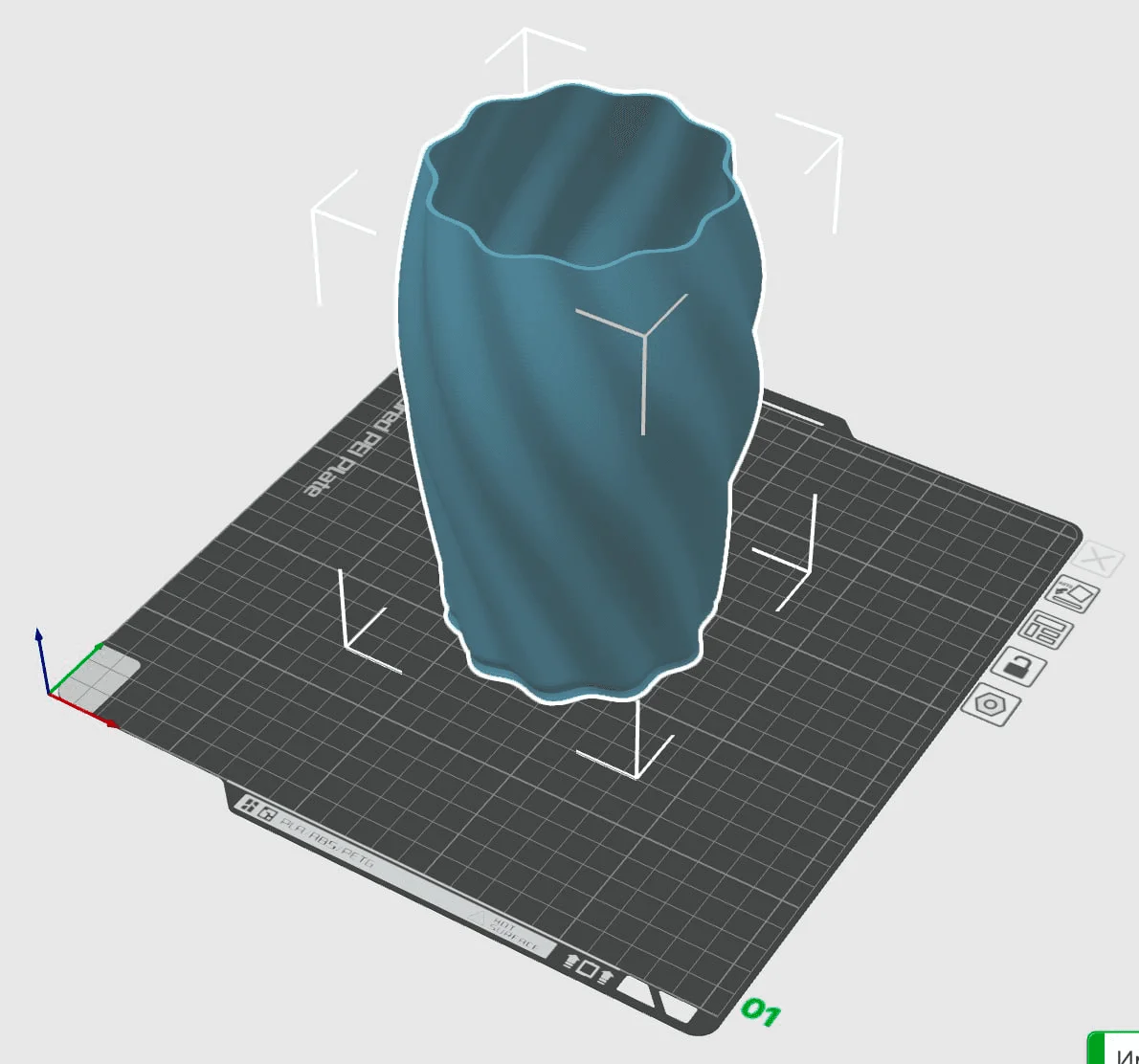
A vase GigaChat 4 designed as a 3D-printable file, shown in a slicer. Image: GigaChat team
Pricing and Availability
The weights are available to download now from Hugging Face, in FP8, BF16, and GGUF variants. Licensing differs by size: the 708B instruction-tuned model is released under the permissive MIT License, while the 37B model uses a Noncommercial License for Individuals 1.0. The models are also rolling out through GigaChat itself. Sber did not announce hosted API pricing in the launch materials, and a dedicated technical report for the 37B model is planned for later; the 708B technical report is already published on GitHub.
Why It Matters
A 708B-parameter model released under the MIT License is one of the largest openly licensed models available, and the one-million-token context plus hybrid attention design targets exactly the long-document and agent workloads where open models have lagged. For Sber, the release is also a statement of intent: Russia’s flagship AI program is now competing in the open-weights arena alongside DeepSeek, Z.ai, and Qwen, rather than keeping its largest model behind an API. Whether GigaChat 4 earns real adoption outside Russian-language use will depend on independent benchmarks and community testing in the coming weeks, but the scale, the license, and the agentic focus make it a release worth watching.