JetBrains released Mellum2.1 Instruct on Wednesday, November 25, an open coding model built to give fast, direct answers inside AI coding agents. The 12-billion-parameter mixture-of-experts model activates only 2.5 billion parameters per token, ships under the Apache 2.0 license on Hugging Face, and is the faster sibling of Mellum2.1 Thinking, the reasoning model JetBrains released in October.
Unlike the Thinking variant, which shows its chain of thought before answering, Instruct gives straight answers without the reasoning trace. JetBrains positions it for sub-agents, tool loops and chat, either on its own or as the fast worker next to a stronger model.
Why an Instruct version
Reasoning models shine on step-by-step work, such as tracing the root cause of a failing test. But much of a coding agent’s daily work is simpler: a small fix, a command to run, a question about the code. In those cases, JetBrains argues, reasoning adds time and computing resources without adding quality, and the cost is felt most when the model runs locally, where every extra thinking token adds to the wait. After the Thinking release, JetBrains says it received many requests from the local-inference community for a more concise model for moderately hard tasks.
Benchmark results
JetBrains compared Mellum2.1 Instruct with its predecessor, Mellum2 Instruct, and two open models in the same class, Qwen3.5 9B and Gemma 4 E4B, with thinking turned off. The biggest gain is on the agentic benchmark SWE-bench Verified, where the score doubled to 40.4 from 20.2. The model also leads its comparison group on code generation, scoring 73.7 on MultiPL-E, and records 51.4 on ToolHop, 38.0 on WorkBench, 87.2 on IFEval and 61.1 on AIME 25/26. Qwen3.5 9B still scores higher on SWE-bench Verified at 49.8, but Mellum2.1 Instruct generates tokens about 1.4x faster for a single request and 1.8x faster under load, according to JetBrains. All benchmark figures are self-reported by JetBrains, measured with the same open-source agent harness for every model.
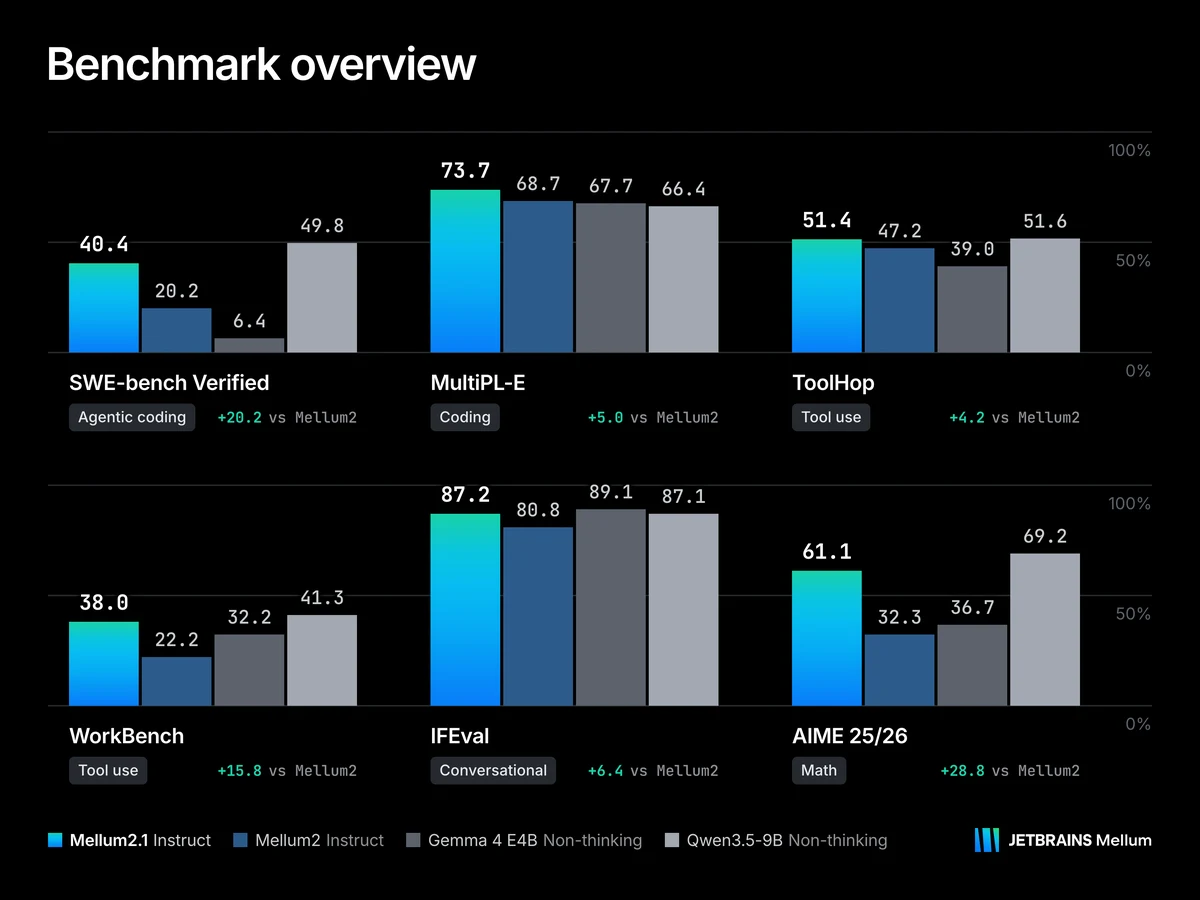
Mellum2.1 Instruct benchmark overview against Mellum2 Instruct, Gemma 4 E4B and Qwen3.5-9B. Image: JetBrains
The efficiency gap is the point. On agentic coding tasks, Instruct generates about 5,600 tokens per task, 45 percent fewer than the Thinking variant’s 10,100, and without tool calls the gap widens to 2,400 tokens versus 8,800, a 73 percent reduction. For comparison, JetBrains reported 47.0 on SWE-bench Verified for the Thinking variant in October, so Instruct trades a small amount of accuracy for a large saving in tokens.
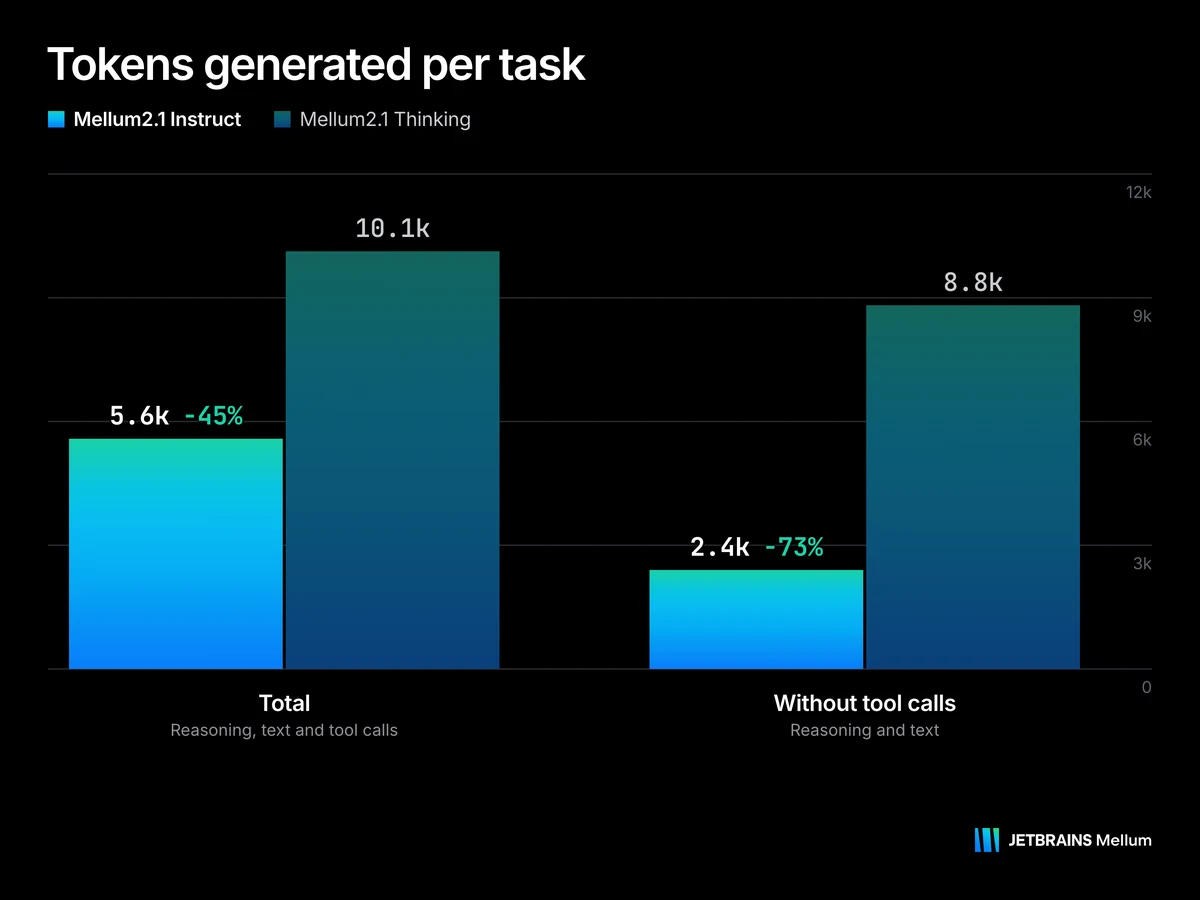
Tokens generated per task: Mellum2.1 Instruct versus Mellum2.1 Thinking. Image: JetBrains
How it was trained
Mellum2.1 Instruct went through the same two reinforcement learning stages as Thinking. First it learned to solve standalone tasks in code, math, tool use and instruction following, then it learned to work as an agent in real repositories, using shell and file tools inside a sandbox and earning rewards only when hidden tests passed. Both stages were built on NVIDIA NeMo open-source training libraries, and a single run collected about half a million agent trajectories from 10,000 concurrent sandboxes running on NVIDIA H200 and B300 GPUs. For the Instruct version, JetBrains tuned the length penalty to keep answers concise and brought generation and training into closer agreement.
Availability
Both Mellum2.1 variants are available on Hugging Face under Apache 2.0, with GGUF builds for running the model on a local machine and a multi-token prediction head that makes generation up to 1.8x faster. The release is aimed at developers building coding agents, sub-agents and AI tools that run on their own infrastructure.
Why it matters
Mellum2.1 Instruct is a bet that the next wave of coding agents will be built from small, cheap, specialized workers rather than one large model doing everything. A 12B model that activates 2.5B parameters per token can run on a single high-end GPU or a local workstation, and halving the tokens per task cuts both latency and cost. The trade is real, Qwen3.5-9B still beats it on the headline agentic benchmark, but for teams running agents at scale, JetBrains is arguing that speed and cost matter as much as the score.