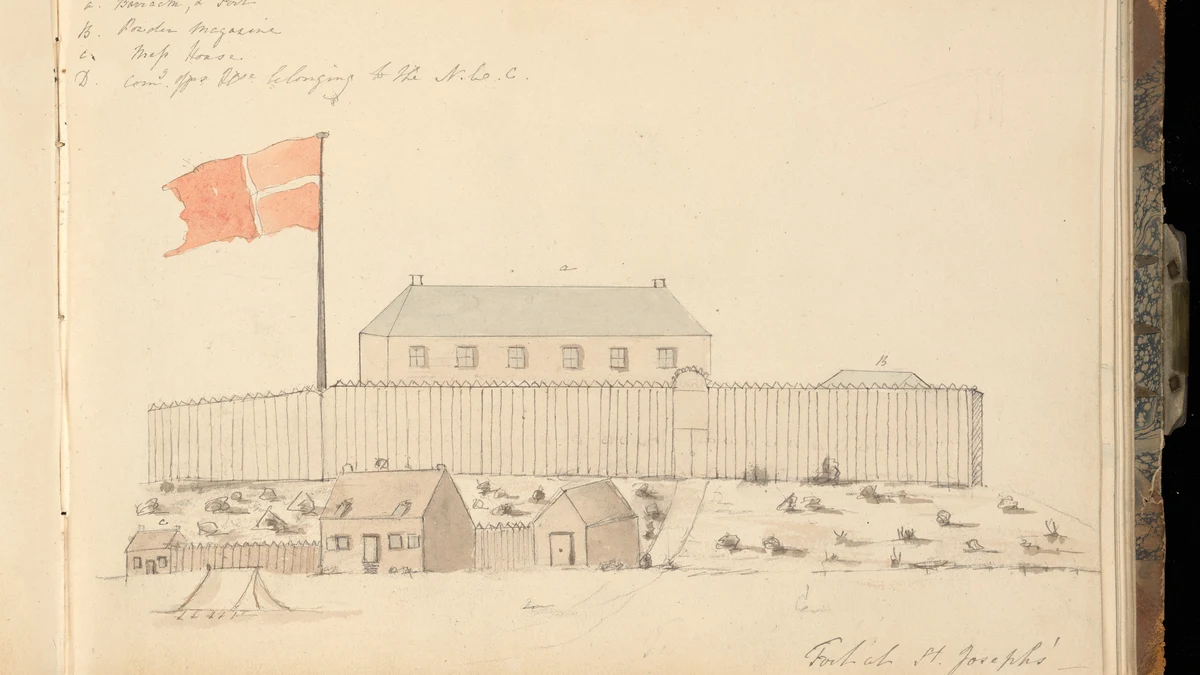
OpenAI’s newest model has done something no human historian managed in more than 200 years: it named the artist behind an anonymous sketchbook from 1808, and it did so in 22 minutes. The claim comes from a single case study, and the model itself later hedged. But the paper trail it uncovered is real, and it has already produced a lost diary that historians call a significant find.
History professor Mark Humphries described the experiment in a post published on November 24 on his Generative History newsletter. He had been testing GPT-6.2 Astra before its public release, and he gave it a task he considered impossible: identify the creator of an anonymous sketchbook held at Yale’s Beinecke Library.
The sketchbook nobody could attribute
The sketchbook has 84 pages, 34 of which carry pencil and ink drawings or watercolours. Only three are dated. It records a journey from Montreal to Fort William on Lake Superior and back in 1808, drawn by someone who depicted places in the Great Lakes that were destroyed only a few years later. Yale bought it from an antiquarian bookseller in 2020, and Humphries says he spent many hours over the years trying to identify the artist, with no luck.
The problem was the route itself. Hundreds of canoes made the same journey every year, so the artist could have been any one of several thousand people. The written sources that survive are handwritten, mostly unindexed and untranscribed, and scattered across dozens of archives. “Without knowing the person’s name in advance, it is almost impossible to know where to start looking,” Humphries wrote.
Twenty-two minutes to a name
Humphries gave GPT-6.2 Astra access to the sketchbook images and a short prompt asking it to determine who likely painted them. He set the model to its Ultra effort level. Only 22 minutes and 1 second later, it answered: “Louis-Guy-Charles-Guillaume de Rohan-Chabot, vicomte de Chabot (1780-1875), probably made the travel drawings.”
Chabot was a minor French aristocrat and Irish landowner whose family was displaced by the French Revolution. In exile he became a British Army officer and spent most of 1808 in Canada, posted as Deputy Adjutant General. Humphries says he had never heard of him, and that Chabot is almost totally unknown to North American and Canadian historians.
The model’s reasoning, as Humphries reconstructs it from its reasoning traces, worked like a historian’s. It first eliminated the two men Humphries had suggested in his prompt by placing them elsewhere on the dates of specific drawings. Then it found its key lead in an unlikely place: the diary of Joseph Frobisher, a retired fur trader, which records that on 6 June 1808 the vicomte de Chabot left Lachine for Kaministiquia with William McGillivray and William McKay. A letter by John Askin Jr., published in a document collection nearly a hundred years ago, placed Chabot at Fort St. Joseph later that month.
The testable prediction that proved it
Crucially, Astra did not just offer a name. It predicted that a travel journal kept by Chabot, available on microfilm from the Special Collections of Cleveland State University, would confirm the hypothesis if examined. Humphries ordered it.
The journal proved the case. Its itinerary aligned with the dated drawings, placing the diarist in the same places on the same days. Then came the decisive line. On 18 June 1808, after his canoe reached Fort St. Joseph, Chabot wrote: “I took a sketch” of the fort, describing the exact view shown in the matching drawing.
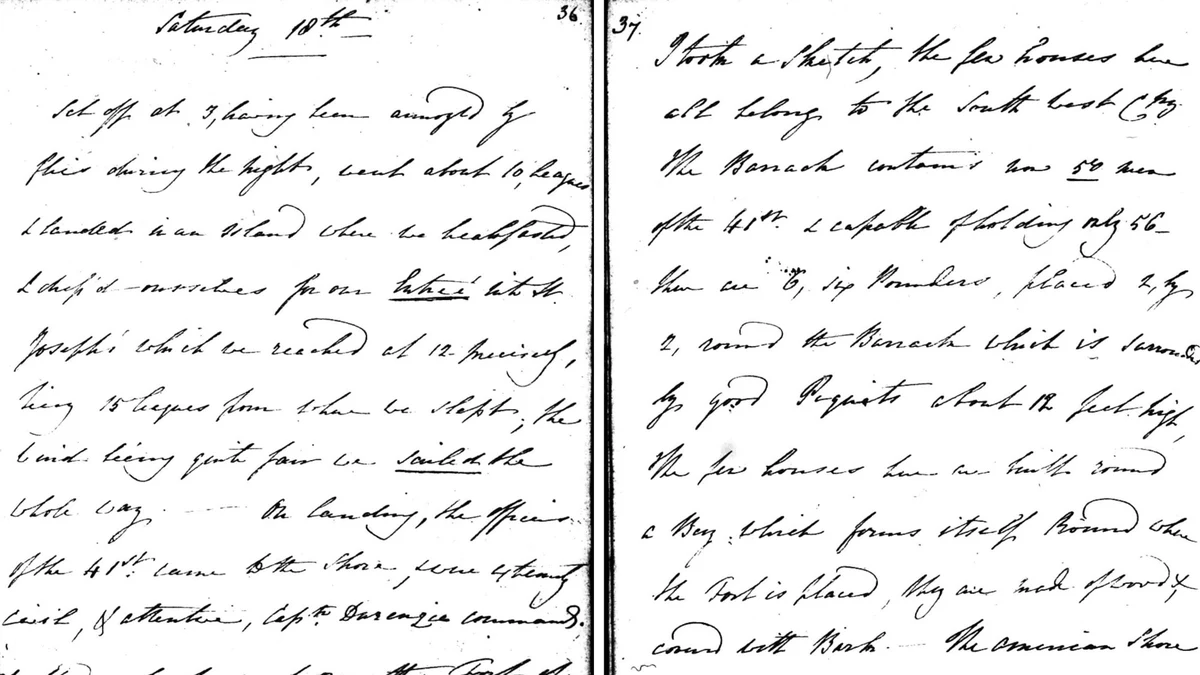
Chabot’s entry for 18 June 1808, pages 36-37 of his ‘Journal to the Upper Country’: ‘I took a sketch’ of Fort St. Joseph. Image: Lafayette Microfilm Collection, Cleveland State University, via Mark Humphries / Generative History
The journal itself is a find in its own right. It runs about 162 notebook pages and preserves excerpts from North West Company papers that were later destroyed, shedding new light on the fur trade, Indigenous ethnography and the origins of the Masson Collection, one of Canada’s most important document collections. A second part, covering Chabot’s travels in Lower Canada, survives in a private family archive in France.

George Nelson’s journal, 1 August 1808: ‘A Great Personage is said to have come to Fort William by the name of Count de Chabot.’ Image: Toronto Public Library, Baldwin Collection of Canadiana, via Mark Humphries / Generative History
What it does and does not prove
This is one practitioner’s report of a single task, not a controlled test, and no other scholar has yet published an independent check of the attribution. Humphries is candid about the limits: he could see only the model’s reasoning summaries and tool calls, and he writes that how Astra learned of the journal “remains a bit unclear”. The model traced it to a single footnote in a 2014 PhD thesis by historian Juliette Reboul, on aristocratic refugee families fleeing the French Revolution.
Humphries also ran the same test with Anthropic’s Fable 5.2. It reached the same conclusion in about 35 minutes, with a more coherent explanation, but it did not identify Chabot’s journal, which Humphries calls the most important piece of evidence. That, he writes, suggests these capabilities “are starting to exist generally at some level across the frontier models”.
There is a telling wrinkle. When Humphries showed Astra the diary, which he says proved the case beyond reasonable doubt, the model started to hedge, worrying that because the diary was not signed it might not be Chabot’s, and preferring to call it “an anonymous diary attributed to Chabot”. Humphries attributes the excessive doubt to a math-focused post-training regime, and calls it a limitation that will probably pass soon.
Why it matters
Humphries frames the result as history’s version of what mathematics went through over the past year, when models began solving long-standing problems. “That an AI model was able to autonomously make this discovery and contribute new knowledge to these fields, is remarkable,” he wrote. The identification of Chabot as the sketchbook’s creator, and the recovery of his largely unknown diary, will be of real interest to historians of both Canada and the fur trade, he says.
Whether the attribution holds up under peer scrutiny remains to be seen. But the diary is real, the sketch is real, and the connection between them was made by a model working from public sources in under half an hour. For a field that measures progress in decades, that is a result worth watching.
Sources
- Mark Humphries, “GPT 6.2 Astra Solves a Historical Mystery”, Generative History, November 24, 2026
- Simon Willison, “GPT 6.2 Astra Solves a Historical Mystery”, November 24, 2026
- Cleveland State University, Lafayette Microfilm Collection, Special Collections
- Yale Beinecke Rare Book and Manuscript Library