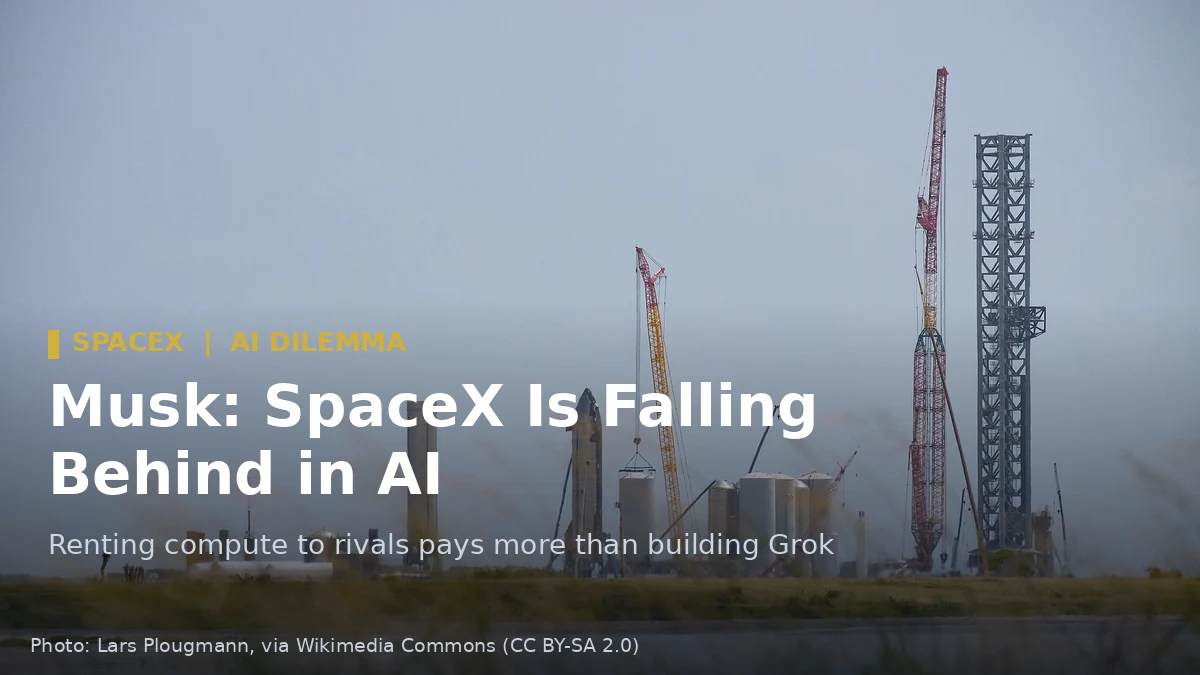
SpaceX falling behind in AI is the blunt message Elon Musk gave employees, according to a New York Times report published on November 23, with renting out the company’s computing power to rivals now paying better than using it to build SpaceX’s own AI products. The admission captures the strange position of the world’s most valuable AI landlord: its data centers earn more from competitors than from its own chatbot, Grok.
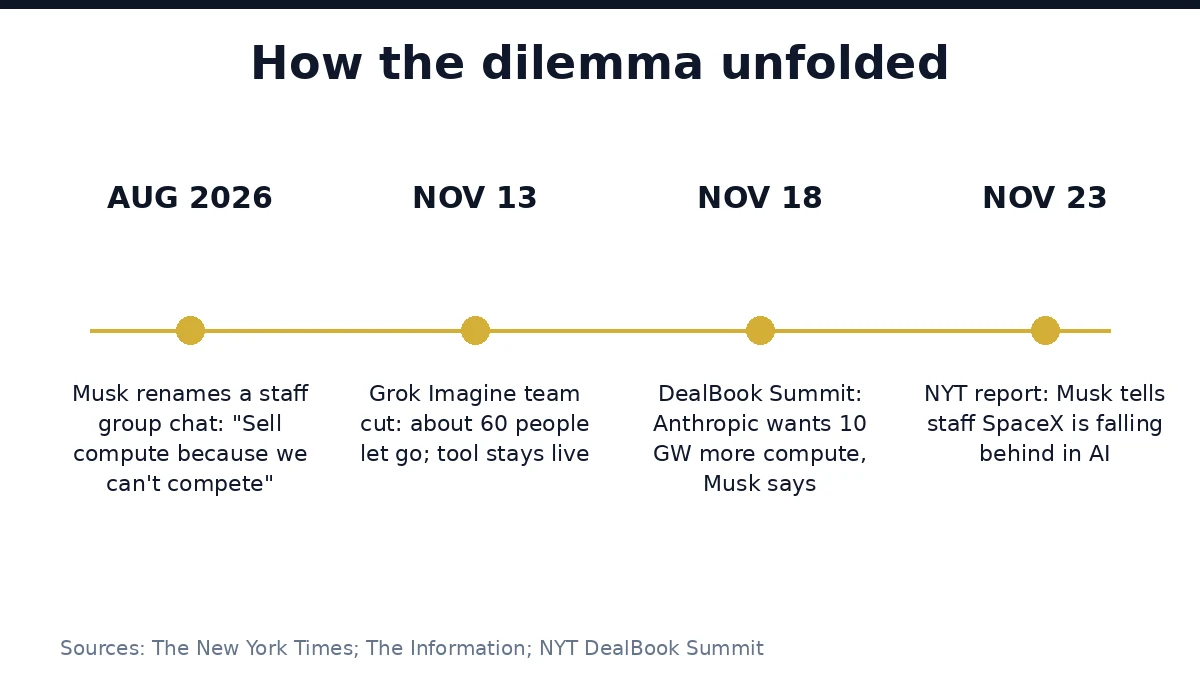
Musk told staff he was frustrated by the gap with rivals, the Times reported, citing people familiar with the matter. In August, he briefly renamed a group chat with employees to “Sell compute because we can’t compete,” and warned that wasting GPUs while the company was “failing to compete” would be treated as “a betrayal of your team,” according to Stocktwits’ account of the Times report.
What SpaceX has already cut back
The frustration has already reshaped SpaceX’s AI work. The company recently disbanded the team behind Grok Imagine, its AI image and video generation tool, cutting about 60 people in the week through November 13, The Information reported. A small number of staff remain to keep the product running, but without a dedicated team its future is uncertain. The Information said SpaceX is now prioritizing AI coding tools and its Grok Bot agent product instead.
The cuts came the same month SpaceX’s AI ambitions collided with its legal troubles. On November 23, Virginia and Oregon sued SpaceX over Grok’s image tools, alleging its “spicy mode” generated millions of sexualized images. The lawsuits target the same Grok Imagine product whose team Musk had just dismantled.
A business that now runs on rentals
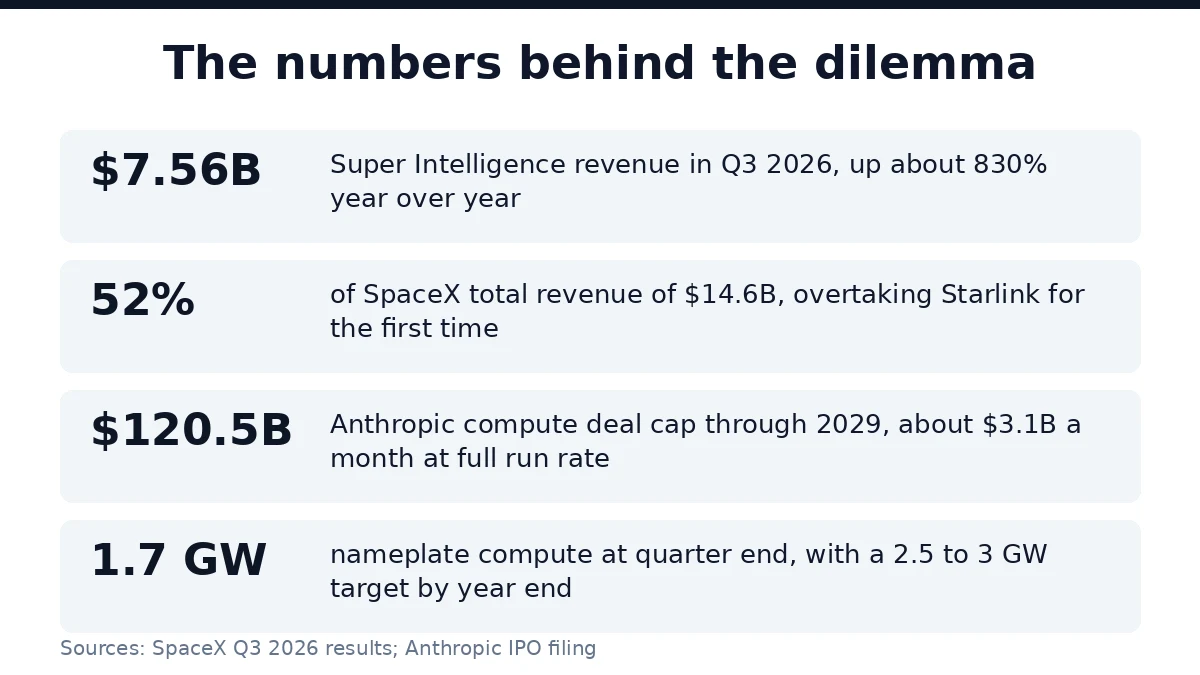
The numbers explain why renting won. In SpaceX’s third-quarter 2026 results, reported in late October, its Super Intelligence segment generated $7.56 billion in revenue, up roughly 830% year over year and accounting for about 52% of the company’s total $14.6 billion in sales, overtaking Starlink for the first time. Most of that revenue came from renting compute capacity to rivals, including Anthropic, the maker of Claude, and Alphabet.
Graphic: GPTOnline, using SpaceX Q3 2026 results and Anthropic’s IPO filing
Anthropic is the anchor tenant. Its IPO filing discloses agreements worth up to $120.5 billion with SpaceX’s AI unit through 2029, running at about $3.1 billion a month once all capacity is delivered, which Anthropic expects in December 2026, according to FourWeekMBA’s reading of the filing. Either side can cancel on 90 days’ notice after the initial non-cancelable periods expire in early 2027.
SpaceX ended the quarter with 1.7 GW of nameplate compute and a target of 2.5 to 3 GW by year end, while capital spending on AI infrastructure reached about $16.4 billion of the company’s $19.6 billion total capital expenditure. In other words, SpaceX is spending like a cloud provider and earning like one, too.
Why Musk still wants the compute
Musk is not walking away from the rental business. At the New York Times DealBook Summit on November 18, he said Anthropic told him it is “extremely likely” to keep renting compute from SpaceX and wants an incremental 10 GW more, about four and a half times what SpaceX had running at the end of October. Microsoft chief executive Satya Nadella said at the same event that he would lease SpaceX capacity if it were available.
Graphic: GPTOnline, using reporting from The New York Times and The Information
Wall Street, for now, is buying the landlord story. Jefferies launched coverage of SpaceX on November 23 with a Buy rating and a $210 price target, and the stock rose about 7% on Monday, even as the Times report circulated.
Why it matters
The dilemma is structural. Every GPU SpaceX rents to Anthropic or Google is a GPU that is not training Grok, yet those rentals fund the data center buildout that Grok would need to catch up. Musk’s own framing makes the tension explicit: selling compute is the rational business today, and competing is the goal he is not yet meeting. Until Grok closes the gap, SpaceX’s AI division will keep earning most of its money from the very rivals it is trying to beat.
Sources
- The New York Times, “Elon Musk Faces an A.I. Dilemma at SpaceX” (November 23, 2026)
- Stocktwits, “SPCX Stock Gets A ‘Buy’ Rating From Jefferies For Its Engineering Edge, But Musk Reportedly Fears SpaceX’s AI Lag” (November 23, 2026)
- The Information via ai123, “SpaceX AI unit cuts about 60 from Grok Imagine video team” (November 13, 2026)
- FourWeekMBA, “Musk Says Anthropic Eyes 10 GW More From SpaceX’s AI Cloud” (November 2026)