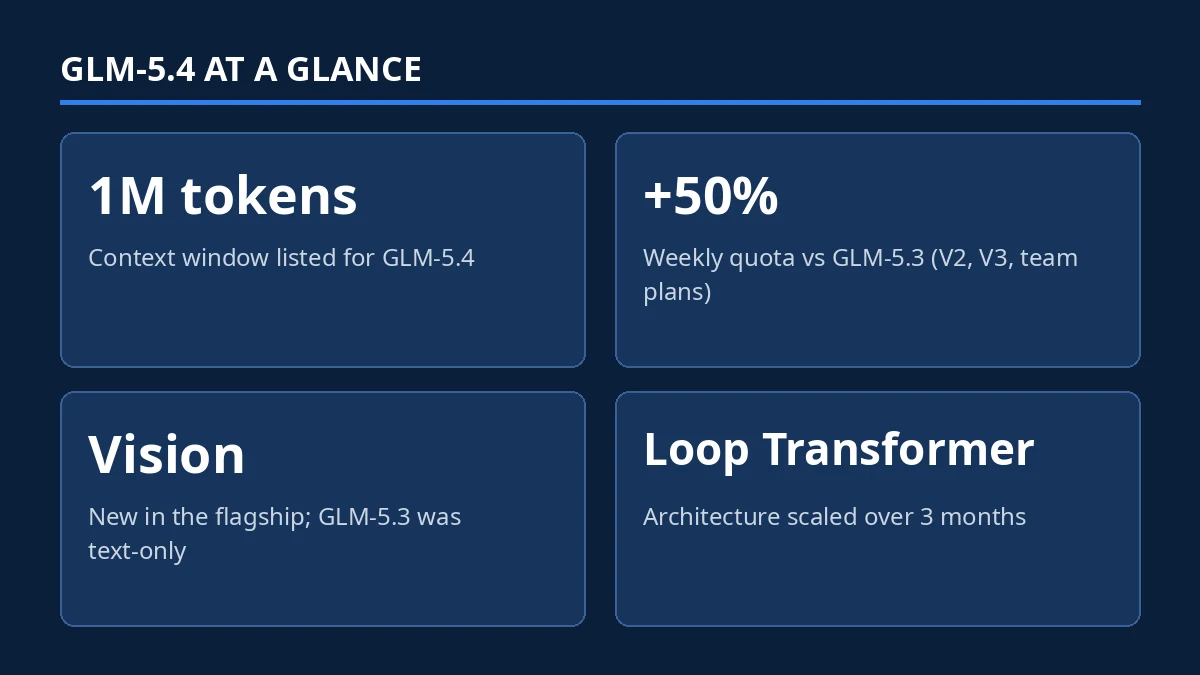
Zhipu has quietly rolled out GLM-5.4, the next version of its flagship coding model, to every subscriber of its GLM Coding Plan. The November 23 release adds vision input to the flagship for the first time, lists a one-million-token context window, and raises weekly usage quotas by 50 percent over GLM-5.3. Zhipu has not published a parameter count, benchmark scores, API pricing or an open-weight release plan yet, and the launch arrived without a formal technical blog post.
What Was Announced?
The rollout was announced on X by Zixuan Li, Z.ai’s head of global ecosystem, in a post the company’s official account reposted. Li wrote: “GLM-5.4 is now available to all GLM Coding Plan users. New vision capabilities and stronger all-round coding performance. For users with weekly quotas, GLM-5.4 now comes with 50% more quota compared to GLM-5.3.” TechNode reported the rollout on November 23, noting the model had appeared in the Coding Plan selection menu that day, listed with vision support and a one-million-token context window.
Subscribers can select the model as glm-5.4 in supported tools, or as glm-5.4[1m] in Claude Code. The 50 percent quota increase applies to V2, V3 and team plans, according to Zhipu’s operations team.
GLM-5.4 at a glance. Graphic: GPTOnline
What Is New in GLM-5.4
Vision is the headline change. The previous flagship, GLM-5.3, handled text only. The lighter GLM-5.3-Flash already accepted images, but the flagship could not. GLM-5.4 closes that gap, so the top model can now work directly from images such as interface screenshots, a practical addition for frontend development and for tracking down page problems.
The context window is the second change. The Coding Plan menu lists a one-million-token window for GLM-5.4, and the glm-5.4[1m] identifier in Claude Code points to that variant. Long context matters for coding agents that must hold large codebases in memory while they plan and edit across files.
Under the hood, Zhipu says it spent the past three months scaling both model size and its Loop Transformer approach. A Loop Transformer reuses layers across multiple passes to increase effective depth without a proportional rise in unique parameters, according to descriptions of the design. Zhipu has not said how large GLM-5.4 is. The company also claims stronger all-round coding performance, but it has published no scores to support that claim yet.
What Zhipu Has Not Disclosed
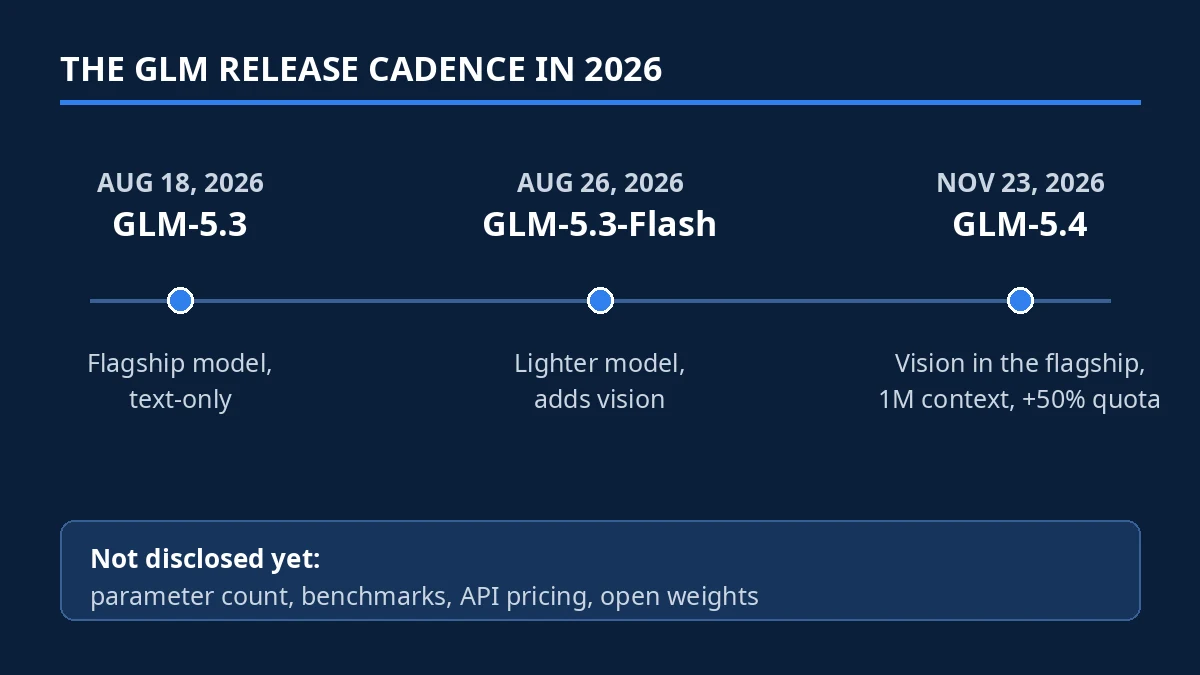
For a flagship release, the gaps are large. As of November 23, Zhipu had disclosed no total parameter count, no active parameter count, and no official benchmark results such as SWE-bench or Terminal-Bench. Pay-as-you-go API pricing is also unannounced, and there is no word on an open-weight release schedule.
There is no formal launch document either. Z.ai’s developer documentation still lists GLM-5.3 and GLM-5.3-Flash as the newest models, and the documentation page for GLM-5.4 returns a not-found error. TechInAsia reported that the model “has not been formally released,” even as it went live inside the subscription plan. The pattern points to a subscription-first rollout: put the model in front of paying developers, collect usage data, and publish the formal details later.
An Early Independent Test
One early independent test gives a first, unofficial read on the model. Blogger AICodeKing ran GLM-5.4 through his own KingBench 4 programming test, six complex projects including a game simulator and a 3D interior designer, and scored it at 55.3 percent, seventh of 19 models tested and the top open-source model on his list.
The same test flagged a cost. GLM-5.4 took 431 minutes to finish the full test, against 109 minutes for Google’s Gemini 4 Neon, and used about 1.04 million tokens, nearly 15 times Neon’s total. The blogger’s verdict was that GLM-5.4 works best as a code reviewer or for complex engineering planning, rather than as the model that handles every task. This is one blogger’s own test, not an official benchmark, and it should be read as an early signal only.
The GLM release cadence in 2026. Graphic: GPTOnline
Why It Matters
GLM-5.4 keeps Zhipu on a fast release cadence. GLM-5.3 arrived on August 18, GLM-5.3-Flash followed on August 26, and the new flagship lands about three months later. The company, a Beijing-based AI developer that Dealroom lists as a decacorn valued at at least $10 billion, is now competing directly with the coding assistants developers already pay for, including Claude Code and GitHub Copilot, by shipping its flagship inside a subscription plan rather than as a standalone launch.
The quiet rollout also fits a wider shift in how Chinese labs ship models: availability first, documentation later. For developers, the practical question is whether the vision support and the larger context window make GLM-5.4 worth the switch inside tools they already use. Until Zhipu publishes benchmarks and pricing, that question has no official answer, only early tests and the quota increase as a reason to try it.