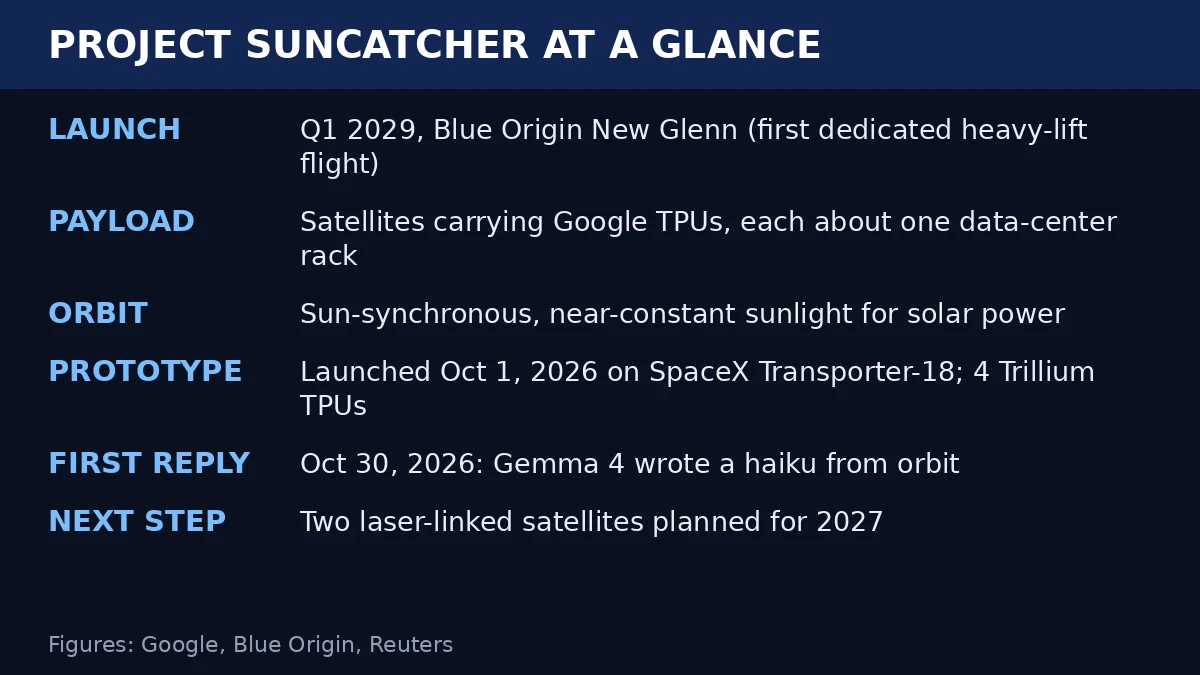
Google is taking its plan to run artificial intelligence in orbit a step closer to reality. The company said on November 19 that it has signed a launch services agreement with Blue Origin to fly satellites for Project Suncatcher, its long term research effort to test whether machine learning compute can scale in space, on the heavy lift New Glenn rocket in the first quarter of 2029.
Each satellite will carry Google Tensor Processing Units, the custom chips Google designs to run AI workloads, and will offer computing capacity roughly equal to a rack of servers in a conventional data center, according to Blue Origin. The satellites will fly into sun-synchronous orbit, where they receive near continuous sunlight.
What Was Announced?
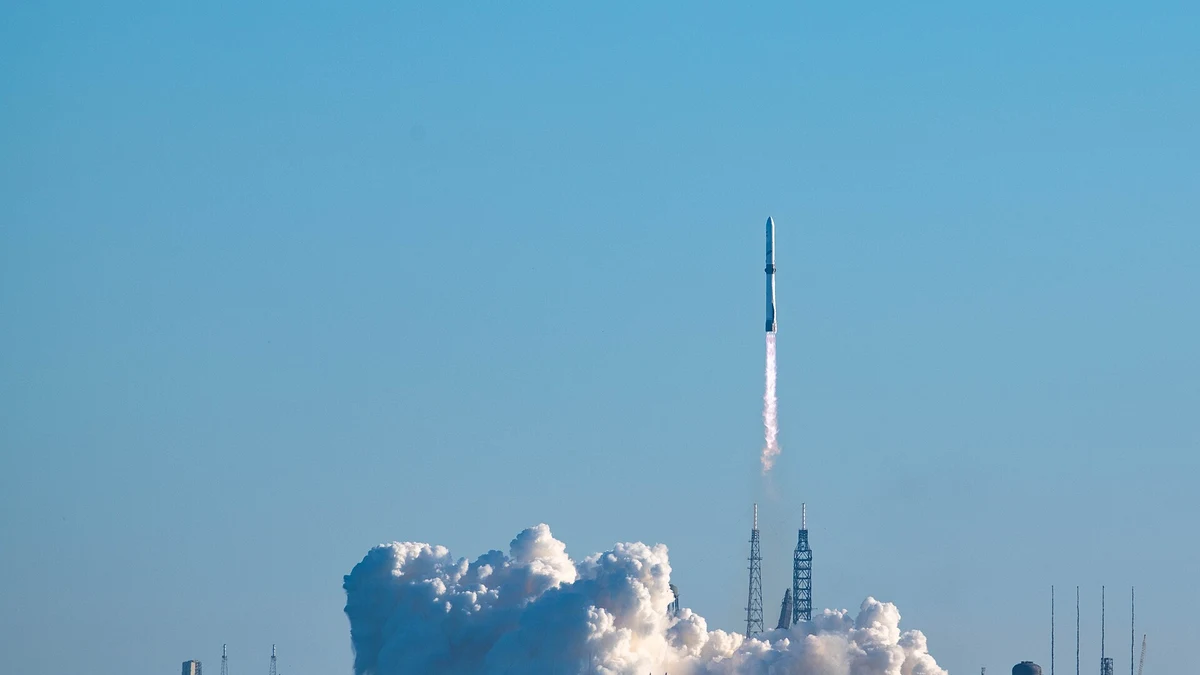
The agreement covers the first dedicated heavy lift launch for Project Suncatcher. Until now, the program has flown only a single small prototype satellite, launched aboard a SpaceX rideshare in October. The 2029 mission will carry several computing satellites on one New Glenn flight, marking the first time Google has booked a dedicated heavy lift rocket for the project.
“Project Suncatcher represents the ambitious missions New Glenn was built to support,” said Jordan Charles, senior vice president of New Glenn at Blue Origin. “Its heavy-lift capacity and large payload volume give customers the flexibility to bring new capabilities to orbit. We’re proud to work with Google to explore space-based computing and its potential to expand the space economy.”
Travis Beals, senior director of Project Suncatcher at Google, called the agreement a milestone for the program. “Project Suncatcher is a long-term moonshot to scale AI infrastructure in space by tapping into the abundant solar power in orbit,” Beals said. “This dedicated launch with Blue Origin represents a crucial milestone on our roadmap as we expand the boundaries of what’s possible for the future of compute.”
Neither company disclosed the value of the launch services agreement. The deal also gives Blue Origin a major future mission for New Glenn as the company works to build up its launch business after delays and a launchpad explosion in May, Reuters reported.
Why Put AI in Space?
The idea behind Suncatcher is energy. AI data centers on Earth consume enormous amounts of electricity, land and water for cooling, and demand keeps rising. In orbit, a satellite in a dawn-dusk sun-synchronous orbit sees near constant sunlight, and Google says a solar panel there can collect up to eight times as much energy in a year as a panel at a mid-latitude site on the ground.
Google’s design paper, published in the journal Joule, sketches a cluster of 81 satellites flying within about a kilometer of each other and linked by free space optical connections, effectively a data center made of satellites instead of concrete. The 2029 launch is a research step toward that vision, not a commercial deployment. Google has announced no timeline for a fully operational constellation.
Google is not alone in exploring the idea. Reuters noted that SpaceX and startup Starcloud are also exploring data centers in orbit as growing AI use drives demand for computing capacity and strains the infrastructure supporting ground facilities.
The Prototype So Far
Project Suncatcher was announced in November 2025. Its first prototype, a Planet-built satellite about the size of a refrigerator, launched on October 1, 2026, aboard SpaceX’s Transporter-18 rideshare mission from Vandenberg Space Force Base. The spacecraft, known internally as MVP, carries four Google Trillium TPUs and draws about one kilowatt of solar power, according to Ars Technica.
On October 30, Google said the prototype had produced the first AI response from a data center class TPU in orbit. The onboard Gemma 4 model answered a prompt uplinked from the ground with a haiku about being in space: “Blue marble below / Data streams in silent grace / Starlight feeds my core.” Google chief executive Sundar Pichai announced the milestone on X the same day.
The prototype is an instrumented stress test, not a working data center. Its job is to gather data on how the chips handle launch forces of up to 10 g, radiation and extreme temperatures, and how to cool them without the airflow available on Earth. In a vacuum, heat from powerful chips must leave through pipes and panels rather than conventional cooling systems, and radiation can damage electronics and corrupt data. Google says thermal stress and radiation testing continue, with a planned 2027 milestone of two interconnected satellites testing the laser links needed to connect future computing clusters.
Why It Matters
The Blue Origin deal turns Suncatcher from a single satellite experiment into a multi-satellite program with a heavy lift launch on the calendar. It also signals how seriously Google is taking the energy problem behind AI scale. If solar powered compute in orbit proves workable, it could ease pressure on electricity grids, land and cooling systems on Earth, though experts caution that high launch costs, engineering hurdles and limited satellite production could keep orbital data centers years away from commercial use.
For now, the 2029 flight is a feasibility test. The results from the prototype, and from the two linked satellites planned for 2027, will decide whether the idea ever grows beyond a research moonshot.
Sources
- Google blog: Google partners with Blue Origin on Project Suncatcher heavy-lift launch
- Blue Origin: Google Selects Blue Origin’s New Glenn for Project Suncatcher
- Reuters: Google picks Bezos’ Blue Origin to launch AI computing satellites in 2029
- Unite.AI: Google Plans Orbital AI Satellite Launch on Blue Origin’s New Glenn