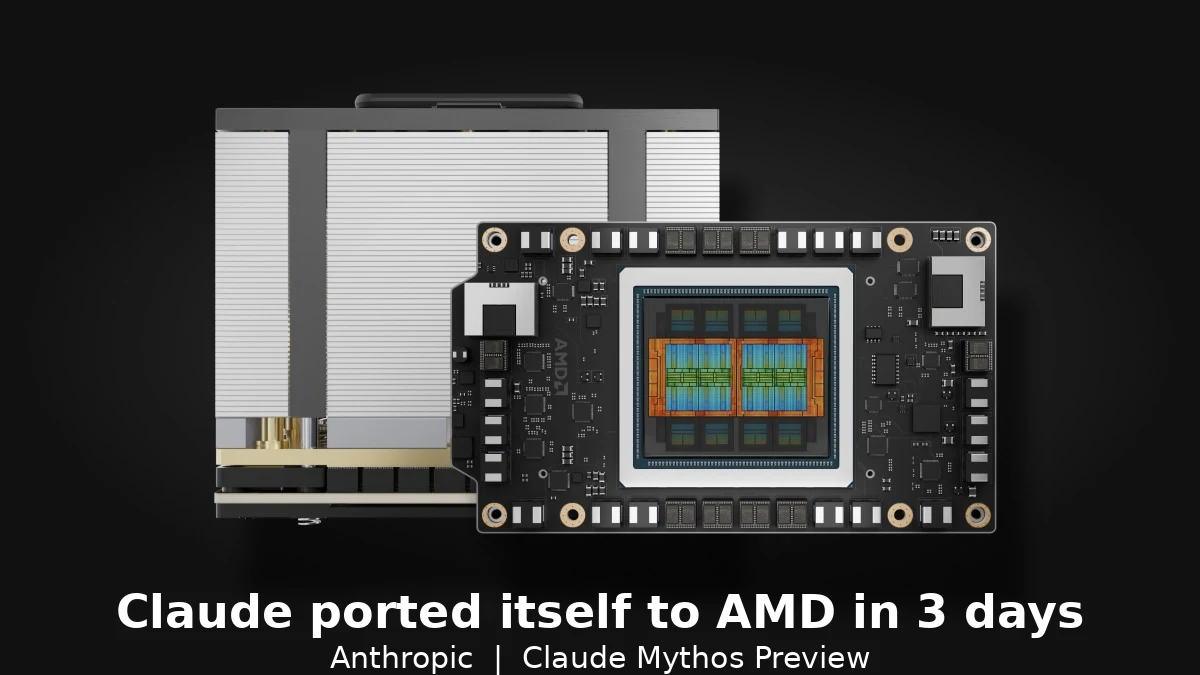
The Claude Mythos AMD port took about three days, Anthropic told IPO investors on November 10, and the model did the work with “basically no human intervention.” The claim, made by co-founder and chief compute officer Tom Brown in Anthropic’s IPO roadshow video, puts a number on a question the AI industry has argued about for a year: whether AI can write the low-level code that ties a model to a new chip.
Tom’s Hardware reported the claim on November 16, and the transcript of Brown’s remarks matches the roadshow video. “This time, we had Mythos try it out,” Brown said. “It got Claude running on AMD in just three days, with basically no human intervention. Claude ported or wrote almost 100% of the kernels.” The kernels are the low-level programs that make a model run efficiently on a specific chip.
What Was Announced?
The model that did the work is Claude Mythos Preview, the name Anthropic used in the roadshow. Anthropic only started working with AMD GPUs this year, and bringing up a new chip platform previously took “dozens of engineers months of work.” The roadshow chart sets the two timelines side by side: about three days with Mythos against about six to 12 months with a traditional approach.
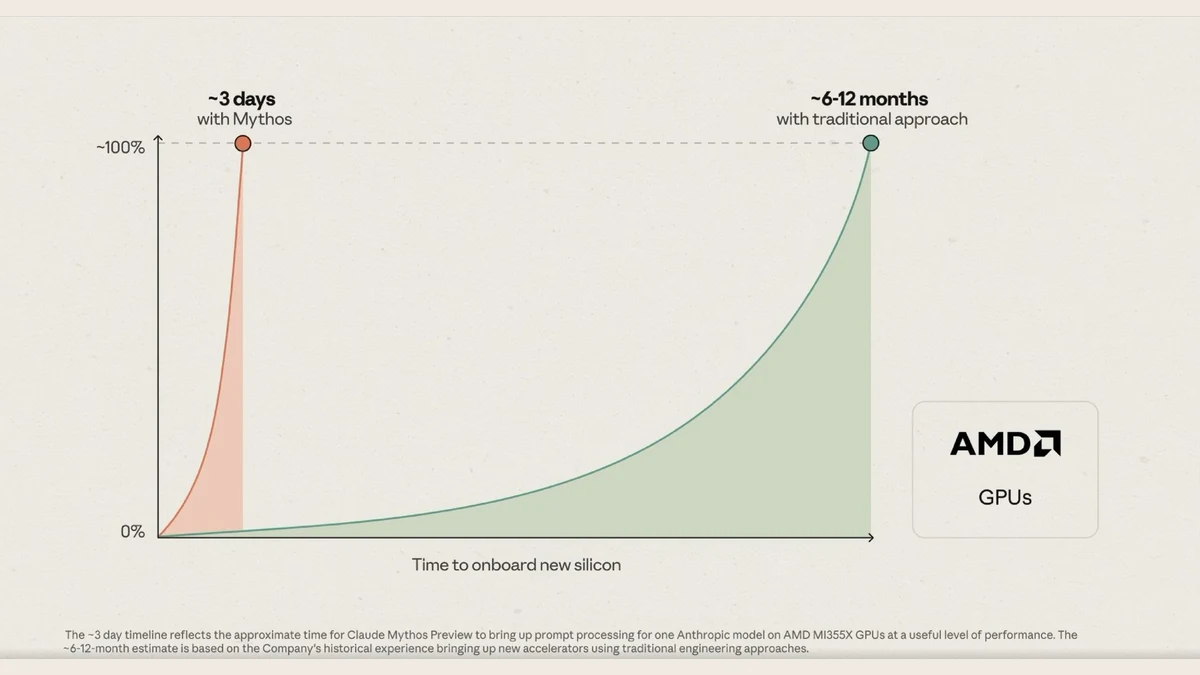
Anthropic’s roadshow chart compares about three days with Mythos to about six to 12 months with a traditional approach. The footnote limits the three days to prompt processing for one model. Image: Anthropic.
The amended prospectus, filed the same day as the roadshow video, makes the same point in writing, though without a number: “We can onboard new chip platforms in a fraction of the time it once took.” “We train and serve Claude now across all four major chip families,” Brown said, naming AWS Trainium, Google TPUs, NVIDIA GPUs, and AMD GPUs, managed as “one fungible pool of compute.” Anthropic holds an agreement with AMD for up to 2 gigawatts of capacity, and its first AMD MI450 chips, in Helios racks, are expected in the first half of 2027.
Read the Footnote Before Repeating the Number
The three-day figure is real, but it is narrower than the headline suggests, and Anthropic’s own slide says so. The footnote under the chart states that the three days reflect “the approximate time for Claude Mythos Preview to bring up prompt processing for one Anthropic model on AMD MI355X GPUs at a useful level of performance.” Prompt processing, or prefill, is the step where a model reads its input before it starts replying. Anthropic has not said whether the reply step, known as decode, was included, or how fast the model ran on AMD hardware compared with NVIDIA hardware. The six-to-12-month baseline is also Anthropic’s own number, based on its “historical experience bringing up new accelerators using traditional engineering approaches,” not an independent measurement.
There is earlier evidence pointing the same way. At AMD’s Advancing AI event on July 23, Brown said one engineer asked Claude to bring up an MI355X rack and left it running “over the weekend.” AMD chief executive Lisa Su said her team was told Anthropic did not need AMD’s help, and AMD’s Vamsi Boppana said some resulting kernels were “better than the most manually tuned versions.” Under the July agreement between the two companies, AMD is also using Claude to optimize workloads for its Instinct GPUs and to speed up development of ROCm, AMD’s rival to NVIDIA’s CUDA software.
The Wider AMD Bet
The hardware itself is moving into production. AMD announced on November 16 that the Lux supercomputer at Oak Ridge National Laboratory, built by HPE, is now open to scientific users, running on AMD Instinct MI355X GPUs. The same chips Anthropic ported Claude to are now doing scientific computing.
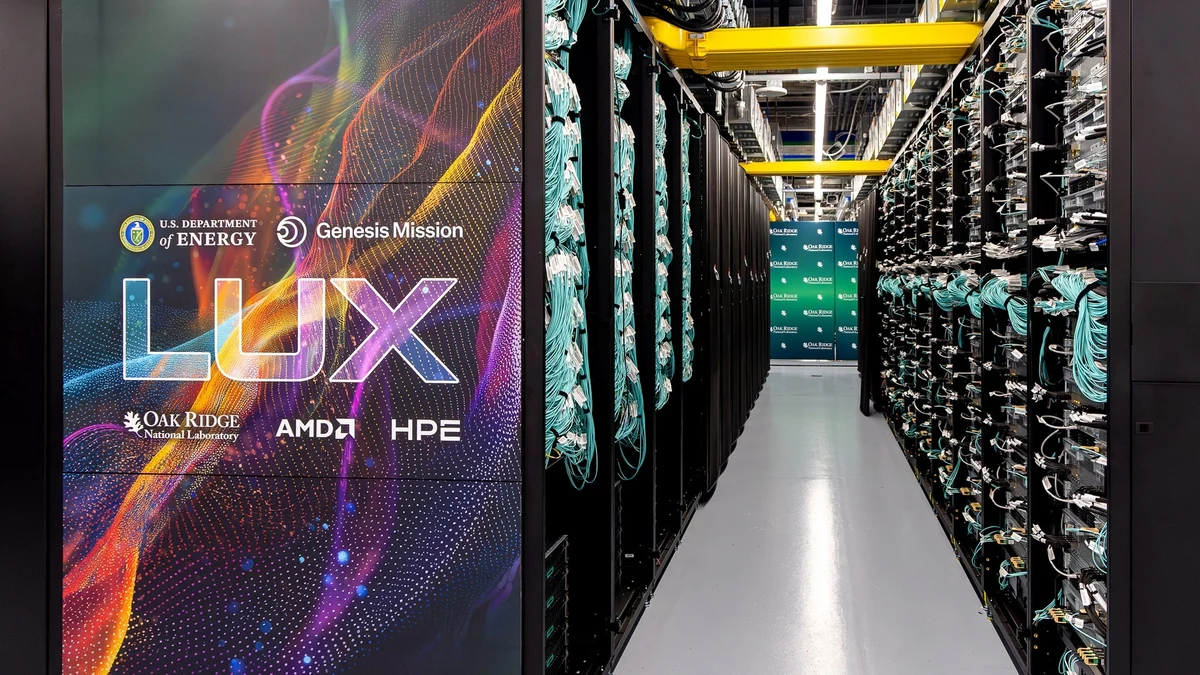
The Lux supercomputer at Oak Ridge National Laboratory runs on AMD Instinct MI355X GPUs. Image: Oak Ridge National Laboratory.
Why It Matters
NVIDIA’s strongest defense has never been only its chips. It has been CUDA, the software platform that makes those chips easy to program, and the years of tuned code built on top of it. If an AI model can write the equivalent low-level code for a rival chip in days, that defense gets thinner. SemiAnalysis argued in July that software creation is not the same moat it was even a year ago, while noting that each agent still needs GPUs to test its code against.
NVIDIA chief executive Jensen Huang has pushed back. In an April interview he said NVIDIA already uses AI on its own kernels and “nobody knows our architecture better than we do,” and he called Anthropic “a unique instance, not a trend.” The financial ties cut both ways: Nvidia and AMD are among seven companies buying $26.0 billion of Anthropic stock at the IPO price. Anthropic’s IPO pricing is expected on November 18, with trading on Nasdaq under the ticker ANT starting November 19.
Anthropic has shown, on its own account, that its model can do in days a piece of hardware onboarding work that once took months of human engineering, for one model and one stage of the workload. Whether that generalizes to full training runs, to decode, and to performance matching NVIDIA hardware is still unproven. The next test comes in the first half of 2027, when the first MI450 chips arrive in Helios racks. GPTOnline previously covered Anthropic’s launch of Claude Fable 5.2 and Mythos 5.2, and the benchmark context for this week’s hardware news in NVIDIA’s Vera Rubin sweep of MLPerf Training v6.1.
Sources
- Anthropic says Claude Mythos Preview cut AMD MI355X onboarding from up to 12 months to around three days (Tom’s Hardware, via Truth Media, November 16, 2026)
- Anthropic’s IPO roadshow video (Simon Willison, transcript extract, November 11, 2026)
- Anthropic IPO roadshow video, “Approach to compute” chapter (Anthropic, November 10, 2026)
- Lux Supercomputer Opens to Scientific Users at Oak Ridge (AMD Newsroom, November 16, 2026)