
NVIDIA’s Vera Rubin platform has made a clean sweep of the flagship AI training benchmark, posting results on every MLPerf Training v6.1 test and delivering up to twice the per-GPU performance of the company’s own GB300 NVL72 system. The Vera Rubin MLPerf debut, announced on November 16, also included a first submission to MLPerf Endpoints, where NVIDIA claims more than 10x the throughput per watt for agentic AI work, though that result is still provisional.
The results landed one day before NVIDIA reports its fiscal third-quarter results on Tuesday, November 17, after the market closes, its first earnings report since Jensen Huang resigned as chief executive on November 12. The benchmark sweep is the first public performance evidence for Vera Rubin, delivered hours before investors hear from interim chief executive Colette Kress.
What Was Announced?
NVIDIA published the results in a blog post on November 16, the same day MLCommons released the MLPerf Training v6.1 results. MLPerf Training measures how fast a system can train a range of AI models to a target level of accuracy. NVIDIA said its platform was the only one with results on every benchmark this round, spanning large language models, image generation, recommender systems, and reinforcement learning post-training. “In its debut, Vera Rubin NVL72 delivered up to 2x more performance per GPU than the highly optimized NVIDIA GB300 NVL72 system,” the company wrote.
The largest gain came on DeepSeek-V3 671B, the mixture-of-experts model, at 2.0x the per-GPU performance of GB300. The rest of the round was consistent rather than spectacular: Qwen3.5 397B GRPO, a reinforcement learning workload, at 1.4x; gpt-oss 20B at 1.6x; Llama 2 70B LoRA at 1.5x; Llama 3.1 8B at 1.6x; FLUX.1, the image generation model, at 1.5x; and DLRMv4, the recommender system, at 1.4x. Vera Rubin posted the fastest training time on six of the seven tests; a much larger GB300 system took the DeepSeek-V3 crown on absolute time.
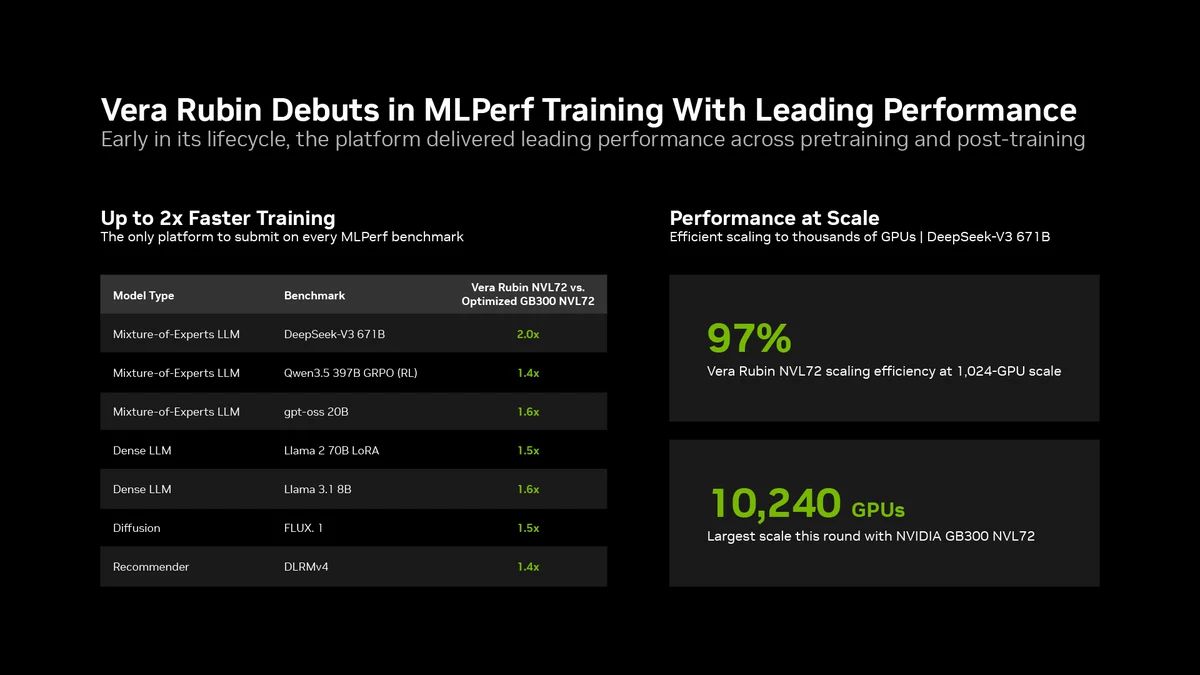
Vera Rubin NVL72 posted results on every MLPerf Training v6.1 benchmark, with per-GPU gains of 1.4x to 2.0x over GB300 NVL72. Image: NVIDIA.
Scaling to Thousands of GPUs
The headline numbers only matter if they hold at the scale where frontier models are actually trained. On the DeepSeek-V3 benchmark, Vera Rubin NVL72 scaled from 256 to 1,024 GPUs with about 97% efficiency: quadrupling the GPUs cut the time to train from 16 minutes to about four.
NVIDIA also ran the benchmark on 10,240 GPUs with GB300 systems, the largest scale in this round, and Microsoft Azure matched that scale with 10,240 GB200 GPUs. “Results at this scale matter because adding GPUs only speeds up training if they can work together efficiently,” NVIDIA wrote, framing the result as a proof point for its networking as much as for the Rubin chips themselves.
Twenty partner organizations submitted results on NVIDIA platforms in this round, including CoreWeave, Microsoft Azure, Google Cloud, Oracle, Dell Technologies, HPE, and Supermicro, a breadth NVIDIA presented as evidence that partners are standardizing on its software stack, not just its silicon.
Agentic Inference: A Provisional 10x
The most eye-catching number in the announcement is also the least certain. MLPerf Endpoints tests systems on real agentic coding and enterprise workflows, checking that agents still complete their tasks correctly while meeting latency and accuracy requirements. In a provisional result for Kimi K3, a large open model built for agentic workflows, Vera Rubin NVL72 delivered more than 10x the throughput per watt of GB300 NVL72 at the same response speed.
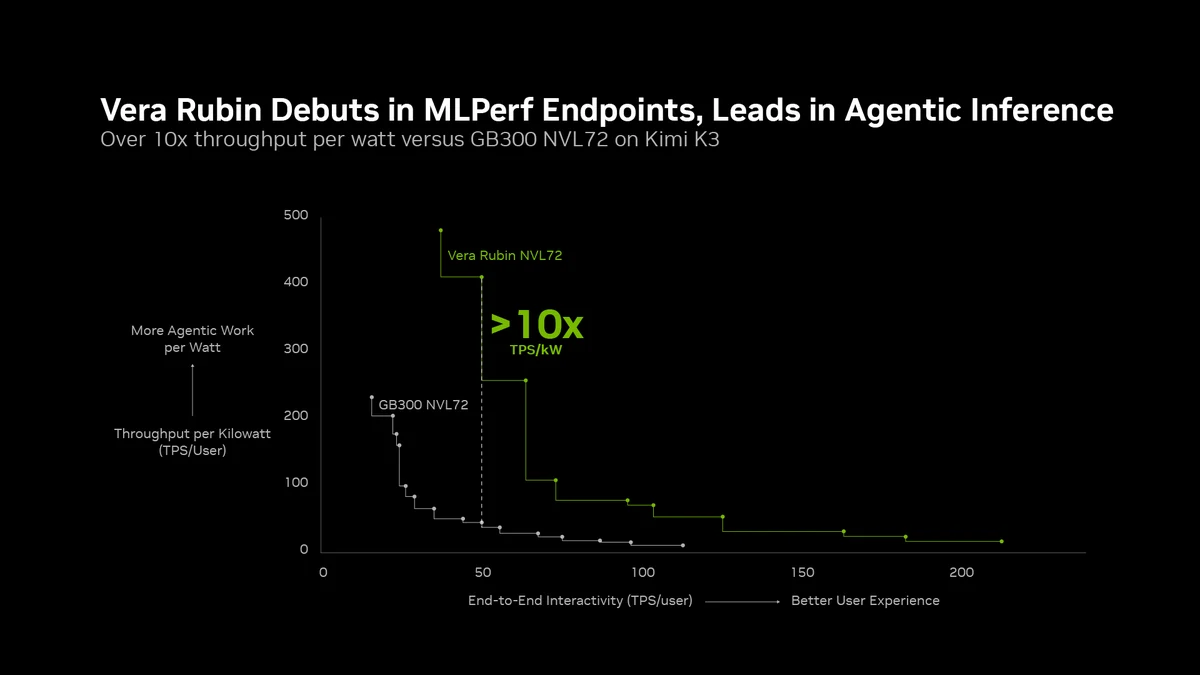
The provisional Kimi K3 result shows Vera Rubin NVL72 at more than 10x the throughput per watt of GB300 NVL72 for agentic inference. Image: NVIDIA.
Read the footnote before repeating the 10x figure. The Vera Rubin result used 32 accelerators handling 1,024 concurrent queries, producing 41,414.2 tokens per second at 100.89 kW, while the GB300 comparison used 48 accelerators at 48 queries, producing 2,210.4 tokens per second at 60 kW, with the comparison set at a shared minimum of 50 tokens per second per user. NVIDIA labels the Vera Rubin result provisional, pending MLCommons Association verification and subject to change after peer review, while the GB300 results are verified. The 10x is a ratio from one specific configuration pairing, not a general claim that Vera Rubin answers agents ten times better.
Why It Matters
For all the caveats on the agentic number, the Training v6.1 sweep is a clean result: full coverage across every benchmark, gains of 1.4x to 2.0x per GPU over NVIDIA’s own previous system, and near-linear scaling to 1,024 GPUs. The comparison is against NVIDIA’s own hardware rather than a rival chip, so the sweep shows generational progress, and Google’s TPUv7, also called Ironwood, debuted in the same round. NVIDIA also says Vera Rubin leads on independent benchmarks including SemiAnalysis AgentX and Artificial Analysis AgentPerf.
The results arrive in a week when NVIDIA is showing the same platform in a different light. At the SC26 supercomputing conference, the company introduced Nemotron for Science, a package of open models and post-training workflows for scientific research agents. Training speed, agentic inference, and scientific computing are three faces of the same pitch: one platform that can pretrain a model, run the agents built on it, and push the research those agents accelerate.
Whether the market buys that pitch will start to show on Tuesday evening, when NVIDIA reports quarterly results and issues guidance written entirely under its interim leadership. The benchmark numbers give Kress a strong opening line, and the provisional 10x is a reminder to read the footnotes: in AI hardware, the biggest number in the announcement is not always the most finished one.
Sources
- NVIDIA Sweeps MLPerf Training and Endpoints as Vera Rubin Debuts With Leading Performance (NVIDIA Blog, November 16, 2026)
- Nvidia (NVDA) Vera Rubin MLPerf debut: where 2x comes from (AIStockWire, November 17, 2026)
- Nvidia Reports Tuesday With 108 Billion Guide (TML News, November 17, 2026)
- MLCommons (MLPerf benchmark authority)




[…] NVIDIA Vera Rubin Sweeps MLPerf Training v6.1 in Benchmark Debut, GPTOnline, November 17, 2026 […]