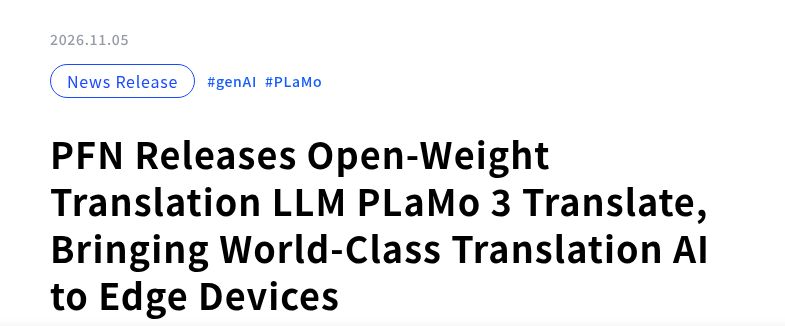
Featured image: headline from the official Preferred Networks announcement, captured November 17, 2026.
PLaMo 3 Translate is a family of open-weight text translation models from Preferred Networks (PFN). The company released the weights on November 5, 2026 in four sizes: 0.8B, 2B, 8B and 31B. The downloadable models are distinct from PFN’s hosted service. With compatible local software and the downloaded files, you can translate without sending each request to a cloud API.
Which size should you try?
Try 0.8B first if storage or memory is tight. Benchmark 2B on the same examples if you need better output. Evaluate 8B or 31B on better-equipped hardware only if the recurring errors justify the extra memory and processing time. Do not assume the largest model is best for every sentence.
The 0.8B model card lists GGUF for llama.cpp and 4-bit MLX for Apple silicon, alongside formats for compatible GPU runtimes. The listed 0.8B GGUF Q4_K_M file is 0.57 GB; the 2B equivalent is 1.81 GB. These are file sizes, not RAM requirements or speed estimates.
Glossary terms versus context
A glossary maps source terms to approved wording. Context explains the surrounding text. For a Japanese-to-English help center, you might map 管理画面 to “admin console” and specify in the context that the text describes account settings. This is a suggested input, not a tested output. Check that the result actually uses the approved term.
PFN reports 53 language entries, counting Simplified and Traditional Chinese separately. The plain/polite style switch is for Japanese output only. The 0.8B card describes a training limit of 32,768 tokens for input and output combined. Leave space for your glossary and the translated text, and split long documents at natural boundaries.
Commercial use is not unconditional
Under the PLaMo Community License, personal and non-commercial use does not require prior registration. Commercial use, including internal business use, requires prior registration for eligible users at or below the ¥1 billion annual revenue or sales threshold, taking affiliation into account. PFN requires a separate agreement above that threshold. The license also requires disclosure for certain publicly distributed long-form publications substantially composed of PLaMo conversion output. Read the license for the model files you intend to use.
Check a small sample before relying on it
Compare ambiguous sentences and repeated terms against the source. Check names, numbers, negations and omissions. Local inference does not tell you whether a separate interface stores or syncs your input; check the whole workflow before using confidential material, and have a qualified reviewer check important translations.