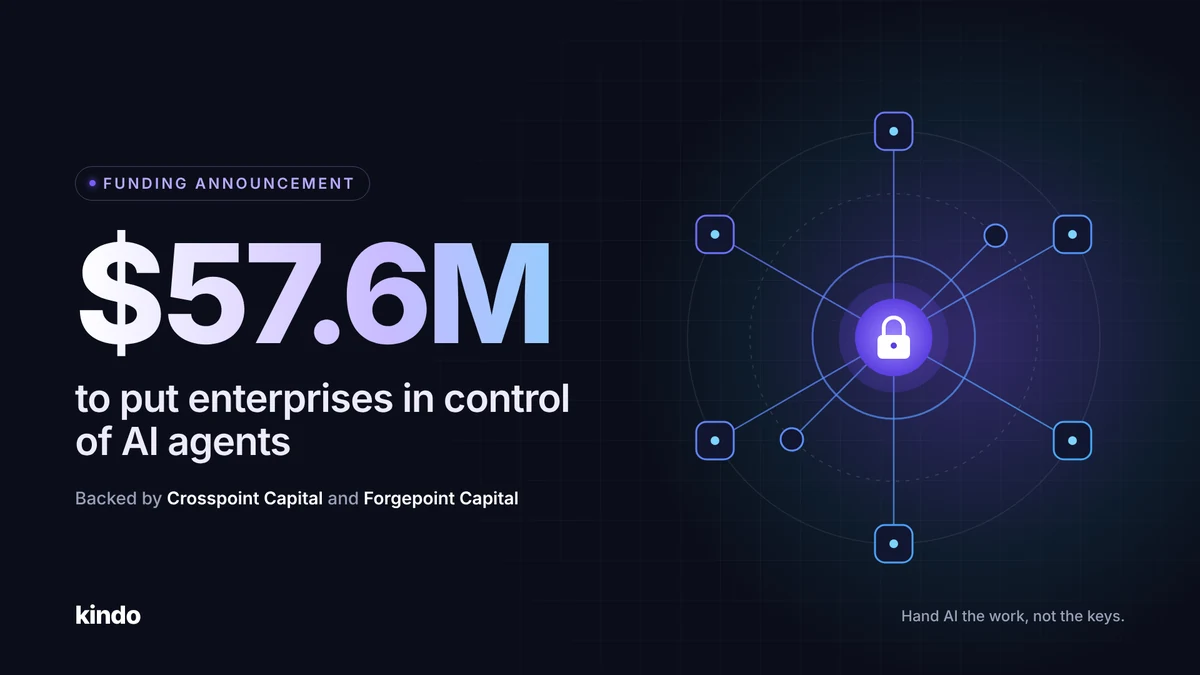
Kindo, a Los Angeles startup building an enterprise control center for AI agents, has raised $30 million in new financing, the company announced on November 12. The round was co-led by Crosspoint Capital and Forgepoint Capital and brings Kindo’s total funding to $57.6 million. The company says revenue grew roughly 800% year over year in 2026, a figure that points to how fast enterprises are moving from experimenting with agents to worrying about what those agents can actually do.
What Was Announced?
TFX Capital and CircleRock Capital joined the round, alongside existing backers including Drive Capital, Riot Ventures, RRE Ventures, Eniac Ventures, Marlinspike Partners, New Era Ventures and Sunset Venture. As part of the financing, Andre Fuetsch, a managing director at Crosspoint Capital, and Ernie Bio, a managing director at Forgepoint Capital, are joining Kindo’s board. The company plans to use the money to expand its go-to-market team and to accelerate development of its AI Control Center platform and its Deep Hat family of models and add-ons, according to the announcement.
Kindo was founded in the summer of 2022 by Ron Williams, a former CIO and CISO at Bird, Clover Health and Riot Games. Williams says he started the company after watching mobile, software as a service and cloud each reach the enterprise years before the tools to centrally control them, and he did not want security, IT, compliance and finance teams to wait again with AI agents. As Fuetsch put it, “2026 has been the year of the agent, and most companies still lack a reliable way to see what their agents are doing.”
What the Platform Does
Kindo describes its product as an enterprise AI Control Center, a single place where security, IT, compliance and finance teams can discover, observe and control every AI agent running across a business, whether it was built in Kindo or somewhere else. Discovery maps where agents are in use, including unapproved shadow AI. Observability puts each agent’s activity, access, cost and outcome in one view, with gateways that govern and audit every call an agent makes to data, tools and approved models. Controls apply existing permissions to people and agents alike, and let teams tighten them centrally. For mission critical agents, a monitoring harness adds round the clock support and direct intervention, including taking over an agent when something goes wrong.

Kindo brand visual. Image: Kindo
The platform is model agnostic and works with any model, agent builder or data source, and it runs on premises, in a customer’s cloud, in Kindo’s cloud, or air gapped. Cost control is a growing part of the pitch. Kindo records every token consumed and every agent run’s outcome, lets finance set budgets and hard spend caps, and flags agents that fail often or run on models that are overkill for the job. Its Deep Hat add-ons push costs down further: Deep Hat Sift skips agent runs a person would dismiss, Tune adapts smaller models to specific tasks, Shrink converts repeatable agent steps into code, and Attack runs low cost offensive security testing. Kindo says the add-ons can save as much as 95% of cost on some work, or remove the need to use AI for the task at all.

Kindo’s homepage visual shows its radar-style view of agents running across an enterprise. Image: Kindo
Why It Matters
The raise lands as agent governance becomes a distinct enterprise category. Companies spent 2025 and 2026 deploying agents that investigate alerts, update customer records, approve requests and change production systems around the clock, often built by people who never shipped enterprise software. The risk is concrete: the same permissions that let an agent finish a job let it expose sensitive data, act outside policy or run up a large inference bill. In Williams’s words, “Hand AI the work, not the keys.”
Kindo points to production use as evidence the category is real. In May 2026, the chief information security officer of Aireon, the global aviation in-flight data provider, reported that using Kindo for threat hunting and Tier 1 and Tier 2 security operations work helped the team move faster and save more than $2 million a year. The company says it now runs in production at large and mid-market enterprises in financial services, professional services, neoclouds, healthcare, defense and aviation.
The funding also fits a wider run of investment in agent infrastructure. LangChain, another agent infrastructure startup, raised a $300 million Series C at a $3 billion valuation earlier in November. Kindo is the smaller, more specialized bet in the same trend: not a bigger model or a new agent framework, but the control layer that lets a company say yes to agents without handing them the keys to everything.